Introduction
In an era where cyber threats have become increasingly stealthy, traditional perimeter defenses like firewalls are no longer enough. Network Detection and Response (NDR) is a specialized cybersecurity solution that continuously monitors an organization’s network traffic to detect, investigate, and respond to malicious activities. By analyzing “East-West” traffic (lateral movement within the network) and “North-South” traffic (data entering and exiting), NDR tools use non-signature-based techniques—primarily Machine Learning (ML) and Artificial Intelligence (AI)—to identify anomalies that indicate a breach, such as credential theft, data exfiltration, or insider threats.
The importance of NDR lies in its ability to provide visibility where other tools are blind. While Endpoint Detection and Response (EDR) monitors individual devices, NDR monitors the “connective tissue” between them, making it impossible for attackers to hide their communications. Key real-world use cases include detecting ransomware staging, identifying unauthorized encrypted tunnels, and monitoring IoT/OT devices that cannot host security agents. When choosing an NDR tool, organizations should evaluate decryption capabilities, automated response workflows, cloud-native integration, and the low rate of false positives.
Best for: Security Operations Center (SOC) teams, Network Architects, and CISOs in mid-to-large enterprises. It is an absolute necessity for industries with complex infrastructures, such as Finance, Healthcare, Government, and Manufacturing (ICS/SCADA), where a single unmanaged device can compromise the entire network.
Not ideal for: Very small businesses with a simple, flat network and few internal assets. For these users, a robust firewall and a high-quality EDR solution are usually sufficient and less resource-intensive than a full-scale NDR deployment.
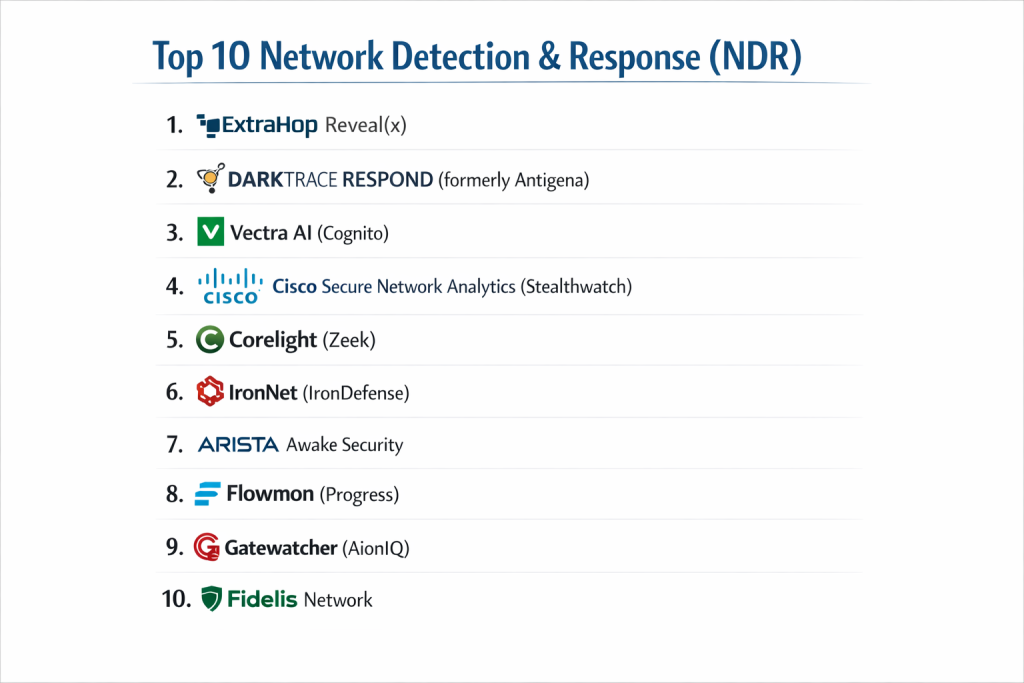
Top 10 Network Detection & Response (NDR) Tools
1 — ExtraHop Reveal(x)
ExtraHop Reveal(x) is a cloud-native NDR platform that provides real-time visibility and threat detection by analyzing every transaction across the network at wire speed.
- Key Features:
- Decryption at Scale: Decrypts SSL/TLS 1.3 traffic in real-time to inspect hidden threats.
- Cloud-Native Insight: Full visibility into AWS, Azure, and Google Cloud environments.
- Automated Investigation: Correlates detections into high-level “stories” to reduce alert fatigue.
- Asset Discovery: Automatically identifies and classifies every device on the network.
- Smart Response: Integrates with SOAR tools to isolate compromised hosts automatically.
- Forensic Search: Allows for rapid searching of historical network data for retroactive hunting.
- Pros:
- Exceptional user interface that visualizes complex network paths clearly.
- Industry-leading ability to decrypt traffic without sacrificing network performance.
- Cons:
- The cost can be high for organizations with massive throughput requirements.
- Requires a certain level of network expertise to fully leverage advanced forensics.
- Security & Compliance: SOC 2 Type II, HIPAA, GDPR, ISO 27001, and FIPS 140-2.
- Support & Community: Excellent enterprise support, comprehensive documentation, and an active “ExtraHop Community” for sharing custom triggers.
2 — Darktrace RESPOND (formerly Antigena)
Darktrace is famous for its “Enterprise Immune System,” which uses Self-Learning AI to understand the unique “pattern of life” for every user and device on a network.
- Key Features:
- Self-Learning AI: Does not rely on signatures or prior knowledge of threats.
- Autonomous Response: Can take targeted action to stop an attack in seconds (e.g., slowing down a connection).
- Cyber AI Analyst: Automatically produces a human-readable report for every incident.
- Email & Cloud Integration: Extends detection to SaaS apps like Salesforce and Microsoft 365.
- Darktrace HEAL: Helps organizations recover by restoring systems to their “last known good” state.
- Pros:
- Highly effective at catching “zero-day” threats that no other tool has seen before.
- Requires very little manual configuration; it learns by simply “listening” to the network.
- Cons:
- The autonomous response can occasionally be too aggressive if not tuned properly.
- Can be a “black box,” making it hard to see exactly why the AI made a certain decision.
- Security & Compliance: ISO 27001, GDPR, SOC 2, and HIPAA.
- Support & Community: 24/7 “Ask the Expert” service and a strong global presence with high-touch customer success.
3 — Vectra AI (Cognito)
Vectra AI focuses on “Attack Signal Intelligence,” aiming to cut through the noise by identifying the specific tactics and techniques attackers use during a breach.
- Key Features:
- Privileged Analytics: Focuses on how administrative credentials are used across the network.
- AI-Driven Prioritization: Automatically ranks threats by “Certainty” and “Threat” scores.
- Cloud & Identity Integration: Links network behavior to Microsoft Azure AD and AWS IAM.
- Metadata Extraction: Efficiently stores network metadata rather than full packets to save space.
- Targeted Hunting: Provides specific workflows for the MITRE ATT&CK framework.
- Pros:
- Very low false-positive rate compared to traditional anomaly detection tools.
- Excellent at identifying lateral movement and account hijacking.
- Cons:
- The platform is highly specialized; it may require other tools for full packet capture forensics.
- Some advanced features are modular and may increase the total cost of ownership.
- Security & Compliance: SOC 2 Type II, ISO 27001, GDPR, and HIPAA.
- Support & Community: Strong professional services team and deep integration partnerships with EDR vendors like CrowdStrike.
4 — Cisco Secure Network Analytics (Stealthwatch)
Formerly Stealthwatch, this tool is the standard for organizations heavily invested in the Cisco ecosystem, utilizing NetFlow data for massive scale.
- Key Features:
- Encrypted Traffic Analytics (ETA): Identifies malware in encrypted traffic without decryption.
- NetFlow Integration: Scales to the largest global networks by using existing switch/router data.
- Trustworthy Infrastructure: Built-in checks for Cisco hardware integrity.
- Policy Management: Helps enforce network segmentation and “Zero Trust” policies.
- Cloud Visibility: Extends monitoring into private, public, and hybrid clouds.
- Pros:
- Unrivaled scalability; can monitor massive networks without deploying sensors everywhere.
- Provides deep historical context for long-term forensic investigations.
- Cons:
- Full power is only realized when used with Cisco hardware (Catalyst, ISR, etc.).
- The user interface can feel dated and complex compared to newer cloud-native NDRs.
- Security & Compliance: FedRAMP, FIPS 140-2, SOC 2, and GDPR.
- Support & Community: Massive global support network and one of the largest user communities in the world.
5 — Corelight (Zeek)
Corelight is the commercial enterprise version of Zeek (formerly Bro), the open-source network monitoring tool used by thousands of security researchers.
- Key Features:
- Open Source Core: Built on Zeek, ensuring no vendor lock-in for your data format.
- Smart PCAP: Targeted packet capture that only saves what is necessary for an investigation.
- Extensive Logs: Generates highly structured, searchable logs for almost every protocol.
- Encrypted Insights: Uses behavioral patterns to identify SSH or RDP tunneling.
- Suricata Integration: Combines Zeek’s metadata with Suricata’s signature-based IDS.
- Pros:
- Produces the highest quality data for “Threat Hunting” teams and data scientists.
- Extremely stable and respected by the global cybersecurity research community.
- Cons:
- Requires a highly mature SOC to get the most value out of the raw data.
- Less “automated response” compared to tools like Darktrace or ExtraHop.
- Security & Compliance: Varies by deployment; supports SOC 2, GDPR, and HIPAA standards.
- Support & Community: Deeply rooted in the Zeek open-source community with professional enterprise support modules.
6 — IronNet (IronDefense)
Founded by former NSA officials, IronNet focuses on “Collective Defense,” allowing companies to share threat intelligence in real-time.
- Key Features:
- IronDome: An industry-first “Collective Defense” system that shares anonymized alerts between peers.
- Behavioral Analysis: Detects command-and-control (C2) and domain generation algorithms (DGA).
- Expert Backed: Analytics derived from nation-state level offensive and defensive experience.
- Integrated Hunt: A dedicated portal for analysts to dive into specific network anomalies.
- Cloud & On-Prem: Parity across physical data centers and cloud VPCs.
- Pros:
- The Collective Defense model provides early warning signs from other companies in your sector.
- Excellent for identifying nation-state level persistent threats (APTs).
- Cons:
- The platform has a high technical barrier and is best suited for high-tier SOCs.
- Smaller market presence compared to giants like Cisco or ExtraHop.
- Security & Compliance: SOC 2, ISO 27001, and HIPAA.
- Support & Community: High-touch support model with direct access to top-tier cyber researchers.
7 — Arista Awake Security
Awake Security (now part of Arista Networks) focuses on an “Entity-centric” approach, making it easier to track threats across different IPs and devices.
- Key Features:
- EntityIQ: Automatically tracks devices even as they change IP addresses or locations.
- Adversarial Modeling: Uses a specialized language to describe complex attacker behaviors.
- Autonomous Hunting: The system performs its own hunts and surfaces only high-fidelity results.
- Full PCAP: Provides the ability to drill down into the raw packets for any detection.
- Zero Trust Support: Identifies unmanaged devices that bypass standard authentication.
- Pros:
- One of the most accurate tools for tracking “shadow IT” and unmanaged IoT devices.
- Very low noise level; doesn’t overwhelm analysts with meaningless anomalies.
- Cons:
- Best suited for environments already considering Arista networking gear.
- The specialized query language has a learning curve for new analysts.
- Security & Compliance: SOC 2, GDPR, and HIPAA compliant.
- Support & Community: Strong enterprise support and a growing community of Arista network users.
8 — Flowmon (Progress)
Flowmon offers a high-performance NDR solution that doubles as a network performance monitoring and diagnostics (NPMD) tool.
- Key Features:
- Flow-based Analysis: Uses NetFlow/IPFIX to monitor high-speed networks with low overhead.
- NPMD + NDR: A single platform for both security and network performance troubleshooting.
- Anomalous Behavior Detection: Identifies port scanning, DDoS, and dictionary attacks.
- Encrypted Traffic Analysis: Provides visibility into encrypted traffic without full decryption.
- Adaptive Baselines: Automatically adjusts the “normal” baseline as the network grows.
- Pros:
- Excellent “bang for the buck” by providing both security and performance monitoring.
- Very easy to deploy in both virtual and physical environments.
- Cons:
- Lacks some of the deepest “AI Analyst” features found in Darktrace or ExtraHop.
- Forensics are based on flow data rather than full packet capture by default.
- Security & Compliance: ISO 27001, GDPR, and SOC 2.
- Support & Community: Reliable customer support and a strong presence in the European and Asian markets.
9 — Gatewatcher (AionIQ)
Gatewatcher is a leading European NDR provider, particularly strong in meeting the “sovereignty” requirements of government and critical infrastructure.
- Key Features:
- Dual Engine: Combines behavioral analysis with signature-based detection.
- Malcore: An integrated sandbox for analyzing files found moving across the network.
- Data Sovereignty: Designed specifically to keep data within certain jurisdictions (GDPR/EU focus).
- Mapping: Visualizes the entire attack surface in real-time.
- Cloud-Ready: Sensors available for AWS, Azure, and OpenStack.
- Pros:
- Highly respected by European regulatory bodies; ideal for compliance-heavy sectors.
- The integrated file analysis (Malcore) is a powerful differentiator.
- Cons:
- Less market recognition and a smaller support footprint in North America.
- UI is functional but less polished than competitors like ExtraHop.
- Security & Compliance: ANSSI (France) certified, GDPR, and ISO 27001.
- Support & Community: High-quality European support and a dedicated focus on critical infrastructure.
10 — Fidelis Network
Fidelis offers a holistic NDR that integrates with their EDR and data security products to provide an “XDR” experience.
- Key Features:
- Deep Session Inspection: Goes beyond headers to inspect the actual content of sessions.
- Internal Visibility: Specialized sensors for monitoring lateral movement between VLANs.
- DLP Integration: Can detect and block sensitive data leaving the network in real-time.
- Asset Risk Scoring: Assigns a risk level to every device based on its behavior and vulnerabilities.
- Decryption Support: Manages SSL/TLS inspection for inbound and outbound traffic.
- Pros:
- Strongest “Data Loss Prevention” (DLP) capabilities of any NDR on this list.
- Provides a unified view of the environment when used with Fidelis Endpoint.
- Cons:
- The platform can be resource-intensive to manage at full scale.
- User interface is very “technical” and can be intimidating for junior SOC analysts.
- Security & Compliance: SOC 2, HIPAA, GDPR, and ISO 27001.
- Support & Community: Professional enterprise support with a focus on large-scale government and retail sectors.
Comparison Table
| Tool Name | Best For | Platform(s) Supported | Standout Feature | Rating (Gartner) |
| ExtraHop Reveal(x) | Performance & Decryption | Cloud, Hybrid, On-Prem | Wire-speed Decryption | 4.8 / 5 |
| Darktrace | “Zero-Day” Detection | Cloud, SaaS, On-Prem | Self-Learning AI | 4.7 / 5 |
| Vectra AI | Attack Signal Quality | Cloud, Hybrid | Signal-to-Noise Ratio | 4.6 / 5 |
| Cisco Secure | Massive Scale | On-Prem, Hybrid | NetFlow Efficiency | 4.4 / 5 |
| Corelight | Threat Hunting Teams | Cloud, On-Prem | Zeek Metadata Quality | 4.5 / 5 |
| IronNet | Collective Defense | Cloud, Hybrid | Industry-wide Sharing | 4.3 / 5 |
| Arista Awake | Unmanaged/IoT Devices | Cloud, On-Prem | EntityIQ Tracking | 4.6 / 5 |
| Flowmon | NPMD + Security | Hybrid, On-Prem | Flow-based Efficiency | 4.4 / 5 |
| Gatewatcher | EU Compliance | Cloud, On-Prem | Integrated File Analysis | 4.5 / 5 |
| Fidelis | Data Loss Prevention | Cloud, Hybrid | Deep Session Inspection | 4.2 / 5 |
Evaluation & Scoring of [Network Detection & Response (NDR)]
We have evaluated these tools using a weighted scoring rubric that reflects the priorities of a modern Security Operations Center.
| Category | Weight | Evaluation Rationale |
| Core Features | 25% | Decryption, behavioral analysis, and automated response capabilities. |
| Ease of Use | 15% | Dashboard intuitiveness and how well the tool reduces “alert fatigue.” |
| Integrations | 15% | Native connections to SIEM, SOAR, EDR, and Cloud Service Providers. |
| Security & Compliance | 10% | Certifications (SOC 2, GDPR) and the tool’s own internal hardening. |
| Performance | 10% | Ability to handle high-bandwidth traffic (100G+) without packet loss. |
| Support & Community | 10% | Technical support quality and the availability of user communities. |
| Price / Value | 15% | ROI, licensing transparency, and modular vs. all-in-one pricing. |
Which [Network Detection & Response (NDR)] Tool Is Right for You?
Solo Users vs SMB vs Mid-Market vs Enterprise
- Small Business (SMB): You likely do not need a standalone NDR. Look at Sophos or Fortinet which offer basic NDR-like features within their firewalls.
- Mid-Market: Darktrace or Flowmon are ideal. They offer high levels of automation so you don’t need a massive team of network engineers to manage them.
- Enterprise: ExtraHop or Vectra AI provide the depth, decryption, and scale required for complex, global infrastructures.
Budget-Conscious vs Premium Solutions
- Budget: Flowmon provides excellent value by combining performance monitoring with security. Microsoft Defender for Office/Cloud also offers some NDR capabilities if you are already in the E5 ecosystem.
- Premium: ExtraHop and Darktrace are the premium leaders. You are paying for the advanced research and AI that significantly reduces the manual work of your analysts.
Feature Depth vs Ease of Use
- Depth: Corelight and Fidelis are for the “Pros.” If you want to dive into every raw packet and protocol, these provide the data you need.
- Ease of Use: Darktrace and Arista Awake are designed to be “hands-off.” They use AI to present you with finished conclusions rather than raw data.
Integration and Scalability Needs
If your environment is Cisco-heavy, the integration with Cisco Secure Network Analytics is unbeatable. If you are 100% Cloud, ExtraHop and Vectra have the most mature cloud-native sensors.
Frequently Asked Questions (FAQs)
Q1: How is NDR different from a Firewall?
Answer: A firewall is a “gate” that blocks known bad traffic. NDR is a “security camera” that watches everything happening inside the house, looking for suspicious behavior that shouldn’t be there.
Q2: Does NDR require decryption to be effective?
Answer: While some tools like Cisco use metadata analysis, most experts agree that real-time decryption (like in ExtraHop) is vital for stopping modern threats that hide in SSL/TLS.
Q3: Can NDR stop an attack automatically?
Answer: Yes. Many NDRs (like Darktrace) can send commands to your firewall or switches to block a specific IP or isolate a device as soon as an attack is detected.
Q4: Is NDR better than EDR?
Answer: They are complementary. EDR sees what happens on the device; NDR sees what happens between the devices. You need both for a “Zero Trust” architecture.
Q5: What is “East-West” traffic?
Answer: This refers to data moving laterally between servers or devices within your network. This is where most modern attackers hide after they have bypassed the perimeter.
Q6: Does NDR cause network latency?
Answer: Modern NDR tools use “out-of-band” monitoring (via SPAN ports or TAPs), meaning they “listen” to a copy of the traffic and do not slow down the actual production network.
Q7: Is NDR the same as IDS/IPS?
Answer: No. IDS/IPS uses signatures of known attacks. NDR uses AI to find unknown behaviors and anomalies. NDR is much better at catching new, “zero-day” threats.
Q8: Can NDR monitor my home office?
Answer: Most enterprise NDRs use cloud sensors to monitor VPN traffic or remote workers’ activity when they are connected to corporate resources.
Q9: How much data does NDR store?
Answer: It depends. Some store full packets (large storage), while others (like Vectra) store only metadata (much smaller storage), which still allows for deep analysis.
Q10: Is NDR expensive?
Answer: It is a high-end security tool. However, it often replaces several legacy tools and significantly reduces the cost of a breach, making the ROI very high for enterprises.
Conclusion
The “best” Network Detection and Response (NDR) tool is ultimately the one that fills the visibility gaps in your specific architecture. If you are struggling with encrypted threats, ExtraHop is the clear frontrunner. If you have a small team and need the AI to do the heavy lifting, Darktrace is an excellent choice.
Ultimately, NDR is about regaining the “home field advantage.” By monitoring your internal network traffic with AI-driven precision, you are ensuring that even the most stealthy attackers have nowhere to hide.

- Top 10 Email Deliverability Tools: Features, Pros, Cons & Comparison - September 6, 2026
- Top 10 Pharmacovigilance Software: Features, Pros, Cons & Comparison - September 6, 2026
- Top 10 Manufacturing Execution Systems (MES) - July 30, 2026