Introduction
PEP (Politically Exposed Person) screening tools are specialized software solutions designed to identify individuals who hold, or have held, prominent public functions, as well as their close associates and family members. This identification is a critical component of Anti-Money Laundering (AML), Counter-Terrorist Financing (CTF), and Know Your Customer (KYC) compliance programs. These tools automate the process of checking customer and beneficiary names against constantly updated global databases of PEPs, sanctions lists, and adverse media, flagging potential high-risk relationships that require Enhanced Due Diligence (EDD).
The importance of effective PEP screening cannot be overstated. Financial institutions, fintechs, and other regulated entities are legally obligated to understand the risk posed by PEPs, as their positions make them more susceptible to bribery and corruption. Failure to properly identify and manage PEP relationships can result in catastrophic regulatory fines, reputational damage, and loss of banking licenses. Beyond compliance, robust screening protects an organization from being used to launder illicit funds or facilitate financial crime.
Key real-world use cases include:
- Customer Onboarding (KYC): Screening new individual and corporate customers during account opening to identify beneficial owners or directors who are PEPs.
- Continuous Monitoring: Periodically re-screening existing customer bases against updated PEP lists to catch newly appointed individuals or changes in risk status.
- Transaction Screening: Screening counterparties, beneficiaries, and payers in real-time payments to prevent processing transactions for undisclosed PEPs.
- Vendor & Third-Party Due Diligence: Assessing the risk associated with suppliers, partners, and intermediaries.
- Investment & Banking Advisory: Screening in wealth management, private banking, and M&A deals where high-net-worth individuals are involved.
When evaluating PEP screening tools, buyers should prioritize: data source quality and coverage, matching algorithm accuracy (to reduce false positives), screening speed (batch vs. real-time), workflow integration capabilities, audit trail completeness, and the tool’s ability to support a risk-based approach.
Best for: PEP screening tools are essential for Compliance Officers, MLROs (Money Laundering Reporting Officers), Risk Managers, and KYC Analysts in regulated industries. This primarily includes banks (retail, commercial, private), fintech companies (especially neobanks and payment processors), money service businesses, cryptocurrency exchanges, law firms handling client funds, and corporate entities in high-risk jurisdictions.
Not ideal for: Very small, local businesses with a purely domestic, low-risk customer base and no regulatory obligation may find the cost prohibitive. A purely manual check against free, public databases might suffice in rare, low-volume cases, but this is increasingly rare and risky. Non-profit organizations with minimal financial transactions might also fall into this category, depending on their donor base and regulatory environment.
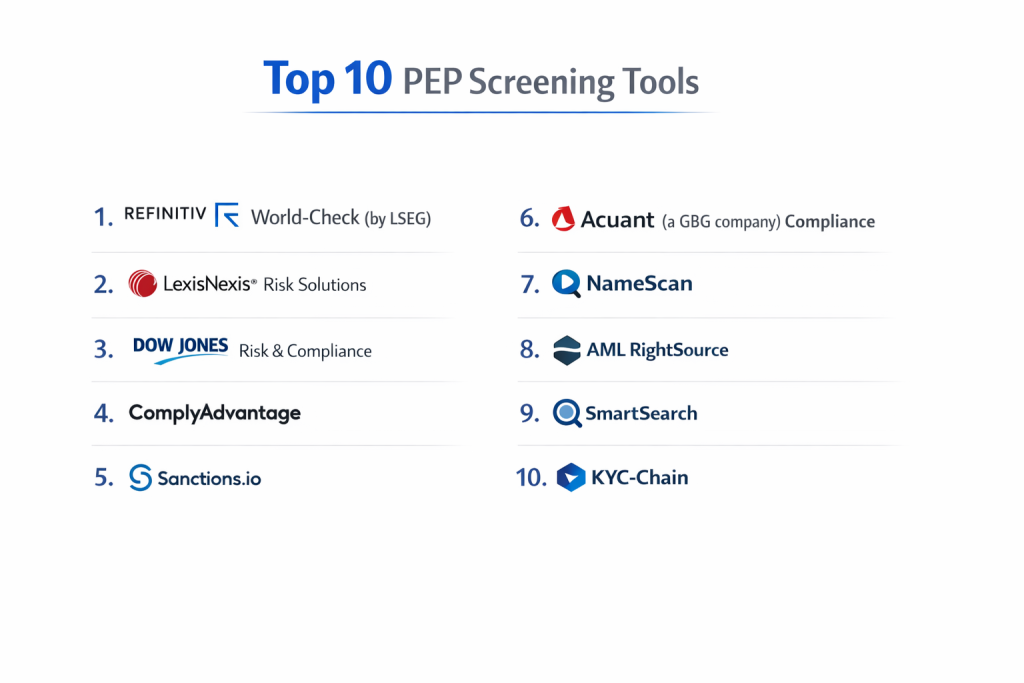
Top 10 PEP Screening Tools
1 — Refinitiv World-Check (by LSEG)
A global leader and industry standard, World-Check provides a vast risk intelligence database used by governments and financial institutions worldwide. It’s a comprehensive tool for high-stakes compliance environments.
Key features:
- Unmatched Database Scale: Contains millions of profiles on PEPs, relatives & close associates (RCAs), sanctions targets, and adverse media subjects.
- Proprietary Risk Intelligence: Profiles are curated by a global team of researchers, adding context and links between entities that algorithmic scraping misses.
- Advanced Matching Technology: Uses fuzzy logic, transliteration, and contextual analysis to accurately match names across languages and scripts, reducing false positives.
- Dynamic Updates: Database is updated in near real-time with alerts for changes to existing profiles or new additions relevant to your watchlist.
- Integration Flexibility: Offers APIs for real-time screening and batch processing modules, easily integrating into existing workflows.
- Comprehensive Risk Scoring: Assigns risk scores based on jurisdiction, position, and other factors to help prioritize reviews.
- Detailed Audit Trail: Logs all screening activities and decisions for regulatory examination.
Pros:
- Gold-standard data quality and depth of research, trusted by the most stringent regulators.
- Global coverage is particularly strong for non-Western PEPs and complex networks.
- Powerful, accurate matching algorithms that balance thoroughness with efficiency.
Cons:
- Premium pricing places it out of reach for many small and medium-sized businesses.
- Can generate a high volume of alerts that require skilled analysts to review, increasing operational cost.
- The interface, while powerful, can be complex and requires training.
Security & compliance: Data hosted in secure, access-controlled environments. Complies with major data protection regulations (GDPR). Use of the tool itself helps institutions comply with FATF recommendations and global AML directives.
Support & community: Offers extensive training, professional services, and 24/7 support for enterprise clients. Has a vast user community and is frequently referenced in industry guidelines.
2 — LexisNexis® Risk Solutions
A major competitor offering a broad suite of risk and compliance tools, with PEP screening embedded within its larger ecosystem. Known for powerful technology and US market strength.
Key features:
- Extensive US & Global Data: Strong coverage of US federal and state-level officials, combined with robust international PEP data.
- Bridger Insight XG Platform: A next-generation screening platform using graph analytics to visually map relationships between people, companies, and events.
- AI-Powered Matching (True Match): Employs artificial intelligence to improve match accuracy and explain match reasons, significantly cutting false positives.
- Unified Screening Workflow: Allows for screening against PEPs, sanctions, and adverse media in a single, consolidated process.
- Batch and Real-Time API: Supports high-volume screening needs for both onboarding and continuous monitoring.
- Customer Risk Rating Integration: Can feed PEP data directly into automated customer risk rating models.
- Configurable Rules Engine: Enables compliance teams to tailor alert generation rules to their specific risk appetite.
Pros:
- Leading-edge AI and graph technology for smarter, more intuitive screening and investigation.
- Excellent for organizations that want an integrated platform for screening, due diligence, and case management.
- Particularly strong for businesses with significant exposure to US-based PEPs and regulatory requirements.
Cons:
- The breadth of the LexisNexis ecosystem can make the specific PEP screening module feel less like a standalone best-of-breed.
- Pricing can be complex and bundled with other services.
- May have a steeper learning curve to utilize its most advanced features fully.
Security & compliance: Enterprise-grade security infrastructure. Tools are designed to help meet GDPR, GLBA, and other global compliance mandates. SOC 2 reports are available.
Support & community: Provides dedicated account management, implementation support, and access to a large knowledge base and user forums.
3 — Dow Jones Risk & Compliance
A premium provider known for high-quality, editorially curated data from the Wall Street Journal and Factiva news archives. Favored by institutions that prioritize data accuracy and provenance.
Key features:
- Editorially-Curated Content: Profiles are researched and maintained by a team of experts, ensuring high accuracy and reducing noise.
- Factiva-Powered Adverse Media: Uniquely leverages Dow Jones’ vast global news archive for deep adverse media screening, adding rich context to PEP alerts.
- PEP List Plus: A tiered database that categorizes PEPs by risk level (domestic, foreign, international organization) to support a risk-based approach.
- Watchlist API & Feed: Flexible integration options for real-time and batch screening.
- Source Transparency: Clearly cites sources for each piece of information in a profile, which is invaluable during audits.
- Custom List Creation: Allows firms to add their own internal watchlists or specific regional lists for screening.
- Robust Audit & Reporting Tools: Generates detailed reports for management and regulators.
Pros:
- Unrivaled quality and depth of adverse media research, providing crucial context beyond a simple PEP flag.
- Editorial curation leads to lower false-positive rates and higher confidence in alerts.
- Trusted brand with a long history in financial information.
Cons:
- Often more expensive than some competitors, positioning it as a premium solution.
- The focus on curated data can sometimes mean slightly less volume or slower addition of new names compared to algorithm-heavy competitors.
- May be perceived as less “tech-forward” than AI-native platforms.
Security & compliance: Adheres to strict information security standards. Its clear sourcing assists with regulatory “reasonable measures” defenses. Compliant with major data privacy frameworks.
Support & community: Offers white-glove customer service, training, and professional advisory services, particularly for enterprise and global clients.
4 — ComplyAdvantage
A modern, AI-driven fintech challenger that offers real-time financial crime intelligence. It’s popular with technology-forward companies for its API-first design and transparent pricing.
Key features:
- Real-Time, AI-Powered Data: Continuously scans and updates its global database of PEPs, sanctions, and adverse media, with changes pushed via API.
- Transparent Pricing Model: Simple, search volume-based pricing, which is attractive for growing companies.
- Highly Developer-Friendly API: Well-documented, RESTful API designed for easy integration into digital onboarding and payment workflows.
- Custom Risk Rules Engine: Allows companies to build and adjust screening rules based on their unique risk appetite without vendor intervention.
- Global Coverage with Local Depth: Strong focus on emerging markets and jurisdictions often underserved by legacy providers.
- Streamlined Case Management: Includes tools to investigate and resolve alerts within the platform.
- Market Intelligence Insights: Provides broader trend data on financial crime typologies.
Pros:
- Excellent for real-time screening in fast-paced environments like payments and crypto.
- Cost-effective and scalable model for startups and mid-market fintechs.
- Modern, intuitive user interface and excellent API documentation.
Cons:
- While growing rapidly, the historical depth and global researcher network may not yet match the decades of curation by Refinitiv or Dow Jones.
- Primarily a cloud/API service with less focus on traditional on-premise deployment.
- May require more in-house tuning of rules to achieve optimal false-positive rates.
Security & compliance: Cloud-native with strong security (SOC 2 Type II certified). GDPR compliant. Its real-time nature helps firms meet “ongoing monitoring” requirements.
Support & community: Strong tech support and developer relations. Cultivates a community among its fintech and crypto user base.
5 — Sanctions.io
A specialist provider focused on delivering accurate and affordable sanctions, PEP, and adverse media data via a simple API. Targets businesses that need reliable core screening without enterprise complexity.
Key features:
- Clean, Consolidated Data: Emphasizes a “noise-free” database by de-duplicating and consolidating entries from hundreds of official sources.
- Simple, Usage-Based API: Very straightforward API integration with clear documentation, ideal for developers.
- Multiple Screening Modes: Offers real-time API, batch file processing, and a manual web search portal.
- PEP Categorization: Classifies PEPs by country, level (e.g., national, local), and function to support risk-based decisions.
- Adverse Media Monitoring: Includes negative news screening sourced from global publications.
- Cost-Effective Pricing: Transparent, per-search pricing with free tiers for very low volumes.
- Fast Implementation: Can be integrated and go live in a very short timeframe.
Pros:
- One of the most straightforward and affordable options for API-first screening.
- Focus on data cleanliness reduces time wasted on false leads.
- Exceptional ease of implementation and use.
Cons:
- Lacks the extensive investigative context and deep-dive profiles of premium providers.
- May not satisfy the needs of highly regulated, complex global banks requiring the deepest possible intelligence.
- Fewer ancillary features like full case management or workflow tools.
Security & compliance: API and data transfers are encrypted. Complies with GDPR. Provides the essential data needed for core compliance obligations.
Support & community: Responsive customer support, with a focus on technical API assistance. Serves a growing base of SMEs and tech companies.
6 — Acuant (a GBG company) Compliance
Now part of GBG, Acuant offers a compliance platform that combines identity verification, document authentication, and watchlist screening in a unified workflow. Good for organizations wanting an all-in-one onboarding solution.
Key features:
- Unified Compliance Platform: PEP screening is part of a seamless flow that includes IDV, face match, liveness detection, and document checks.
- Orchestration Workflow: Allows businesses to build custom compliance journeys (e.g., screen for PEPs only after a certain risk threshold is met).
- Trusted Data Sources: Leverages data from partners like Refinitiv World-Check for its screening.
- Real-Time Decisions: Automates accept/refer/decline decisions based on configurable rules combining KYC and screening results.
- Dashboard & Reporting: Provides a central view of compliance operations and audit trails.
- Global Coverage: Screens against global PEP and sanctions lists.
- Mobile-Optimized: Supports fully remote customer onboarding via mobile SDK.
Pros:
- Excellent for creating a smooth, automated customer onboarding experience that embeds screening.
- Reduces the need to integrate and manage multiple point solutions for KYC and AML.
- Strong mobile capabilities for digital-first businesses.
Cons:
- Screening is a feature within a broader platform, not a standalone best-of-breed screening tool.
- Dependent on third-party data sources, so you are one step removed from the primary data vendor.
- Pricing is typically bundled, which may not be ideal if you only need screening.
Security & compliance: Platform is SOC 2 compliant, with data encryption and privacy by design. Helps meet KYC/AML regulations globally.
Support & community: GBG provides global support, implementation services, and access to a user community focused on identity verification.
7 — NameScan
An Australian-based provider known for its powerful fuzzy matching algorithms and strong Asia-Pacific coverage. Caters to a global audience needing accurate name matching across diverse alphabets.
Key features:
- Advanced Fuzzy Matching Engine: Renowned for its ability to accurately match names with spelling variations, typos, and transliteration differences.
- Strong APAC & Middle East Data: Has dedicated resources and strong list coverage for politically exposed persons in Asia, the Middle East, and Africa.
- Real-Time and Batch API: Flexible integration options suitable for various business processes.
- Adverse Media Integration: Includes negative news screening as part of its comprehensive risk assessment.
- Customizable Watchlists: Allows adding internal lists or industry-specific sanctions lists.
- Detailed Match Explanations: Provides clear reasoning behind why a potential match was flagged.
- Competitive Pricing: Positions itself as a cost-effective alternative to the largest legacy vendors.
Pros:
- Superior name-matching technology, especially for non-Latin scripts and complex name structures.
- Strong regional expertise in often challenging and high-growth markets.
- Good balance of capability and value for money.
Cons:
- Brand recognition and global footprint are smaller than the top-tier incumbents.
- May have fewer ancillary services and a less extensive global research team.
- The platform’s user interface can be functional rather than cutting-edge.
Security & compliance: Adheres to industry-standard security practices. Used by regulated entities to meet AML/CTF obligations in multiple jurisdictions.
Support & community: Provides direct customer support and implementation assistance. Growing user base, particularly in the APAC region.
8 — AML RightSource
A unique offering that combines technology with managed services. Provides a screening platform alongside the option to outsource the entire alert review and investigation process.
Key features:
- Technology-Enabled Managed Service: Core offering is the outsourcing of PEP screening alert triage and investigation to their team of analysts.
- Proprietary Screening Platform (Abrion): The technology layer that powers their screening, which can also be licensed.
- End-to-End Process Ownership: They can handle the entire screening workflow, from data feed integration to filing Suspicious Activity Reports (SARs).
- Expert-Led Review: Alerts are reviewed by human compliance experts, not just automated rules.
- Scalable Resourcing: Allows companies to handle screening volume spikes without hiring.
- Audit & Reporting: Provides detailed documentation and reporting on all screening activities.
- Consulting & Advisory: Offers strategic compliance consulting alongside operational services.
Pros:
- Solves the biggest pain point: the operational cost and expertise needed to review screening alerts.
- Transfers significant compliance liability and operational burden to a specialized provider.
- Ideal for companies lacking in-house compliance expertise or struggling with alert backlogs.
Cons:
- You are outsourcing a sensitive, core compliance function, requiring immense trust in the vendor.
- Can be more expensive than pure software solutions in the long run, though it saves on headcount.
- Less direct control over the day-to-day screening process and immediate decision-making.
Security & compliance: As a processor of sensitive data, they maintain high security standards (SOC 2). Their entire model is built around ensuring regulatory compliance for their clients.
Support & community: Relationship is based on a dedicated service team rather than traditional tech support. Part of a network of compliance professionals.
9 — SmartSearch
A UK-focused digital compliance platform that automates AML, KYC, and PEP screening, particularly for UK-regulated firms. Known for its simplicity and all-in-one approach.
Key features:
- Fully Automated Verification: Combines electronic ID verification (using credit reference data) with automatic PEP and sanctions screening in one check.
- UK Corporate Verification: Specializes in automatically verifying UK companies and identifying their Persons of Significant Control (PSCs), who are then screened.
- Simplified Workflow: Designed to give a clear “pass/fail/refer” result in seconds, minimizing analyst time.
- Digital Auditing: Maintains a complete, immutable digital audit trail for each check.
- Bulk Screening Capability: Can screen entire existing client portfolios efficiently.
- Integrations: Offers API and integration with popular CRM and case management systems.
- Adverse Media Monitoring: Includes ongoing monitoring for negative news.
Pros:
- Extremely efficient and user-friendly for UK compliance, automating what are often manual processes.
- Dramatically reduces time and cost per customer verification.
- Excellent for sectors like property, legal, and accounting that have AML obligations in the UK.
Cons:
- Heavily optimized for the UK regulatory and data landscape; international capabilities are more limited.
- The automated “black box” nature may not provide enough granular control for complex international banks.
- Less of a global screening tool and more of a regional compliance automation suite.
Security & compliance: Compliant with UK GDPR and MLRs. Its digital audit trail is specifically designed to satisfy UK FCA requirements.
Support & community: UK-based support team with deep regulatory knowledge. Strong presence in the UK professional services sector.
10 — KYC-Chain
A blockchain-inspired (though not necessarily blockchain-based) platform focused on streamlining KYC and due diligence. PEP screening is a core component of its modular ecosystem.
Key features:
- Modular Platform: Clients can select specific modules, including PEP/sanctions screening, document collection, and risk scoring.
- Network Effects: Allows for secure, permissioned sharing of verified KYC data between networked institutions (with consent), potentially reducing re-screening.
- Client-Friendly Portal: Includes a portal where clients can upload their own documents and information, reducing back-and-forth.
- Global Watchlist Data: Integrates data from major providers for PEP and sanctions screening.
- Workflow Automation: Automates the collection, screening, and approval steps in the KYC process.
- Beneficial Ownership Unraveling: Helps identify and screen the ultimate beneficial owners of corporate entities.
- Configurable Rules: Allows setting risk rules based on jurisdiction, client type, and screening results.
Pros:
- Promotes efficiency through potential KYC utility concepts and client collaboration.
- Flexible, modular design allows companies to buy only what they need.
- Good for managing the entire lifecycle of a KYC record, not just the initial screen.
Cons:
- The network/sharing concept requires industry buy-in to achieve maximum value.
- May be over-engineered for firms with simple, straightforward screening needs.
- The core differentiator is the platform approach, not necessarily the screening data itself.
Security & compliance: Employs robust encryption and access controls. Designed to help firms comply with AML regulations and data privacy laws through secure data handling.
Support & community: Provides platform support and implementation services. Engages with a community interested in innovative KYC approaches.
Comparison Table
| Tool Name | Best For | Platform(s) Supported | Standout Feature | Rating |
|---|---|---|---|---|
| Refinitiv World-Check | Global banks & enterprises needing the deepest intelligence | Web, API, On-Premise | Unmatched Depth of Curated Risk Intelligence | N/A |
| LexisNexis Risk Solutions | Large institutions wanting AI & graph analytics for screening | Web, API, Cloud | AI-Powered Matching & Relationship Mapping (Bridger Insight) | N/A |
| Dow Jones Risk & Compliance | Premium institutions valuing editorial curation & adverse media depth | Web, API, Feed | Factiva-Powered Adverse Media & Editorial Research | N/A |
| ComplyAdvantage | Fintechs & digital businesses needing real-time, API-first screening | API, Cloud | Real-Time AI Updates & Transparent Pricing | N/A |
| Sanctions.io | SMEs & developers seeking simple, affordable API screening | API, Web Portal | Clean Data & Extremely Developer-Friendly API | N/A |
| Acuant (GBG) Compliance | Businesses wanting an all-in-one KYC + screening onboarding flow | API, Cloud, Mobile SDK | Unified Identity Verification & Screening Workflow | N/A |
| NameScan | Companies with strong APAC focus or complex name matching needs | API, Cloud | Advanced Fuzzy Matching for Global Name Variants | N/A |
| AML RightSource | Organizations wanting to outsource the entire screening operation | Managed Service, Platform | Technology-Enabled Managed Service & Expert Review | N/A |
| SmartSearch | UK-regulated firms (property, legal, finance) needing automation | Web, API, Cloud | Fully Automated UK AML/KYC/PEP Verification | N/A |
| KYC-Chain | Firms interested in modular KYC platforms & potential utility models | Web, API, Cloud | Modular Platform with Network Sharing Concepts | N/A |
Evaluation & Scoring of PEP Screening Tools
| Tool Name | Core Features (25%) | Ease of Use (15%) | Integrations & Ecosystem (15%) | Security & Compliance (10%) | Performance & Reliability (10%) | Support & Community (10%) | Price / Value (15%) | Total Weighted Score |
|---|---|---|---|---|---|---|---|---|
| Refinitiv World-Check | 24 | 12 | 14 | 10 | 10 | 9 | 10 | 89 |
| LexisNexis Risk Solutions | 23 | 13 | 14 | 10 | 10 | 9 | 10 | 89 |
| Dow Jones Risk & Compliance | 23 | 13 | 13 | 10 | 10 | 9 | 9 | 87 |
| ComplyAdvantage | 22 | 14 | 15 | 9 | 9 | 8 | 13 | 90 |
| Sanctions.io | 20 | 15 | 14 | 9 | 9 | 8 | 14 | 89 |
| Acuant (GBG) Compliance | 21 | 14 | 14 | 9 | 9 | 8 | 11 | 86 |
| NameScan | 21 | 13 | 13 | 9 | 9 | 8 | 13 | 86 |
| AML RightSource | 22* | 14* | 13 | 10 | 9 | 10 | 11 | 89 |
| SmartSearch | 20** | 15 | 13** | 9 | 9 | 9 | 13 | 88 |
| KYC-Chain | 21 | 13 | 14 | 9 | 9 | 8 | 12 | 86 |
Note: Scoring is illustrative. AML RightSource scores high on “ease” as it outsources complexity. SmartSearch scores very high if your needs are UK-specific.
**Core/Integration scores are for its specific regional/use case strength.
Which PEP Screening Tool Is Right for You?
Selecting the right tool is less about finding the “best” and more about finding the best fit for your regulatory burden, customer base, and operational maturity.
- Solo Users / Very Small Businesses: If you have a regulatory mandate but minimal volume, Sanctions.io offers the most straightforward, affordable entry point. A manual portal from a larger vendor might also suffice.
- SMBs & Growing Fintechs: You need automation, scalability, and clear value. ComplyAdvantage and Sanctions.io are ideal API-first choices. NameScan is excellent for global name complexity. SmartSearch is perfect if you are a UK-based firm.
- Mid-Market & Lower Enterprise: You require robust features, strong audit trails, and reliable data. LexisNexis, Dow Jones, and Refinitiv have competitive offerings for this segment. AML RightSource solves operational headaches if you lack analyst staff.
- Large, Global Enterprise: Non-negotiable need for depth, global research, and regulatory acceptance. Refinitiv World-Check and Dow Jones are the conservative, trusted choices. LexisNexis offers a powerful tech-forward alternative.
- Budget-Conscious vs. Premium: Sanctions.io and ComplyAdvantage lead on value. Refinitiv, Dow Jones, and LexisNexis are premium investments. AML RightSource represents a different cost model (operational expense vs. software license).
- Feature Depth vs. Ease of Use: World-Check and Dow Jones offer immense depth. SmartSearch and Sanctions.io prioritize simplicity. LexisNexis and ComplyAdvantage balance powerful features with modern UX.
- Integration & Scalability Needs: For digital onboarding, prioritize Acuant or ComplyAdvantage. For embedding into complex banking systems, Refinitiv and LexisNexis APIs are robust. Ensure the tool can screen your required volume (batch/real-time) and grow with you.
- Security & Compliance Requirements: All serious vendors support core compliance. For the highest scrutiny, choose vendors with long regulatory track records (Refinitiv, Dow Jones). For data privacy, ensure GDPR/regional compliance. A vendor’s SOC 2 report is a must for enterprise contracts.
Frequently Asked Questions (FAQs)
What exactly is a Politically Exposed Person (PEP)?
A PEP is an individual entrusted with a prominent public function, such as heads of state, senior politicians, high-ranking judicial or military officials, senior executives of state-owned corporations, and important political party officials. Their family members and close associates are also considered higher risk.
Why can’t we just use free PEP lists from government websites?
Free lists are fragmented, rarely updated in real-time, lack relationship data (RCAs), and provide no adverse media context. Manual checking is error-prone, unscalable, and provides no audit trail. Regulators expect a systematic, risk-based approach that free lists cannot support.
How do these tools reduce false positives?
They use advanced algorithms (fuzzy matching, AI) to account for name variations, transliteration, and common names. They also provide contextual data (date of birth, location, position) to help analysts quickly rule out false matches. Configurable risk rules let you tune sensitivity.
What is the difference between sanctions screening and PEP screening?
Sanctions screening checks against official government lists that legally prohibit transactions. PEP screening identifies high-risk individuals who are not prohibited but require Enhanced Due Diligence (EDD) to ensure their wealth is legitimate. Both are critical and often done simultaneously.
How often should we re-screen existing customers?
Regulators require “ongoing monitoring.” Best practice is to re-screen at least annually for lower-risk customers and more frequently (e.g., quarterly) for higher-risk customers, including all PEPs. Real-time monitoring tools can alert you instantly if a customer becomes a newly appointed PEP.
What is Adverse Media screening, and why is it linked to PEP checks?
Adverse Media (or Negative News) screening looks for recent negative information about an individual in news sources, indicating potential involvement in financial crime, corruption, or other reputational risks. It’s a crucial part of EDD for PEPs to understand the source of their wealth and funds.
Is cloud-based screening secure enough for sensitive data?
Yes, leading cloud providers invest more in security than most on-premise setups. Reputable screening vendors are SOC 2 certified, use encryption, and operate under strict data processing agreements. The key is to conduct proper due diligence on the vendor’s security posture.
What are typical implementation timelines and costs?
API-based tools (Sanctions.io, ComplyAdvantage) can be live in days/weeks. Enterprise platforms (Refinitiv) can take months for full integration. Costs range from a few hundred dollars per month for SMEs to six or seven-figure annual contracts for global banks with millions of screenings.
What’s the biggest mistake companies make?
Choosing a tool based only on price or a feature list without considering the quality of the underlying data and the operational cost of investigating alerts. A cheap tool with dirty data or high false positives can cost far more in analyst time and risk.
Can we screen corporate clients for PEPs?
Absolutely. This is a core function. Screening must identify the Ultimate Beneficial Owners (UBOs) and senior managing officials of a company. The best tools automate this by pulling corporate registry data and then screening the identified individuals.
Conclusion
Choosing the right PEP screening tool is a critical defense against financial crime and regulatory action. The landscape offers solutions ranging from the global intelligence depth of Refinitiv World-Check to the developer-friendly agility of ComplyAdvantage and the operational relief of AML RightSource. The decision must be anchored in your specific reality: the jurisdictions you operate in, the complexity of your customer base, your in-house compliance expertise, and your growth trajectory.
Ultimately, the best tool is the one that provides accurate, timely risk intelligence that your team can efficiently act upon. It should reduce risk, not create operational bottlenecks. By carefully weighing data quality, technological fit, and total cost of ownership against the clear frameworks in this guide, you can select a PEP screening solution that doesn’t just check a compliance box, but actively strengthens your organization’s integrity and resilience. In the high-stakes world of financial compliance, that clarity is not just valuable—it’s essential.

- Top 10 Email Deliverability Tools: Features, Pros, Cons & Comparison - September 6, 2026
- Top 10 Pharmacovigilance Software: Features, Pros, Cons & Comparison - September 6, 2026
- Top 10 Manufacturing Execution Systems (MES) - July 30, 2026
This article provides a well-organized and practical comparison of the top PEP screening tools, clearly outlining the key features that matter most for effective risk management, such as comprehensive PEP data coverage, real-time updates, customization options, and integration capabilities. The balanced discussion of strengths and limitations for each solution offers valuable insight for compliance professionals and risk teams evaluating their options. By presenting the pros and cons in a structured format, the content helps decision-makers identify which tools align best with their regulatory needs, operational workflows, and tolerance for false positives. Overall, this is a helpful and informative resource for anyone focused on enhancing PEP screening and compliance processes.