Introduction
Predictive maintenance platforms are advanced digital ecosystems designed to help industrial organizations fix equipment before it actually fails. Unlike traditional maintenance, which happens on a set schedule or only after a breakdown, these platforms use a combination of Internet of Things (IoT) sensors, artificial intelligence (AI), and machine learning to “listen” to the health of a machine. By analyzing variables like vibration, temperature, sound, and pressure in real-time, the software can spot tiny anomalies that suggest a part is wearing out. This allows maintenance teams to intervene at the exact moment it is necessary, preventing catastrophic failures and expensive unscheduled downtime.
The importance of these platforms lies in their ability to transform a business from a reactive state to a proactive one. In high-stakes industries like manufacturing, energy, and aviation, a single hour of downtime can cost hundreds of thousands of dollars. Key real-world use cases include monitoring the bearings on wind turbines, tracking the thermal health of power grid transformers, and predicting engine wear in commercial aircraft fleets. When choosing a tool in this category, users should evaluate criteria such as sensor interoperability, the accuracy of the AI models, ease of integration with existing management systems, and the scalability of the platform across multiple global sites.
Best for: Large-scale manufacturing plants, utility providers, oil and gas companies, and heavy transport fleets. It is particularly beneficial for reliability engineers, maintenance managers, and operations directors who oversee high-value assets where failure results in significant safety risks or financial loss.
Not ideal for: Small businesses with simple equipment that is inexpensive to replace or easy to fix. If your equipment does not support digital sensors or if the cost of the platform exceeds the cost of a potential breakdown, a traditional preventative maintenance schedule is likely a better and more cost-effective alternative.
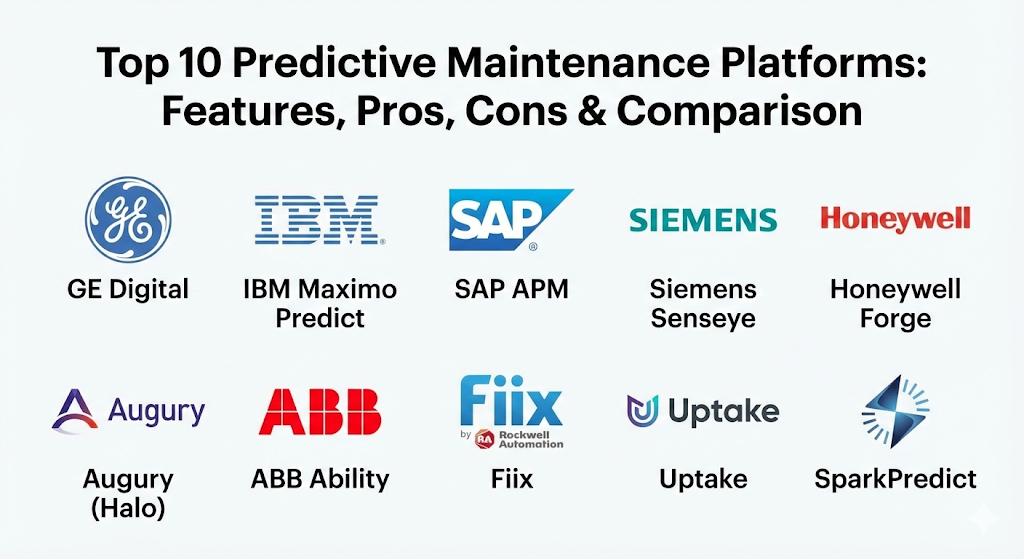
Top 10 Predictive Maintenance Platforms Tools
1 — GE Digital (APM Reliability Management)
GE Digital is a pioneer in the industrial internet. Their Asset Performance Management (APM) suite is a heavy-duty platform designed to manage the reliability of massive industrial assets. It is built for companies that operate in the most demanding environments on earth, such as power plants and refineries.
- Key features:
- SmartSignal technology for early detection of equipment anomalies.
- Digital Twin blueprints for a wide variety of industrial assets.
- Root Cause Analysis (RCA) tools to prevent recurring failures.
- Integrated strategy management to balance risk and cost.
- Advanced thermal and vibration analysis modules.
- Seamless data flow from edge devices to the cloud.
- Automated workflow triggers for maintenance work orders.
- Pros:
- Unrivaled depth in “heavy” industrial sectors like energy and oil.
- The Digital Twin capabilities are among the most advanced in the industry.
- Cons:
- The platform is highly complex and requires specialized training.
- Implementation can be a long-term project involving significant consulting.
- Security & compliance: ISO 27001, SOC 2 Type II, GDPR compliant, and features robust SSO and encryption protocols.
- Support & community: Enterprise-grade 24/7 support, dedicated customer success managers, and a massive global user network.
2 — IBM Maximo Predict
IBM Maximo has been the gold standard for enterprise asset management (EAM) for decades. Maximo Predict is the AI-driven layer that sits on top of this ecosystem, using Watson AI to provide deep insights into when and why a machine might fail.
- Key features:
- Integration with Watson IoT for real-time sensor data ingestion.
- Automated machine learning model building for non-data scientists.
- Scoring of asset health based on historical and real-time data.
- “Remaining Useful Life” (RUL) estimations for critical parts.
- Visual dashboards that aggregate health scores across a global fleet.
- Direct integration with Maximo’s world-class work order system.
- Mobile access for technicians to receive alerts in the field.
- Pros:
- Best-in-class integration for companies already using the IBM Maximo EAM.
- Extremely scalable for large enterprises with hundreds of thousands of assets.
- Cons:
- Can be very expensive for mid-market companies.
- Some users find the interface to be data-heavy and slightly dated.
- Security & compliance: FedRAMP, HIPAA (in specific clouds), SOC 2, GDPR, and ISO 27001 compliant.
- Support & community: Massive global community, extensive “IBM Academy” training, and worldwide enterprise support.
3 — SAP Asset Performance Management (APM)
SAP APM is designed for businesses that want their maintenance data to live in the same house as their financial and supply chain data. It is a powerful tool for organizations that prioritize a “one source of truth” approach to their operations.
- Key features:
- Native integration with SAP S/4HANA and SAP EAM.
- Reliability Centered Maintenance (RCM) and Failure Mode and Effects Analysis (FMEA).
- Asset health monitoring with real-time IoT triggers.
- Predictive modeling using SAP’s proprietary AI engine.
- Collaborative dashboards for engineers and financial controllers.
- Advanced risk-based inspection tools.
- Global asset hierarchy management.
- Pros:
- The best choice for companies already deep in the SAP ecosystem.
- Excellent for aligning maintenance schedules with financial budgets.
- Cons:
- Setup can be complex and requires SAP-specific expertise.
- Not as “agile” or fast to deploy as some cloud-only specialized PdM startups.
- Security & compliance: SOC 1/2/3, ISO 27001, GDPR, and localized data residency options.
- Support & community: Huge global partner network and 24/7 premium support for enterprise accounts.
4 — Siemens Senseye Predictive Maintenance
Senseye, now part of Siemens, is a platform designed to make predictive maintenance accessible to the average maintenance team without needing a PhD in data science. It is highly automated and focuses on ROI.
- Key features:
- Automated machine learning that “learns” normal behavior by itself.
- Seamless connection to Siemens PLC and SCADA systems.
- Attention-based alerts that highlight the most critical issues first.
- Benchmarking of similar machines across different factory sites.
- Simple “Remaining Useful Life” indicators.
- Hardware-agnostic; it can take data from almost any sensor.
- “Senseye ROI” tracking to prove the value of the platform.
- Pros:
- Very user-friendly and designed for the people on the factory floor.
- Faster implementation time than the giant enterprise suites.
- Cons:
- Less focused on “heavy” infrastructure (like jet engines) compared to GE.
- While hardware-agnostic, it works best within the Siemens automation ecosystem.
- Security & compliance: ISO 27001, GDPR, and SOC 2 compliant; features secure industrial gateways.
- Support & community: Strong technical documentation and dedicated onboarding for industrial clients.
5 — Honeywell Forge (Connected Maintenance)
Honeywell Forge is a “performance-focused” platform that looks at maintenance through the lens of overall operational efficiency. It is used extensively in high-tech buildings, industrial plants, and the aerospace sector.
- Key features:
- Enterprise-wide visibility into asset health and energy consumption.
- Sophisticated predictive analytics for HVAC and rotating equipment.
- Integration with Honeywell’s deep catalog of industrial sensors.
- Mobile-enabled task management for field service crews.
- Cybersecurity monitoring for connected industrial assets.
- Automated anomaly detection using physics-based models.
- Executive-level dashboards for multi-site performance tracking.
- Pros:
- Exceptional at managing both “building health” and “industrial health.”
- Strong emphasis on cybersecurity, which is critical for connected machinery.
- Cons:
- Can be difficult to integrate with non-Honeywell control systems.
- Pricing structure is geared toward large-scale enterprise deployments.
- Security & compliance: SOC 2 Type II, ISO 27001, and specialized industrial cybersecurity standards.
- Support & community: Global presence with specialized support for different industrial verticals.
6 — Augury (Halo)
Augury is a specialized player that focuses on the “senses” of a machine—specifically vibration and ultrasound. They are known for providing the full package: the sensors, the connectivity, and the AI platform.
- Key features:
- Continuous 24/7 monitoring using proprietary high-resolution sensors.
- Specialized AI for rotating equipment (pumps, fans, compressors).
- “Machine Health” as a service model (subscription-based).
- Direct access to human vibration experts for secondary validation.
- Rapid deployment; can be up and running in days.
- Simple, color-coded health alerts (Green, Yellow, Red).
- Offline data sync for remote areas.
- Pros:
- High accuracy for specific types of rotating machinery.
- “Full stack” approach means you don’t have to source sensors separately.
- Cons:
- Limited to the specific assets that their sensors can support.
- Not a general-purpose EAM; it focuses strictly on health monitoring.
- Security & compliance: SOC 2, GDPR, and uses highly secure proprietary wireless protocols.
- Support & community: High-touch customer service and a growing community of reliability experts.
7 — ABB Ability (Condition Monitoring)
ABB Ability is a collection of digital solutions that leverages ABB’s 100+ years of engineering knowledge. Their condition monitoring and predictive maintenance tools are essential for companies using ABB drives, motors, and robots.
- Key features:
- Digital “powertrain” monitoring for motors, bearings, and pumps.
- Specialized algorithms for industrial robotics.
- Cloud-based dashboards with deep technical diagnostics.
- Energy efficiency analysis paired with maintenance alerts.
- Remote assistance from ABB experts via the platform.
- Integration with smart sensors for legacy non-ABB equipment.
- Detailed failure mode reports.
- Pros:
- Incredibly deep knowledge of electrical and robotic systems.
- Excellent for optimizing the energy use of a plant while maintaining it.
- Cons:
- Primarily focused on electrical/mechanical assets; less for “process” data.
- The software interface can be very technical and engineering-heavy.
- Security & compliance: ISO 27001, GDPR, and follows strict industrial control system (ICS) security.
- Support & community: Global technical support and a specialized network of ABB certified partners.
8 — Fiix (by Rockwell Automation)
Fiix is a cloud-based CMMS (Computerized Maintenance Management System) that has been supercharged by Rockwell Automation’s AI capabilities. It is designed for mid-market and enterprise companies looking for an easy-to-use, AI-enabled maintenance hub.
- Key features:
- AI-driven “Foreman” tool that spots trends in maintenance data.
- Easy integration with PLC and IoT data via Rockwell’s ecosystem.
- Drag-and-drop workflow builder for maintenance tasks.
- Multi-site management with centralized inventory tracking.
- Mobile app that works offline for technicians in remote pits or shafts.
- Automated parts ordering based on predictive alerts.
- Simplified reporting for compliance and safety audits.
- Pros:
- One of the most modern and intuitive user interfaces in the market.
- Great balance of price and feature set for mid-sized manufacturers.
- Cons:
- The predictive features are newer than the core CMMS features.
- Deep asset modeling is not as advanced as GE or IBM.
- Security & compliance: SOC 2 Type II, GDPR, and ISO 27001 compliant.
- Support & community: Excellent online “Fiix University” and responsive customer support.
9 — Uptake
Uptake is a cloud-native platform that prides itself on having a massive library of industrial “failure data.” They use this data to provide pre-trained AI models that can work on day one without months of “learning.”
- Key features:
- Access to thousands of pre-built failure models for common assets.
- Data-science-as-a-service for custom industrial problems.
- Unified data lake for all operational and maintenance data.
- Prioritized task lists for maintenance teams.
- “Asset Strategy” tool to compare maintenance costs vs. risks.
- Hardware-agnostic; connects to existing telematics and IoT.
- Fleet-wide performance benchmarking.
- Pros:
- Faster “time to value” because the AI models are already trained on similar assets.
- Very strong for mobile fleets like trucks, trains, and construction equipment.
- Cons:
- Smaller partner ecosystem compared to giants like SAP or IBM.
- Requires high-quality historical data to get the best results.
- Security & compliance: SOC 2, GDPR, and ISO 27001 compliant; secure cloud infrastructure.
- Support & community: Dedicated technical support and a focus on collaborative implementation.
10 — SparkPredict (SparkCognition)
SparkPredict uses patented “automated machine learning” to analyze sensor data. It is a highly scientific platform often used in the oil and gas and renewable energy sectors where assets are complex and data is noisy.
- Key features:
- Unsupervised machine learning that identifies “unknown unknowns.”
- Natural language processing (NLP) to analyze technician notes.
- Physics-informed AI for high-accuracy predictions.
- Scalable cloud or on-premise deployment options.
- Visualizations of the “probability of failure” over time.
- Automated data cleaning and feature engineering.
- Root Cause Analysis powered by AI.
- Pros:
- Exceptionally strong at finding subtle patterns in very complex data.
- The NLP feature for reading old maintenance logs is a standout.
- Cons:
- Requires a certain level of data maturity in the organization.
- Not a full EAM/CMMS; it is a specialized “intelligence” layer.
- Security & compliance: SOC 2 Type II, ISO 27001, and HIPAA compliant.
- Support & community: Technical account managers and a scientific approach to customer support.
Comparison Table
| Tool Name | Best For | Platform(s) Supported | Standout Feature | Rating |
| GE Digital | Power, Oil & Gas | Cloud, On-Premise | Advanced Digital Twins | 4.8 / 5 |
| IBM Maximo | Global Enterprises | Cloud, Hybrid, On-Prem | Watson AI Integration | 4.9 / 5 |
| SAP APM | SAP Ecosystem Users | Cloud, Hybrid | Finance-to-Field Sync | 4.7 / 5 |
| Senseye | Factory Floor Teams | Cloud, Edge | Automated “Self-Learning” | 4.6 / 5 |
| Honeywell | Buildings & Aerospace | Cloud, Edge | Cybersecurity + Maintenance | 4.5 / 5 |
| Augury | Rotating Machinery | Cloud, Proprietary Sensors | Vibration/Ultrasound Focus | 4.7 / 5 |
| ABB Ability | Electrical & Robotics | Cloud, Edge | Powertrain Diagnostics | 4.6 / 5 |
| Fiix | Mid-Market Manufacturers | Cloud, Mobile | User-Friendly CMMS Hub | 4.4 / 5 |
| Uptake | Mobile Fleets & Trains | Cloud | Pre-trained Failure Models | 4.5 / 5 |
| SparkPredict | Complex Process Assets | Cloud, On-Premise | NLP for Maintenance Logs | 4.6 / 5 |
Evaluation & Scoring of Predictive Maintenance Platforms
Predictive maintenance is a high-stakes investment. A platform must be more than just a dashboard; it must be a reliable guide for your most expensive assets. We have evaluated these tools using a weighted scoring rubric that reflects the real priorities of an industrial maintenance team.
| Criterion | Weight | Scoring Logic |
| Core Features | 25% | Depth of AI modeling, sensor support, and RUL (Remaining Useful Life) accuracy. |
| Ease of Use | 15% | Intuitiveness for technicians and the time required to set up new assets. |
| Integrations | 15% | How well the tool talks to existing ERP, CMMS, and SCADA systems. |
| Security & Compliance | 10% | Mandatory standards like SOC 2, ISO 27001, and industrial cybersecurity. |
| Performance | 10% | Speed of anomaly detection and the ability to process massive sensor loads. |
| Support & Community | 10% | Availability of training, technical documentation, and expert human help. |
| Price / Value | 15% | Return on investment based on reduced downtime vs. platform cost. |
Which Predictive Maintenance Platforms Tool Is Right for You?
Solo Users vs SMB vs Mid-Market vs Enterprise
If you are a solo consultant or a very small specialized firm, you likely don’t need a platform. You need specialized hardware like a handheld vibration analyzer. For Small to Medium Businesses (SMBs), a “full-stack” solution like Augury or an easy-to-use CMMS like Fiix is usually the best entry point. Mid-market companies with a few factories should look at Senseye (Siemens) for its automation. Large Enterprises with global operations and diverse asset types (turbines, trucks, and buildings) almost always require the deep integration of IBM Maximo, SAP, or GE Digital.
Budget-Conscious vs Premium Solutions
Predictive maintenance is rarely “cheap,” but there are different levels. Fiix and Uptake offer a more accessible entry price for companies focused on specific asset types. GE Digital, Honeywell, and IBM are premium solutions. While the upfront and monthly costs are higher, they offer a level of “risk reduction” and multi-site coordination that justifies the cost for a multi-billion dollar corporation.
Feature Depth vs Ease of Use
If you have a dedicated team of reliability engineers, you want feature depth. GE Digital and SparkPredict offer deep scientific tools that let you “poke” the data. If your maintenance team is already stretched thin, you want ease of use. Senseye and Augury are designed to give you “answers” rather than just “data,” which saves time for busy staff.
Integration and Scalability Needs
For companies that need to scale across the world, integration is everything. If your whole business runs on SAP, the integration benefits of SAP APM far outweigh almost any specific feature advantage a smaller competitor might have. Similarly, if you run a factory full of Rockwell Automation hardware, Fiix will be the most seamless way to start your predictive journey.
Security and Compliance Requirements
If you are in a highly regulated industry like nuclear energy, defense, or pharmaceuticals, security isn’t just a feature—it’s a legal requirement. Honeywell and IBM have specialized clouds and security protocols that meet the most stringent government and industrial standards.
Frequently Asked Questions (FAQs)
1. What is the difference between predictive and preventative maintenance?
Preventative maintenance is done on a schedule (e.g., “change the oil every 6 months”). Predictive maintenance is done based on data (e.g., “change the oil because the sensor sees metal shavings in the lubricant”). Predictive maintenance prevents you from fixing things that aren’t broken while catching problems that occur between scheduled checks.
2. How much data do I need to start using these platforms?
It varies. Some platforms, like Uptake, have pre-trained models and can start quickly. Others, like IBM Maximo, need several months of your historical machine data to “learn” what a failure looks like for your specific machines.
3. Do I need to buy new sensors for all my machines?
Not necessarily. Many machines already have “hidden” data in their PLC (Programmable Logic Controller) or SCADA systems. Platforms like Senseye can pull this existing data. However, for older “dumb” machines, you will likely need to add vibration or temperature sensors.
4. How accurate are the “Remaining Useful Life” (RUL) predictions?
Accuracy depends on data quality. For well-understood machines like pumps and motors, RUL can be very accurate. For unique or custom-built machines, the RUL is usually a “best guess” that gets better over time as the AI learns.
5. Can these platforms help with energy savings?
Yes. A machine that is wearing out often uses more energy to do the same job (due to friction or heat). Platforms like ABB Ability and Honeywell specifically highlight energy waste as part of their maintenance reporting.
6. Is predictive maintenance expensive to implement?
The initial cost can be high due to sensor hardware and software setup. However, the goal is “Return on Investment.” If the platform prevents one major factory shutdown, it often pays for itself for several years.
7. Can I use these platforms for mobile equipment like trucks?
Yes. Platforms like Uptake and GE Digital are excellent for mobile assets. They use telematics data (GPS and engine data) to predict failures in engines, brakes, and transmissions.
8. What happens if the AI makes a mistake?
This is known as a “False Positive” (it says there is a problem when there isn’t) or a “False Negative” (it misses a failure). Most platforms include a “Human in the Loop” feature where a reliability engineer can tell the AI, “You were wrong here,” which helps the system learn and improve.
9. Are these platforms difficult to secure from hackers?
Connected machinery is a target, which is why security is a major focus. The best platforms use one-way data flows (data goes out to the cloud, but commands cannot go back in to the machine) to ensure that a hacked platform cannot be used to damage physical equipment.
10. Do I need a data scientist on my team to use these?
Ten years ago, the answer was yes. Today, most platforms like Senseye and Fiix are “Low-Code/No-Code.” They are designed for maintenance managers and engineers, not for mathematicians.
Conclusion
The transition to predictive maintenance is one of the most significant steps an industrial company can take toward “Industry 4.0.” The “best” platform is not necessarily the one with the most features, but the one that fits into your existing culture and technology stack.
For those already invested in big enterprise systems, IBM Maximo and SAP APM remain the undisputed leaders for their sheer scale and integration power. For companies with a heavy focus on mechanical reliability and rotating parts, Augury and GE Digital provide the most scientific depth. Meanwhile, Senseye and Fiix are leading the charge in making these powerful AI tools usable for the everyday maintenance team.
Ultimately, the best way to choose is to start with a pilot program on your “most painful” asset—the one that breaks the most or costs the most when it fails. Once you prove the value there, the right platform will make it easy to scale that success across your entire organization.

- Top 10 Email Deliverability Tools: Features, Pros, Cons & Comparison - September 6, 2026
- Top 10 Pharmacovigilance Software: Features, Pros, Cons & Comparison - September 6, 2026
- Top 10 Manufacturing Execution Systems (MES) - July 30, 2026