Introduction
Product Feedback & Roadmap Tools are specialized software platforms designed to systematically collect, organize, analyze, and act on input from users and stakeholders. They serve as a central hub for capturing feature requests, bug reports, and ideas, and then translating that data into a visual, actionable product roadmap. These tools close the loop between users who build the product and those who use it, moving product development from guesswork to a data-informed process.
Their importance is fundamental to modern, user-centric product development. They directly combat building in a vacuum, ensuring teams prioritize work that delivers real user value and business impact. By publicly sharing roadmaps, they build trust and transparency with customers, turning them into invested partners. Internally, they align cross-functional teams—product, engineering, marketing, sales—around a single source of truth for what’s being built and why. Key real-world use cases include: managing a public feature voting board, prioritizing a backlog of internal stakeholder requests, communicating release plans to customers to support renewals, and validating new ideas through targeted user feedback loops.
When choosing a tool, key evaluation criteria include: robust feedback capture (in-app widgets, email, portals), powerful aggregation and analysis to surface trends, flexible roadmap visualization (Now/Next/Later, timeline-based), engagement features like voting and commenting, and seamless integration with development tools like Jira, GitHub, and Slack. The tool should facilitate conversation, not just act as a passive repository.
Best for: These tools are essential for Product Managers, Product Owners, and product-led companies of all sizes. They deliver immense value to SaaS and software companies where user input directly shapes the competitive product. Startups use them to find product-market fit, while enterprises use them to manage complex stakeholder input. Customer Success and Support teams also benefit from streamlined feedback handoff.
Not ideal for: Companies building purely speculative or visionary products with little initial user interaction may not need structured feedback loops early on. Teams developing internal tools with a tiny, fixed set of users might manage requests via simple project management software. Organizations with rigid, contract-driven development (e.g., some government or bespoke B2B contracts) where the feature set is predetermined may not require public roadmap tools.
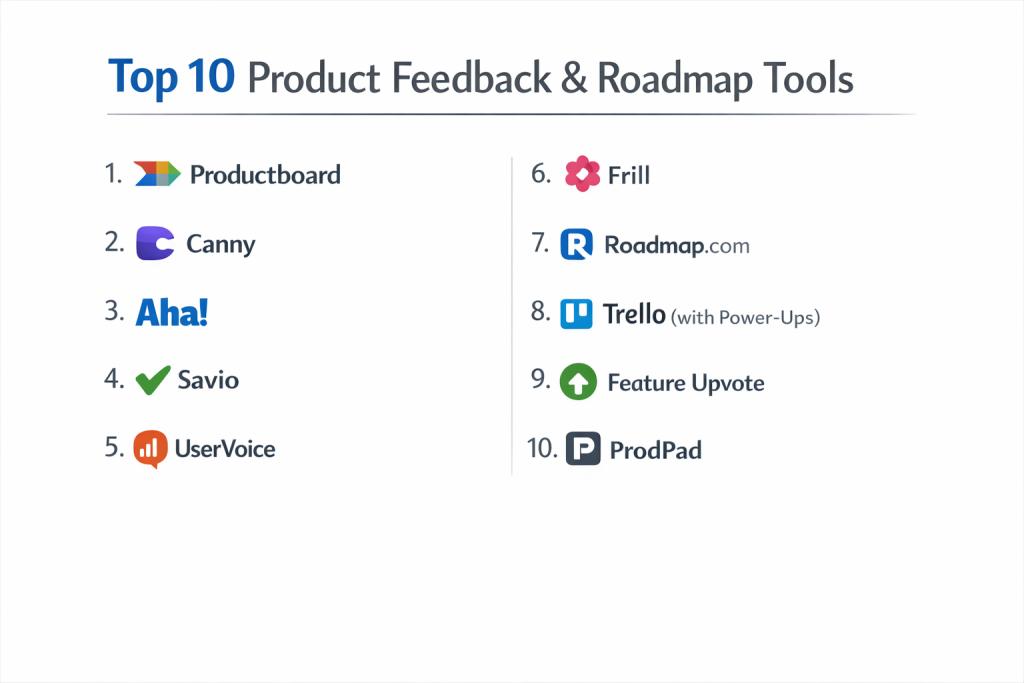
Top 10 Product Feedback & Roadmap Tools
1 — Productboard
Productboard is a comprehensive product management system that helps teams understand user needs, prioritize what to build next, and align everyone around a clear product roadmap.
Key features:
- Centralized feedback inbox aggregating data from Intercom, Zendesk, Slack, and more.
- Insights repository to tag and link feedback to specific features and user segments.
- Dynamic prioritization scoring frameworks (e.g., RICE, Value vs. Effort) to objectively rank features.
- Multiple roadmap views (timeline, now/next/later, swimlanes) for different audiences (execs, team, public).
- Integration as a single source of truth with Jira, GitHub, Azure DevOps for synchronizing roadmaps and development.
- User portal to collect feedback and share roadmap updates directly with customers.
Pros:
- Exceptional at connecting the “why” (user insights) directly to roadmap items, ensuring decisions are evidence-based.
- Highly visual and flexible roadmap creator that adapts to various planning styles and communication needs.
Cons:
- Can have a steeper learning curve due to its depth and range of features.
- Pricing scales with the number of “contributors,” which can become costly for large, collaborative organizations.
Security & compliance: SOC 2 Type II certified, GDPR compliant. Offers SSO (SAML, Google), granular permissions, and data encryption.
Support & community: Strong knowledge base, email & chat support, active user community forum, and dedicated enterprise onboarding.
2 — Canny
Canny is a user feedback management tool built specifically to close the loop with customers. It focuses on public boards for feature voting, automated user updates, and a clean, customer-facing roadmap.
Key features:
- Customizable, public feature voting boards to gauge demand and engage users.
- Automatic notifications to users when their requested features are updated or released.
- Dedicated changelog to announce product updates.
- Simple, intuitive roadmap (Planned, In Progress, Launched) for customer communication.
- Feedback aggregation from various sources into a single admin dashboard.
- Integration with Intercom, Slack, and Zapier to streamline workflows.
Pros:
- Unbeatable for creating a transparent, engaging customer community around product development.
- The automated notification system is a game-changer for building user loyalty and demonstrating that feedback is heard.
Cons:
- Less focused on deep, internal strategic planning and complex prioritization frameworks compared to full product management platforms.
- Primarily designed for B2B or B2C SaaS with a user base willing to engage on a public board.
Security & compliance: SOC 2 Type II certified, GDPR/CCPA compliant. Offers SSO, private boards, and data export.
Support & community: Responsive email support, detailed help docs, and a community of product-led growth practitioners.
3 — Aha!
Aha! is an enterprise-grade product strategy and roadmap software. It is designed for product managers who need to connect high-level company strategy to detailed feature planning and visual roadmapping.
Key features:
- Ideas portals to capture and score feedback from internal teams and customers.
- Strategy models to define goals, initiatives, and link them to features on the roadmap.
- Highly customizable, multi-product roadmaps with Gantt-chart timelines and presentations.
- Detailed feature definition with requirements, mockups, and workflows.
- Extensive reporting and analytics on portfolio health and progress.
- Robust integrations with Jira, Salesforce, Azure DevOps, and many more.
Pros:
- Unmatched depth for strategic planning, making it ideal for aligning product work with business objectives.
- Extremely powerful for large organizations managing complex product portfolios and release trains.
Cons:
- Can be overwhelming and “heavy” for small teams or those seeking a lightweight, agile feedback tool.
- Higher price point and a significant time investment required to configure and adopt fully.
Security & compliance: SOC 2 Type II, ISO 27001 certified. GDPR compliant. Features include SSO, audit logs, and enterprise-grade security.
Support & community: Comprehensive training (Aha! Academy), 24/5 enterprise support, detailed documentation, and large user conferences.
4 — Savio
Savio is a feedback tracking tool built for B2B SaaS product teams. It excels at aggregating qualitative feedback from support, sales, and success teams, and tying it to customer attributes like MRR or plan type.
Key features:
- Chrome extension and integrations to capture feedback directly from tools like Intercom, Zendesk, and Help Scout.
- Automatic tagging of customer attributes (e.g., “Enterprise Plan,” “Churned,” “MRR $5k+”) to every piece of feedback.
- Powerful filtering to answer questions like “What do our high-value enterprise customers want most?”
- Vote consolidation to deduplicate similar feedback and count unique customer votes.
- Simple, Kanban-style roadmap to share plans internally or with customers.
- Sync with Segment to automatically enrich customer profiles.
Pros:
- Superior for prioritizing feedback based on customer revenue and value, ensuring the most important customers are heard.
- Seamlessly bridges the gap between customer-facing teams (support/sales) and product management.
Cons:
- Less focused on visual, timeline-based roadmapping or complex strategic planning layers.
- The core strength is feedback analysis; roadmap presentation is more basic.
Security & compliance: SOC 2 compliant, GDPR ready. Data encrypted in transit and at rest, with secure infrastructure.
Support & community: Known for exceptional, personal customer support, quick onboarding, and helpful resources.
5 — UserVoice
One of the pioneers in the space, UserVoice provides tools for collecting user feedback, creating help centers, and publishing product roadmaps to foster customer communication.
Key features:
- Customizable feedback forums for public or private user suggestion and voting.
- Smart inbox to manage and respond to all user feedback from one place.
- Product roadmap with status updates to communicate progress on top requests.
- Helpdesk and knowledge base capabilities for customer support.
- Analytics and reporting to track trending topics and user satisfaction.
- API and integrations with common business and support tools.
Pros:
- A mature, reliable platform that combines feedback collection with support portal functionality.
- Good for organizations that want an all-in-one solution for feedback, support, and roadmap communication.
Cons:
- Can feel less modern and visually polished compared to newer, more focused competitors.
- As a broader suite, it may not have the deep, specialized capabilities of best-in-class standalone tools.
Security & compliance: Varies based on plan. Offers data security features and compliance with major data protection standards.
Support & community: Standard support channels, documentation, and a long-standing user base.
6 — Frill
Frill is a modern, embeddable widget for collecting feature requests and sharing your roadmap. It emphasizes simplicity, beautiful design, and seamless integration into your existing product.
Key features:
- Lightweight, embeddable widget that can be added to any website or web app with a few lines of code.
- Public roadmap with customizable statuses and categories.
- Idea management board where users can post, vote, and comment on suggestions.
- Changelog module to announce new features and updates.
- Moderation tools to manage community submissions.
- Custom CSS styling to match your brand perfectly.
Pros:
- Incredibly easy to set up and integrate, providing immediate value with minimal configuration.
- The design is clean and user-friendly, encouraging higher engagement from end-users.
Cons:
- Lacks the deep backend integrations for aggregating feedback from other systems (like support tickets).
- Primarily a communication and collection tool, with lighter-weight analysis and prioritization features.
Security & compliance: GDPR compliant. Data is encrypted, and the platform follows security best practices.
Support & community: Responsive support via email and chat, along with clear setup documentation.
7 — Roadmap.com
Roadmap.com is a platform designed specifically for creating and sharing beautiful, visual product roadmaps with both internal teams and external stakeholders.
Key features:
- Drag-and-drop roadmap builder with multiple view types (timeline, swimlane, calendar).
- “Portal” feature to create and share read-only, customized roadmap views with specific customers or groups.
- Feedback integration via a built-in ideas board or connections to Canny and Savio.
- Goal tracking to link roadmap items to strategic objectives.
- Presentation mode for showcasing roadmaps in meetings.
- Integration with Jira and GitHub to sync status and dependencies.
Pros:
- Arguably the best-in-class for creating stunning, communicative, and easy-to-understand roadmap visuals.
- The customer portal feature is unique and powerful for strategic account management and enterprise sales.
Cons:
- Originally more focused on roadmap visualization than feedback aggregation, though this is changing.
- May require a separate dedicated feedback tool for comprehensive input management.
Security & compliance: SOC 2 compliant, GDPR/CCPA ready. Offers SSO (Google, SAML) and private hosting options.
Support & community: Email and chat support, helpful knowledge base, and webinars.
8 — Trello (with Power-Ups)
Trello is a flexible, kanban-based project management tool that can be adapted into a feedback and roadmap system using its Power-Up ecosystem and templates.
Key features:
- Kanban boards to visualize feedback stages (Submitted, Under Review, Planned, Launched).
- Voting Power-Up to allow users to vote on cards/features.
- Custom fields to add prioritization scores, effort estimates, and feedback source.
- Butler automation to create rules for moving cards and sending notifications.
- Calendar Power-Up for timeline-based roadmap views.
- Massive integration ecosystem via Power-Ups (Slack, Jira, Google Drive, etc.).
Pros:
- Extreme flexibility and a low-cost starting point, especially for teams already using Trello for other purposes.
- Familiar, intuitive interface that requires little training for new users.
Cons:
- Requires manual setup and configuration; not an out-of-the-box, purpose-built solution.
- Can become cluttered and lack the specialized analytics and aggregation of dedicated tools at scale.
Security & compliance: Atlassian Cloud security standards, SOC 2, GDPR. Offers SSO and advanced permissions on premium plans.
Support & community: Vast Atlassian community, extensive help docs, and standard support channels.
9 — Feature Upvote
Feature Upvote is a straightforward tool that allows you to create feedback boards where your customers can suggest, upvote, and comment on ideas for your product.
Key features:
- Simple, customizable feedback boards that are easy for customers to understand and use.
- Anonymous voting to encourage unbiased feedback.
- Moderator controls to categorize, merge, and respond to ideas.
- Automatic email notifications to users who submit or vote on ideas.
- SSO and private board options for internal or sensitive feedback.
- Embeddable widget to integrate the board into your website.
Pros:
- One of the simplest and most affordable ways to launch a public voting board quickly.
- Focuses on doing one thing well—feedback collection and voting—without unnecessary complexity.
Cons:
- Does not include roadmap visualization or sophisticated prioritization features.
- Lacks native, deep integrations with other business systems for automated feedback aggregation.
Security & compliance: GDPR compliant. Offers data processing agreements and secure data handling.
Support & community: Email support and online help documentation.
10 — ProdPad
ProdPad is a product management tool focused on lean methodologies. It connects ideas, customer feedback, and market problems to a visual, outcome-driven roadmap.
Key features:
- Idea management with flexible scoring and linking to customer feedback and problems.
- Customer feedback linker to tie raw input directly to ideas and roadmap items.
- Outcome-driven roadmaps focusing on goals and problems solved rather than just feature lists.
- Persona and customer journey tracking.
- Integration with Jira, Pivotal Tracker, and DevOps tools.
- Product vision and strategy documentation tools.
Pros:
- Strong philosophical focus on outcome-based roadmaps and problem-space thinking, which leads to better product decisions.
- Effectively connects the dots between feedback, ideas, and the “why” behind the work.
Cons:
- The interface and workflow can feel unique and require a shift in mindset for teams used to feature-led planning.
- Smaller user community and integration ecosystem compared to the largest players.
Security & compliance: ISO 27001 certified, GDPR compliant. Data encrypted, with secure data centers.
Support & community: Responsive support, comprehensive online knowledge base, and training webinars.
Comparison Table
| Tool Name | Best For | Platform(s) Supported | Standout Feature | Rating |
|---|---|---|---|---|
| Productboard | Product teams needing to link insights to strategy & visual roadmaps | Cloud, Web | Unified system for insights, prioritization & multi-audience roadmaps | 4.7/5 |
| Canny | SaaS companies building public user communities & closing the feedback loop | Cloud, Web | Automated customer notifications & clean public voting boards | 4.6/5 |
| Aha! | Enterprise product strategists connecting goals to detailed execution | Cloud, Web | Deep strategic planning & portfolio roadmap capabilities | 4.5/5 |
| Savio | B2B SaaS teams prioritizing feedback by customer value (MRR, segment) | Cloud, Web, Browser Ext | Feedback filtering by customer attributes & revenue data | 4.4/5 |
| UserVoice | Organizations wanting a combined feedback forum & support portal | Cloud, Web | Integrated helpdesk and feedback management suite | 4.0/5 |
| Frill | Teams wanting a simple, embeddable widget for requests & a roadmap | Cloud, Web (Embeddable) | Beautiful, easy-to-embed widget & minimal setup | 4.3/5 |
| Roadmap.com | Creating and sharing stunning, client-facing roadmap visualizations | Cloud, Web | Best-in-class visual roadmaps & customer portal feature | 4.5/5 |
| Trello | Teams needing a flexible, low-cost starting point they can customize | Cloud, Web, Mobile | Ultimate flexibility via Kanban & Power-Ups | 4.2/5* |
| Feature Upvote | The simplest, most affordable public voting board | Cloud, Web (Embeddable) | Simplicity & focus on public voting boards | 4.1/5 |
| ProdPad | Teams practicing outcome-driven, problem-space roadmapping | Cloud, Web | Outcome-focused roadmap philosophy & feedback linking | 4.3/5 |
Note: Trello’s rating reflects its adaptability, not as a dedicated out-of-the-box solution.
Evaluation & Scoring of Product Feedback & Roadmap Tools
| Evaluation Criteria | Weight | Productboard | Canny | Aha! | Savio | Frill |
|---|---|---|---|---|---|---|
| Core Features | 25% | 97 | 90 | 96 | 88 | 82 |
| Ease of Use | 15% | 88 | 95 | 80 | 92 | 96 |
| Integrations & Ecosystem | 15% | 95 | 87 | 97 | 85 | 80 |
| Security & Compliance | 10% | 96 | 92 | 98 | 90 | 85 |
| Performance & Reliability | 10% | 95 | 94 | 96 | 92 | 93 |
| Support & Community | 10% | 92 | 90 | 94 | 96 | 86 |
| Price / Value | 15% | 85 | 90 | 80 | 92 | 94 |
| Weighted Total Score | 100% | 92.5 | 90.7 | 90.5 | 89.5 | 87.5 |
Which Product Feedback & Roadmap Tool Is Right for You?
- Solo PMs vs. Small Teams vs. Large Enterprises: A solo product manager might start with Trello or Frill. A small, agile product team needs a balanced tool like Productboard or Canny. Large enterprises with complex strategy needs should evaluate Aha! or enterprise plans from Productboard.
- Budget-Conscious vs. Premium Solutions: For a near-zero budget, Trello is powerful. Affordable dedicated tools include Feature Upvote and Frill. Mid-market teams find great value in Canny and Savio. Premium solutions like Productboard and Aha! justify cost with deep functionality that saves strategic time.
- Feature Depth vs. Ease of Use: If you need advanced prioritization, insights correlation, and complex roadmaps, prioritize feature depth (Productboard, Aha!). If your goal is immediate user engagement with minimal setup, prioritize ease of use (Canny, Frill).
- Integration and Scalability Needs: Map your stack. If Jira is your heart, check Productboard or Aha! sync depth. If feedback lives in Intercom/Zendesk, Savio or Canny excel. Ask vendors about API limits, single sign-on (SSO), and ability to handle multiple products.
- Security and Compliance Requirements: For enterprise clients, SOC 2 Type II certification is essential. If sharing roadmaps with European customers, ensure GDPR compliance. Tools like Aha! and Productboard lead with enterprise-grade security.
Frequently Asked Questions (FAQs)
- What’s the difference between a roadmap and a changelog?
A roadmap is forward-looking; it shows what you plan to build in the future (themes, goals, rough timelines). A changelog is historical; it lists what you have already built and released, often with details on new features and fixes. - Should our roadmap be public or private?
A public roadmap builds tremendous trust, engages users, and can reduce support tickets. However, it requires careful communication to avoid promising specific dates. A private roadmap is safer for highly competitive features or if your plans are highly uncertain. Many tools offer both. - How do we avoid just building the features with the most votes?
Votes indicate popularity, not always importance. Use a prioritization framework (like RICE or Value vs. Effort) that factors in reach, impact, confidence, and effort. Tools like Productboard and Aha! have these frameworks built-in to balance data with strategy. - Can we integrate feedback from our support tickets automatically?
Yes. Most dedicated tools (Savio, Productboard, Canny) offer direct integrations with Zendesk, Intercom, Help Scout, and Freshdesk. They can pull in tickets tagged as “feedback” or “feature request,” preventing valuable insights from getting lost. - What is an “outcome-driven roadmap”?
Instead of listing features (“Build a dark mode”), an outcome-driven roadmap focuses on the problem to solve or the goal to achieve (“Improve user engagement in low-light environments”). This gives engineering teams more autonomy on the “how” and keeps the “why” central. - How much time does it take to manage one of these tools?
Initial setup and feedback import can take a few days. Ongoing management requires a weekly cadence to triage new feedback, update statuses, and refine the roadmap—typically a few hours per week for a product manager. The time saved in chaotic meetings and misalignment is far greater. - What’s a common mistake when launching a feedback board?
The #1 mistake is not closing the loop. If users submit ideas and never hear back, they become disillusioned. Use statuses (Under Review, Planned, Completed) and tools like Canny’s automatic notifications to show users their voice matters. - Do engineering teams need direct access to these tools?
It’s highly beneficial. Engineers can add effort estimates, see the user context behind their work, and understand how their tasks fit into broader goals. Most tools offer viewer or collaborator licenses for engineers at a lower cost. - Can we use these tools for non-software products?
Absolutely. The principles of collecting input and communicating plans are universal. These tools can manage feedback for physical products, services, or internal business processes. The key is adapting the “feature” and “release” concepts to your domain. - What’s the first step after choosing a tool?
Import your existing data. Gather all feedback from spreadsheets, emails, issue trackers, and support tickets into the new system. Then, define your workflow (e.g., New → Reviewed → Prioritized → On Roadmap) and create your first, simple roadmap view to share with your team.
Conclusion
Selecting the right Product Feedback & Roadmap tool is a foundational step in building a customer-centric, evidence-driven product organization. The market offers tailored solutions, from the community-focused simplicity of Canny to the strategic depth of Aha! and the integrated power of Productboard.
Remember, the “best” tool is the one that fits your team’s size, process maturity, and communication style. Prioritize a system that reduces the chaos of scattered feedback, provides clarity for your team, and builds a transparent relationship with your users. By investing in the right platform, you empower your team to build not just features, but the right product that consistently delivers value and drives growth.

- Top 10 Email Deliverability Tools: Features, Pros, Cons & Comparison - September 6, 2026
- Top 10 Pharmacovigilance Software: Features, Pros, Cons & Comparison - September 6, 2026
- Top 10 Manufacturing Execution Systems (MES) - July 30, 2026
