Introduction
In the modern sales landscape, “cold calling” has evolved from a manual grind into a data-driven science. Prospecting Automation Tools are software platforms designed to automate the initial stages of the sales funnel—specifically finding, qualifying, and engaging potential leads. These tools leverage massive B2B databases, Artificial Intelligence (AI), and automated workflows to identify the right decision-makers and reach out to them via email, LinkedIn, or phone without a sales representative having to lift a finger for every individual task.
The importance of these tools cannot be overstated. According to recent industry data, sales representatives spend nearly 40% of their week on manual prospecting and administrative tasks. Automation shrinks this time sink significantly, allowing teams to focus on what they do best: closing deals. By utilizing intent data, real-time lead enrichment, and automated sequences, businesses can maintain a “pipeline that never sleeps,” ensuring a steady flow of high-quality opportunities. Key real-world use cases include building targeted account lists for Account-Based Marketing (ABM), automating multi-channel follow-ups, and enriching CRM data to ensure sales teams always have the most current contact information.
When choosing a tool in this category, users should evaluate platforms based on data accuracy (the “gold standard” of prospecting), compliance (GDPR/CCPA), integration capabilities with existing CRMs like Salesforce or HubSpot, and the depth of intent signals that indicate when a prospect is actually ready to buy.
Best for: These tools are essential for Sales Development Representatives (SDRs), Business Development Managers (BDRs), and RevOps teams within mid-market and enterprise-level B2B companies. They are particularly beneficial in industries with high-ticket sales or complex buying committees, such as SaaS, FinTech, and professional services.
Not ideal for: Small local businesses or B2C retailers where the target audience is the general public rather than specific professional personas. Additionally, companies with extremely low lead volume might find the high cost of premium tools like ZoomInfo or Cognism difficult to justify compared to manual outreach.
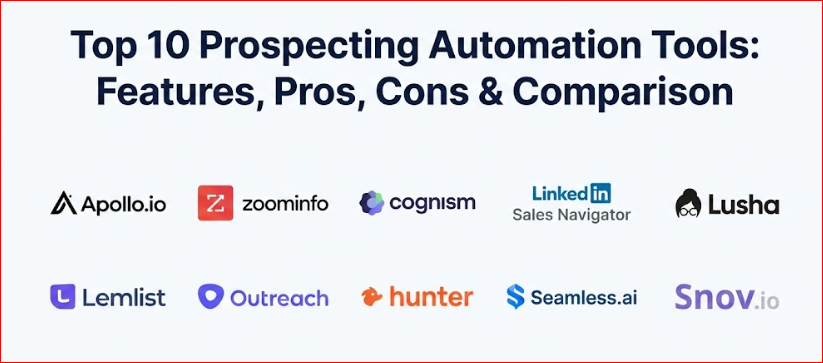
Top 10 Prospecting Automation Tools
1 — Apollo.io
Apollo.io has rapidly become the “Swiss Army Knife” of prospecting. It combines a massive B2B database of over 275 million contacts with a powerful built-in sales engagement platform, making it a favorite for teams that want an all-in-one solution.
- Key features:
- Massive B2B database with 65+ advanced search filters.
- Automated multi-channel sequences (Email, LinkedIn, Tasks).
- AI-powered Writing Assistant for personalized outreach copy.
- Real-time CRM enrichment for HubSpot and Salesforce.
- Built-in dialer and conversation intelligence for call recording.
- Buying intent signals to track company research behavior.
- Chrome Extension for prospecting directly on LinkedIn.
- Pros:
- Unbeatable value for money, offering a “one-stop-shop” that replaces multiple tools.
- Extremely user-friendly interface with a minimal learning curve.
- Strong free tier that allows startups to begin prospecting immediately.
- Cons:
- Data accuracy for phone numbers can sometimes lag behind premium competitors like ZoomInfo.
- Email deliverability can suffer if users don’t properly configure the built-in “warm-up” features.
- Security & compliance: SOC 2 Type II certified, GDPR compliant, CCPA compliant, and ISO 27001.
- Support & community: Offers an extensive “Apollo Academy,” highly active user community, and tiered support ranging from email to dedicated success managers for enterprise clients.
2 — ZoomInfo SalesOS
ZoomInfo is widely regarded as the industry leader for data depth and accuracy in the North American market. It is a premium, enterprise-grade platform that provides highly granular firmographic and technographic data.
- Key features:
- Industry-leading accuracy for direct-dial phone numbers.
- “Intent” data that identifies companies actively searching for your solution.
- Technographic tracking to see which software your prospects currently use.
- Workflows that trigger actions based on leadership changes or funding rounds.
- Automated lead scoring and routing.
- Comprehensive mobile app for on-the-go prospecting.
- Deep integration with all major enterprise CRM and MAP systems.
- Pros:
- The highest standard of data quality for large-scale enterprise outreach.
- Advanced “Scoops” feature provides real-time internal company news and pain points.
- Cons:
- Significantly more expensive than other tools on this list, often requiring annual contracts.
- The platform is dense and can be overwhelming for smaller teams without dedicated RevOps support.
- Security & compliance: SOC 2 Type II, ISO 27001, GDPR compliant, and TRUSTe certified.
- Support & community: High-touch enterprise support, dedicated account managers, and a vast library of “ZoomInfo University” training modules.
3 — Clay
Clay is a revolutionary “programmable” prospecting tool that operates like a powerful spreadsheet. It allows users to pull data from 50+ providers simultaneously to create highly customized, AI-enriched prospect lists.
- Key features:
- Aggregation of data from multiple sources (Apollo, Hunter, LinkedIn, etc.) in one view.
- “Claygent” AI agent that can research specific questions about a company via the web.
- Automated AI-written personalization based on recent LinkedIn posts or news.
- Waterfall enrichment to find emails by checking multiple databases sequentially.
- Web scraping capabilities to find leads from niche directories.
- Deep integrations with Slack, CRM, and Outreach tools.
- Pros:
- Allows for “hyper-personalization” at scale that was previously impossible.
- Extremely flexible; if the data exists on the web, Clay can likely find and automate it.
- Cons:
- Steep learning curve; requires a “builder” mindset to set up complex workflows.
- Credit-based pricing can become expensive if not monitored carefully during large runs.
- Security & compliance: SOC 2 Type II compliant, GDPR compliant.
- Support & community: Very strong Slack community (“Claymates”) and high-quality technical documentation.
4 — LinkedIn Sales Navigator
The foundation of modern B2B prospecting. Sales Navigator provides the most up-to-date professional data because it comes directly from the source: the users themselves.
- Key features:
- Advanced Lead and Account search with 40+ filters.
- InMail messaging to reach prospects outside of your direct network.
- Real-time alerts on lead job changes and company growth.
- “Smart Links” to track who is engaging with your shared content.
- CRM Sync to automatically log activities and save leads.
- Team collaboration tools and shared lead lists.
- Pros:
- The most accurate source for job titles and current company status.
- Indispensable for social selling and building long-term relationships.
- Cons:
- Does not provide email addresses or phone numbers natively (requires 3rd party extensions).
- Strict limits on the number of searches and InMails you can send per month.
- Security & compliance: Enterprise-grade security via Microsoft, GDPR, and CCPA compliant.
- Support & community: Comprehensive LinkedIn Learning modules and standard professional support.
5 — Cognism
Cognism is the preferred choice for companies prospecting in the UK, Europe, and APAC, primarily due to its rigorous focus on “compliant” mobile data and international regulations.
- Key features:
- Diamond-verified mobile numbers with a 98% accuracy guarantee.
- Focus on GDPR-compliant data (notably TPS/CTPS filtered numbers).
- Strong coverage for the EMEA and APAC regions.
- Intent data powered by Bombora.
- Browser extension that works over LinkedIn and company websites.
- Seamless CRM integration and data cleaning.
- Pros:
- The best tool for staying legally safe in regions with strict privacy laws.
- High-quality mobile data that significantly increases connect rates for callers.
- Cons:
- Smaller overall database compared to US-centric giants like ZoomInfo.
- Premium pricing model that may be out of reach for very small startups.
- Security & compliance: ISO 27001, GDPR compliant, SOC 2 compliant.
- Support & community: Dedicated customer success team and excellent localized support for European time zones.
6 — Lusha
Lusha is designed for speed and simplicity. It started as a browser extension and has evolved into a full-scale prospecting platform known for its “plug-and-play” nature.
- Key features:
- Instant contact reveal (Email & Mobile) via a Chrome extension.
- Bulk enrichment of CSV files or CRM lists.
- Simple search engine for finding new prospects.
- Intent data and company alerts.
- Automated list building and export.
- Native integrations with Salesforce, HubSpot, and Pipedrive.
- Pros:
- One of the easiest tools to set up and use; great for individual SDRs.
- Very high accuracy for mobile phone numbers in the US market.
- Cons:
- Less advanced automation/sequencing features compared to Salesloft or Apollo.
- Free plan is very limited, and credits can be used up quickly.
- Security & compliance: GDPR and CCPA compliant, ISO 27001, SOC 2 Type II.
- Support & community: 24/7 customer support for premium tiers and a helpful online knowledge base.
7 — Salesloft
Salesloft is not just a data provider; it is a “Sales Engagement Platform” that focuses on the execution of the prospecting process through automated “cadences.”
- Key features:
- Cadence automation (sequences of calls, emails, and social touches).
- Built-in dialer with local presence and one-click calling.
- “Rhythm” AI that prioritizes the most important tasks for a rep each day.
- Deep analytics on team performance and message effectiveness.
- Integration with major data providers for seamless lead import.
- Conversation intelligence for coaching and call reviews.
- Pros:
- The best tool for keeping high-volume sales teams organized and accountable.
- Excellent for A/B testing different outreach strategies to see what converts.
- Cons:
- Requires a separate data source (like ZoomInfo or LinkedIn) to find the leads initially.
- Can be complex to set up and requires management oversight.
- Security & compliance: SOC 2 Type II, GDPR, CCPA, and Privacy Shield.
- Support & community: Robust “Salesloft University,” large annual conference (Rainmaker), and premium enterprise support.
8 — Outreach.io
Outreach is the primary competitor to Salesloft, offering a high-powered sales execution platform designed for large, complex enterprise sales organizations.
- Key features:
- Advanced automated sequences and multi-channel workflows.
- “Outreach Guide” AI that provides real-time coaching during calls.
- Sophisticated deal management and pipeline forecasting.
- Detailed reporting on every stage of the sales cycle.
- Robust integration ecosystem (300+ apps).
- Enterprise-grade security and administrative controls.
- Pros:
- Extremely powerful for large teams needing deep visibility into their pipeline.
- Highly customizable workflows that can fit any sales methodology.
- Cons:
- The interface is notoriously complex and has a steep learning curve.
- Expensive, with a pricing structure built for enterprise budgets.
- Security & compliance: SOC 2 Type II, ISO 27001, GDPR, HIPAA compliant.
- Support & community: Dedicated enterprise success managers and an extensive knowledge base.
9 — PhantomBuster
PhantomBuster is a lead generation “automation engine” that works by scraping data and automating actions across social media platforms like LinkedIn, Twitter, and Instagram.
- Key features:
- “Phantoms” (bots) that can extract lists of people who liked a post or are in a group.
- Automated LinkedIn connection requests and messages.
- Email discovery and verification.
- Web scraping from any public URL.
- Workflows that chain multiple automations together.
- Pros:
- Allows for creative, “out-of-the-box” prospecting strategies that other tools can’t do.
- Very affordable for the amount of data it can extract.
- Cons:
- Operates in a “gray area” of platform Terms of Service; carries a risk of account suspension.
- Requires technical configuration to avoid being detected as a bot.
- Security & compliance: Varies / N/A (Focus is on scraping; users must ensure their own compliance).
- Support & community: Very active community-led tutorials and a “PhantomBuster Academy.”
10 — Kaspr
Kaspr is a lightweight, effective prospecting tool that focuses on helping users find B2B contact details instantly while browsing LinkedIn.
- Key features:
- Chrome Extension for instant email and phone number retrieval.
- Basic automation for LinkedIn invitations and messages.
- Bulk enrichment of LinkedIn searches.
- Native CRM integrations.
- Lead management dashboard to organize found contacts.
- Pros:
- Extremely fast and simple; perfect for individual contributors.
- Competitive pricing for small teams.
- Cons:
- Data coverage is smaller than Apollo or ZoomInfo.
- Limited features for managing full-scale sales cadences.
- Security & compliance: GDPR and CCPA compliant.
- Support & community: Live chat support and a straightforward help center.
Comparison Table
| Tool Name | Best For | Platform(s) Supported | Standout Feature | Rating (Gartner/TrueReview) |
| Apollo.io | All-in-one / SMBs | Web, LinkedIn, Chrome | Integrated B2B Database & Sequences | 4.8 / 5 |
| ZoomInfo | Enterprise Data | Web, Mobile, CRM | Intent Data & Direct Dial Accuracy | 4.5 / 5 |
| Clay | Hyper-Personalization | Web, API | AI-Powered Data Aggregation | 4.9 / 5 |
| LinkedIn SN | Social Selling | Direct Access to User-Updated Data | 4.6 / 5 | |
| Cognism | EMEA Compliance | Web, LinkedIn, Chrome | GDPR-Compliant Mobile Numbers | 4.7 / 5 |
| Lusha | Quick Lead Sourcing | Web, Chrome | Ease of Use / Instant Reveal | 4.4 / 5 |
| Salesloft | Team Cadences | Web, CRM, Mobile | Workflow & Task Orchestration | 4.5 / 5 |
| Outreach.io | Enterprise Execution | Web, CRM | Advanced Pipeline Forecasting | 4.4 / 5 |
| PhantomBuster | Lead Scraping | Web, Social Media | Niche Social Media Automation | 4.3 / 5 |
| Kaspr | Individual SDRs | Web, LinkedIn, Chrome | Fast LinkedIn Contact Extraction | 4.4 / 5 |
Evaluation & Scoring of Prospecting Automation Tools
| Criteria | Weight | Apollo | ZoomInfo | Clay | Cognism | Salesloft |
| Core Features | 25% | 9/10 | 10/10 | 10/10 | 8/10 | 9/10 |
| Ease of Use | 15% | 10/10 | 7/10 | 6/10 | 8/10 | 8/10 |
| Integrations | 15% | 9/10 | 10/10 | 9/10 | 9/10 | 10/10 |
| Security/Compliance | 10% | 9/10 | 10/10 | 8/10 | 10/10 | 9/10 |
| Performance | 10% | 8/10 | 10/10 | 9/10 | 9/10 | 9/10 |
| Support | 10% | 8/10 | 9/10 | 9/10 | 9/10 | 9/10 |
| Price / Value | 15% | 10/10 | 5/10 | 8/10 | 7/10 | 7/10 |
| Weighted Total | 100% | 9.1 | 8.6 | 8.6 | 8.4 | 8.8 |
Which Prospecting Automation Tool Is Right for You?
Choosing the right tool is a strategic decision that depends on your company’s stage and sales goals.
- Solo Users vs SMB vs Enterprise:
- Solo/Startups: Look at Apollo.io or Kaspr. They offer low entry costs and all the basic features you need to start getting meetings.
- SMB/Mid-Market: Lusha or Salesloft are great for teams of 5-20 who need organization without the extreme complexity of enterprise tools.
- Enterprise: ZoomInfo and Outreach.io are the gold standard for large teams where data accuracy and pipeline predictability are worth the high price tag.
- Budget-Conscious vs Premium:
- If budget is your main concern, Apollo.io provides the most features per dollar.
- If “connect rate” (how many people actually pick up the phone) is the priority, premium tools like Cognism or ZoomInfo pay for themselves by saving your reps from dialing dead numbers.
- Feature Depth vs Ease of Use:
- Clay offers the most depth but requires technical skill.
- Lusha offers the least depth but can be mastered in 10 minutes.
Frequently Asked Questions (FAQs)
1. What is the difference between a lead database and a sales engagement tool?
A database (like ZoomInfo) provides you with the contact information. An engagement tool (like Salesloft) is the engine that sends the emails and schedules the calls. Some tools, like Apollo, do both.
2. How accurate is the data in these tools?
Accuracy varies. Premium tools like ZoomInfo and Cognism claim 90-95% accuracy for direct dials, while more affordable tools may range from 70-85%.
3. Is it legal to use these tools under GDPR?
Yes, provided the tool is GDPR-compliant. Tools like Cognism focus specifically on “Legitimate Interest” and provide data that has been screened against “Do Not Call” lists.
4. Can these tools automate my LinkedIn outreach?
Some can (like PhantomBuster or Apollo), but be careful. LinkedIn has strict limits on automation. Using these tools too aggressively can result in your account being restricted.
5. Do I still need a CRM if I have a prospecting tool?
Yes. Prospecting tools are for the “top of the funnel.” Once a lead becomes an active opportunity, it should be managed in a CRM like Salesforce or HubSpot for long-term tracking.
6. What are “Intent Signals”?
Intent signals are data points showing a company is researching your category—such as visiting your website, looking at review sites, or hiring for specific roles.
7. How do I prevent my automated emails from going to spam?
Use “Email Warm-up” features, ensure your SPF/DKIM records are set up, and most importantly, personalize your emails so they don’t look like bulk blasts.
8. Can I export data from these tools?
Most allow CSV exports or direct syncing to your CRM. However, some (like LinkedIn Sales Navigator) require a third-party tool to extract the data into a spreadsheet.
9. What is “Waterfall Enrichment”?
It is a process where the software checks multiple databases in a row to find a missing email address, stopping only when it finds a verified result.
10. What is the biggest mistake people make with automation?
“Setting it and forgetting it.” Automation should enhance personalization, not replace it. Generic, high-volume “spam” will lead to low conversion and burnt domains.
Conclusion
The “best” prospecting automation tool isn’t the one with the most features; it’s the one that your sales team will actually use every day. If you are a high-growth startup, Apollo.io offers an unbeatable entry point. If you are an enterprise chasing the Fortune 500, ZoomInfo is your best bet for data quality. And if you want to be on the cutting edge of AI-driven outreach, Clay is the tool defining the future of the industry.

- Top 10 Email Deliverability Tools: Features, Pros, Cons & Comparison - September 6, 2026
- Top 10 Pharmacovigilance Software: Features, Pros, Cons & Comparison - September 6, 2026
- Top 10 Manufacturing Execution Systems (MES) - July 30, 2026