Introduction
In the high-stakes world of emergency response, every second counts. To manage these critical moments, emergency services rely on Public Safety Dispatch (CAD) Systems, also known as Computer-Aided Dispatch. At its core, a CAD system is a mission-critical software platform used by dispatchers and call-takers to initiate emergency calls, track the status of field units (police, fire, or EMS), and coordinate a rapid, effective response. These systems act as the “brain” of a dispatch center, integrating geographic information systems (GIS), 911 call handling, and records management to ensure that help arrives exactly where it is needed, as fast as possible.
The importance of a modern CAD system cannot be overstated. Beyond simple record-keeping, these platforms provide real-time situational awareness. For example, when a 911 call comes in, the CAD system can automatically identify the caller’s location, suggest the closest available fire truck with the right equipment, and provide officers with the floor plans of the building they are entering. Key use cases include managing high-volume city traffic, coordinating multi-agency responses during natural disasters, and maintaining constant communication with responders via mobile data terminals (MDTs). When evaluating CAD software, users look for reliability (uptime), ease of use under pressure, seamless integration with existing radios and databases, and robust security to protect sensitive data.
Best for: Large city police and fire departments, county-wide multi-agency dispatch centers, and statewide emergency management agencies. It is essential for dispatchers, shift supervisors, and field responders who need a unified view of ongoing incidents.
Not ideal for: Private security firms with minimal dispatch needs, very small volunteer organizations with low call volumes that can be managed manually, or corporate office management where basic communication tools are sufficient.
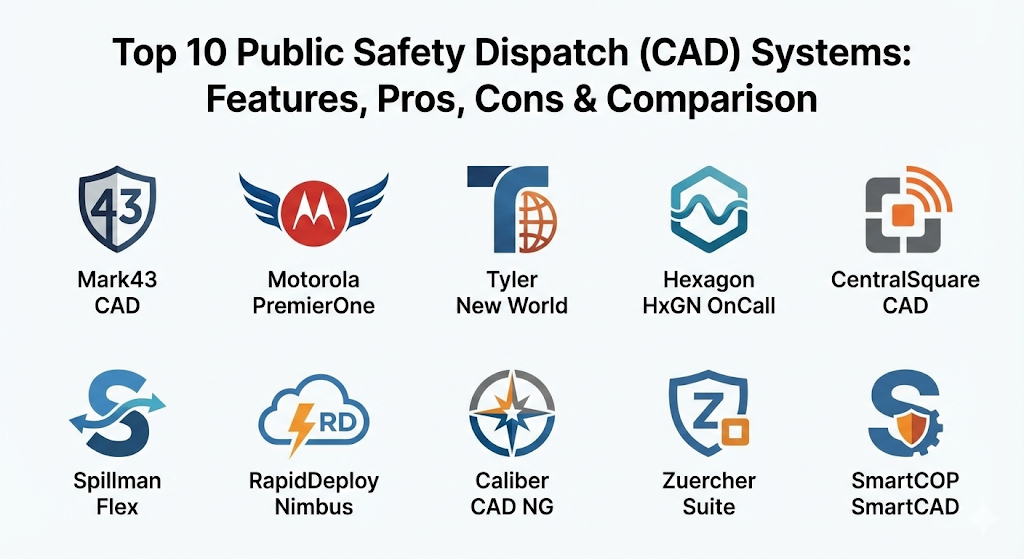
Top 10 Public Safety Dispatch (CAD) Systems Tools
1 — Mark43 CAD
Mark43 is a cloud-native public safety platform that focuses on modernizing the dispatch experience with an intuitive, browser-based interface. It is designed to reduce the “clicks” required to dispatch a unit, allowing teams to move faster in crisis situations.
- Key features:
- Cloud-native architecture for high availability and remote access.
- Automated response plans based on agency-defined rules.
- Real-time situational awareness with integrated GIS mapping.
- Unified workflow between CAD, RMS (Records), and Analytics.
- Predictive impact modeling for operational changes.
- Automated unit recommendations.
- Pros:
- Highly intuitive and modern user interface that reduces training time.
- No local servers to maintain, reducing the IT burden on agencies.
- Cons:
- Requires a very stable internet connection for optimal performance.
- Limited customization for agencies with highly niche, legacy workflows.
- Security & compliance: AWS GovCloud hosting, CJIS compliant, AES-256 encryption, SOC 2 Type II.
- Support & community: 24/7/365 support via phone and email; extensive online documentation and training drills.
2 — Motorola Solutions PremierOne CAD
As an industry leader, Motorola’s PremierOne is a high-performance system built for large-scale, multi-jurisdictional environments. It is known for its incredible depth of features and its ability to handle massive call volumes without lag.
- Key features:
- Seamless integration with Motorola radio and body-cam ecosystems.
- Advanced GIS components using Esri ArcGIS resources.
- Dispatcher-controlled radio talkgroup grouping.
- Location-based unit recommendations.
- Multi-agency and multi-discipline database configurations.
- Automated status updates via GPS.
- Pros:
- Proven stability and reliability in the largest dispatch centers globally.
- Unmatched interoperability with hardware (radios, consoles, etc.).
- Cons:
- Higher total cost of ownership compared to cloud-only startups.
- The user interface can feel complex and “heavy” for new users.
- Security & compliance: CJIS compliant, endpoint detection and response (EDR), 24/7 Security Operations Center (SOC) monitoring.
- Support & community: Extensive enterprise support, global user community, and dedicated implementation specialists.
3 — Tyler Technologies New World Public Safety
Tyler Technologies offers the New World suite, a highly integrated solution that provides a “cradle-to-grave” workflow from the initial 911 call to the final court record. It is widely used across all agency sizes.
- Key features:
- Integrated CAD, RMS, and Mobile in a single database.
- Multi-jurisdictional data sharing capabilities.
- Drag-and-drop unit assignments and status changes.
- Proactive alerting for responder safety (e.g., prior cautions at an address).
- Integrated NCIC/State database queries.
- Configurable dispatch screens for individual dispatcher preferences.
- Pros:
- Extremely strong integration across different public sector departments.
- Highly scalable, suitable for both small towns and large counties.
- Cons:
- System updates can sometimes be complex for on-premise deployments.
- Initial setup and training can be time-consuming due to the system’s depth.
- Security & compliance: CJIS compliant, role-based access controls, and audit logs.
- Support & community: Tyler University for ongoing education, 24/7 support, and regional user groups.
4 — Hexagon HxGN OnCall Dispatch
Hexagon is a global leader in sensor and software solutions. Their HxGN OnCall Dispatch is a next-generation platform designed to be flexible and agile, supporting both on-premise and cloud deployments.
- Key features:
- Assistive AI (Smart Advisor) to identify patterns in emergency calls.
- Flexible deployment options (SaaS or on-premise).
- Streamlined workflows for call-takers and dispatchers.
- Built-in major event management for large-scale disasters.
- Advanced mobility for field units on tablets and smartphones.
- Strong integration with external data (SMS, video feeds).
- Pros:
- Exceptional at managing complex, large-scale events and disasters.
- The AI tools help catch critical details that a human might miss.
- Cons:
- Operational complexity can be high for smaller agencies.
- The advanced features come with a premium price tag.
- Security & compliance: Microsoft Azure Gov Cloud, ISO 27001, CJIS compliant.
- Support & community: 30+ years of industry experience; proactive monitoring and 24/7 technical assistance.
5 — CentralSquare Public Safety CAD
CentralSquare provides a suite of tools built for “Hero-grade” technology. Their CAD system focuses on breaking down silos between jurisdictions to improve response times across regional boundaries.
- Key features:
- Unified awareness for cross-jurisdictional coordination.
- Advanced unit recommendation engine based on real-time location.
- Next Generation 911 (NG911) ready.
- Cloud-hosted or on-premise flexibility.
- Integration with RapidSOS for pinpoint caller location.
- Customizable workflows and response plans.
- Pros:
- Strong “CAD-to-CAD” features that allow different agencies to talk.
- Great focus on the “next generation” of dispatching technology.
- Cons:
- Customer sentiment regarding support response times can be mixed.
- Transitioning from legacy CentralSquare products to new versions can be difficult.
- Security & compliance: SOC 2 compliant, CJIS compliant, AWS-backed cloud security.
- Support & community: Large user base, online resource library, and regular webinar series.
6 — Spillman Flex (by Motorola Solutions)
Spillman Flex is known for its “Integrated Hub” philosophy, where all data is stored in a single, shared database. This makes it a favorite for agencies that prioritize data integrity and seamless records sharing.
- Key features:
- Full integration between CAD, RMS, Jail, and Fire modules.
- Superior multi-jurisdictional data sharing (Flex Insight).
- Customizable dispatcher screens (colors, fonts, layout).
- Built-in mapping and GIS location validation.
- Intelligence-led policing and crime analytics modules.
- Mobile field reporting for officers on the go.
- Pros:
- Data only has to be entered once, reducing errors and saving time.
- The system is highly stable and reliable for on-premise needs.
- Cons:
- The interface is functional but can look dated compared to newer SaaS tools.
- It is primarily designed as an on-premise solution, which may not suit “cloud-first” agencies.
- Security & compliance: CJIS compliant, robust audit trails, and encrypted data sharing.
- Support & community: Dedicated customer service, user-focused development, and regular training conferences.
7 — RapidDeploy Nimbus
RapidDeploy is a cloud-native platform that gained fame for its mapping and analytics. Nimbus is their primary CAD offering, designed specifically for the modern, data-rich environment of 911.
- Key features:
- Integrated NextGen 911 (NG911) mapping (Radius).
- Access to live video, telematics, and health data from callers.
- Cloud-native resilience—no on-site servers required.
- Real-time text-to-911 and language translation capabilities.
- Advanced analytics and reporting via the Eclipse module.
- Extremely fast deployment times.
- Pros:
- Provides the most advanced “situational awareness” data (video, health alerts).
- Lower upfront costs due to the SaaS subscription model.
- Cons:
- Entirely dependent on cloud connectivity; requires robust backup internet.
- May not yet have the full “legacy” feature depth of 30-year-old on-premise systems.
- Security & compliance: CJIS compliant, hosted on Azure and AWS GovCloud, end-to-end encryption.
- Support & community: High customer satisfaction; proactive cloud monitoring and remote support.
8 — Caliber Public Safety CAD NG
Caliber focuses on providing future-ready solutions that are easy to use. Their “CAD NG” (Next Generation) is designed to be intuitive for the modern dispatcher who expects a “smartphone-like” experience.
- Key features:
- Highly automated dispatching to reduce dispatcher workload.
- Embedded GIS and mapping for complete situational insight.
- Integrated NCIC and state database queries within the CAD screen.
- Scalable from single-station dispatch to large regional centers.
- Automated alerts and notifications for field units.
- Seamless integration with Caliber’s Online RMS.
- Pros:
- Dispatchers frequently praise how “easy” the system is to learn and use.
- Excellent maintenance and support—often described as “part of the family.”
- Cons:
- Smaller user base compared to giants like Motorola or Tyler Technologies.
- Less “global” presence; very focused on the North American market.
- Security & compliance: CJIS compliant, HIPAA and NIST standards supported.
- Support & community: “Caliber University” for training, 24/7 technical support, and the Golden Headset Award for user excellence.
9 — Zuercher Suite (CentralSquare)
Part of the CentralSquare family, the Zuercher Suite is a “one-stop-shop” software system that is particularly popular with small to mid-sized sheriff’s offices and police departments.
- Key features:
- Fully integrated CAD, RMS, Jail, and Civil modules.
- Simple, modern user interface.
- Web-based and mobile-friendly for field access.
- Drag-and-drop dispatching and unit status management.
- Automated reporting and NIBRS compliance.
- Integrated evidence and property management.
- Pros:
- The unified interface for all modules is very easy to manage.
- Highly cost-effective for smaller agencies that need a full suite.
- Cons:
- May lack the advanced “high-end” fire dispatch features needed by major cities.
- Customization options are more limited than the enterprise CentralSquare products.
- Security & compliance: CJIS compliant, secure cloud hosting options, role-based security.
- Support & community: 24/7 phone and live support; strong reputation for customer service in the mid-market.
10 — SmartCOP SmartCAD
SmartCOP is designed for real-world conditions, emphasizing flexibility and field-to-dispatch coordination. It is highly favored by highway patrols and state agencies.
- Key features:
- Hybrid architecture (Cloud-capable or on-premise).
- Real-time mapping powered by ESRI.
- Integrated NCIC support and AVL (Automatic Vehicle Location).
- Flexible command options (Command line, function keys, or drag-and-drop).
- Natural resource enforcement modules for specialized agencies.
- Integration with body-cams and RapidSOS.
- Pros:
- Unmatched scalability for state-level agencies and highway patrols.
- The “SmartWEB” portal allows public and leadership access to live data.
- Cons:
- The sheer amount of features can overwhelm a first-time user.
- Support documentation is sometimes reported as being incomplete for complex scenarios.
- Security & compliance: CJIS compliant, secure NIBRS-compliant reporting.
- Support & community: Strong partner integrations; responsive US-based support team.
Comparison Table
| Tool Name | Best For | Platform(s) Supported | Standout Feature | Rating |
| Mark43 CAD | Modern Cloud Agencies | Web (Cloud-Native) | Automated Response Plans | 4.8 / 5 |
| Motorola PremierOne | Large Metro Agencies | On-Premise / Hosted | Deep Radio Integration | 4.7 / 5 |
| Tyler New World | Mid to Large Agencies | On-Premise / Cloud | Cradle-to-Grave Workflow | 4.6 / 5 |
| Hexagon OnCall | Complex Disaster Mgmt | On-Premise / SaaS | Assistive AI (Smart Advisor) | 4.8 / 5 |
| CentralSquare CAD | Regional Coordination | On-Premise / Cloud | CAD-to-CAD Interoperability | 4.5 / 5 |
| Spillman Flex | Multi-Jurisdictional | On-Premise | Single Shared Hub Database | 4.6 / 5 |
| RapidDeploy Nimbus | Data-Driven PSAPs | Web (Cloud-Native) | Live Video/Health Data | 4.9 / 5 |
| Caliber CAD NG | Small to Mid Agencies | On-Premise / Cloud | Highly Intuitive UX | 4.7 / 5 |
| Zuercher Suite | Sheriff’s Offices | Web-Based / SaaS | Full “One-Box” Suite | 4.6 / 5 |
| SmartCOP CAD | State/Highway Patrol | Hybrid / Cloud | State-Level Scalability | 4.4 / 5 |
Evaluation & Scoring of Public Safety Dispatch (CAD) Systems
To help you decide, we have evaluated these tools against the most critical success factors for a dispatch center.
| Criterion | Weight | Scoring Logic |
| Core Features | 25% | Presence of GPS tracking, AVL, unit recommendations, and GIS mapping. |
| Ease of Use | 15% | Intuitiveness of the interface under high-stress conditions. |
| Integrations | 15% | How well it talks to radios, body-cams, 911 phone systems, and state databases. |
| Security & Compliance | 10% | CJIS compliance, encryption standards, and SOC 2 audits. |
| Performance & Reliability | 10% | Historical uptime, lag times during high call volume, and failover support. |
| Support & Community | 10% | Availability of 24/7 help and a strong peer user community. |
| Price / Value | 15% | Balancing upfront costs versus long-term efficiency and IT savings. |
Which Public Safety Dispatch (CAD) Systems Tool Is Right for You?
Choosing a CAD system is one of the most significant decisions an agency will make. Here is how to navigate that choice based on your specific needs.
Agency Size and Jurisdiction
For small to mid-market agencies (SMBs), a “one-box” suite like Zuercher or Caliber is often the best choice. These systems provide everything you need (CAD, RMS, and Jail) in a single package that is easy to manage. Large metropolitan agencies, however, require the industrial-strength power of Motorola PremierOne or Hexagon, which are built to handle hundreds of calls simultaneously across multiple cities.
Cloud vs. On-Premise
If your agency has a limited IT staff and wants to avoid buying expensive servers every five years, a cloud-native solution like Mark43 or RapidDeploy is the way to go. These systems update automatically and can be accessed from any laptop with an internet connection—vital for disaster recovery. However, if you are in a remote area with unreliable internet, a stable on-premise system like Spillman Flex remains the gold standard for reliability.
Budget and Feature Depth
Budget-conscious agencies should look toward SaaS (Software as a Service) models where costs are spread out over time. Solutions like 10-8 Systems (noted for affordability) or SmartCOP offer great value. If budget is less of a concern than “mission-critical” features, premium solutions like Motorola offer the most advanced radio integrations and safety features available on the market today.
Frequently Asked Questions (FAQs)
- What is a CAD system in public safety?It is a software platform used by dispatchers to log 911 calls, track the location and status of emergency responders, and manage incident data in real-time.
- Is cloud-based CAD safe for police data?Yes, provided the vendor is CJIS (Criminal Justice Information Services) compliant. Most modern cloud CADs use high-level encryption and secure “GovCloud” servers from AWS or Azure.
- How does a CAD system improve response times?By using GPS and AVL (Automatic Vehicle Location), the system can instantly recommend the closest unit to an emergency, saving precious minutes.
- Can different agencies share a CAD system?Yes, multi-jurisdictional CAD systems allow police, fire, and EMS from different towns or counties to share data and coordinate a unified response.
- What happens to the CAD if the internet goes down?Cloud-based systems usually have “offline modes” or backup cellular connections. On-premise systems keep working because they run on local servers inside the building.
- How long does it take to implement a new CAD system?Implementation can take anywhere from 6 months to 2 years, depending on the size of the agency and the complexity of moving old data into the new system.
- What is NG911?Next Generation 911 (NG911) allows dispatch centers to receive text messages, photos, and live video from callers, which modern CAD systems like RapidDeploy can display.
- Is training difficult for dispatchers?It depends on the system. Modern SaaS tools (Mark43, Caliber) focus on intuitive design, while legacy enterprise systems may require several weeks of specialized classroom training.
- Can CAD systems talk to each other?Yes, through “CAD-to-CAD” technology, a city police CAD can send data directly to a county ambulance CAD, even if they are made by different companies.
- How much does a CAD system cost?Pricing varies wildly. Small agencies might pay a few thousand dollars a month for a subscription, while large cities may spend millions on a permanent on-premise installation.
Conclusion
Selecting the right Public Safety Dispatch (CAD) system is a balance of technology, trust, and budget. There is no single “perfect” tool for every agency; instead, the best tool is the one that fits your agency’s specific size, geography, and technical comfort level.
For agencies looking to the future, cloud-native platforms like Mark43 and RapidDeploy offer unmatched agility and data-rich situational awareness. For agencies that require proven, heavy-duty stability and hardware integration, Motorola and Tyler Technologies remain the reliable pillars of the industry. Ultimately, what matters most is that the system you choose empowers your dispatchers to act with confidence when lives are on the line.

- Top 10 Email Deliverability Tools: Features, Pros, Cons & Comparison - September 6, 2026
- Top 10 Pharmacovigilance Software: Features, Pros, Cons & Comparison - September 6, 2026
- Top 10 Manufacturing Execution Systems (MES) - July 30, 2026