Introduction
A Reverse ETL Tool is a data integration solution that takes processed, enriched data out of a data warehouse (like Snowflake, BigQuery, or Redshift) and syncs it back into operational “SaaS” tools like Salesforce, HubSpot, Zendesk, or Slack. While traditional ETL is about gathering data for analysis, Reverse ETL is about data activation—making that data actionable for teams on the front lines. It turns your data warehouse from a passive storage unit into an active engine that powers your entire business stack.
Why It Matters
Reverse ETL is important because it solves the “last mile” problem of data. It ensures that the sophisticated insights created by your data scientists—such as “churn risk scores,” “customer lifetime value (CLV),” or “product-qualified lead (PQL)” status—are actually visible to the people who interact with customers. Instead of forcing a sales rep to check a BI dashboard, Reverse ETL pushes that information directly into the rep’s daily workspace.
Key Real-World Use Cases
- Personalized Marketing: Syncing custom audience segments from a warehouse to Facebook Ads or Google Ads for laser-targeted retargeting.
- Sales Productivity: Sending lead scores based on product usage data into Salesforce to help reps prioritize their outreach.
- Customer Support: Pushing a customer’s recent purchase history and subscription status into Zendesk so support agents have full context.
- Operational Alerts: Sending Slack or Microsoft Teams notifications when a high-value customer’s health score drops.
What to Look For
When evaluating Reverse ETL platforms, prioritize connector depth (can it write to the specific objects you need?), sync frequency (how close to real-time is it?), observability (can you see why a sync failed?), and visual mapping vs. code-based configurations.
Best for: Data engineers, growth marketers, and revenue operations (RevOps) professionals in mid-sized to enterprise organizations. It is highly beneficial for SaaS, E-commerce, and Fintech companies that rely on high-volume customer data.
Not ideal for: Early-stage startups with very low data complexity or companies that don’t yet have a centralized cloud data warehouse. If your data is still living exclusively in spreadsheets, you aren’t ready for Reverse ETL.
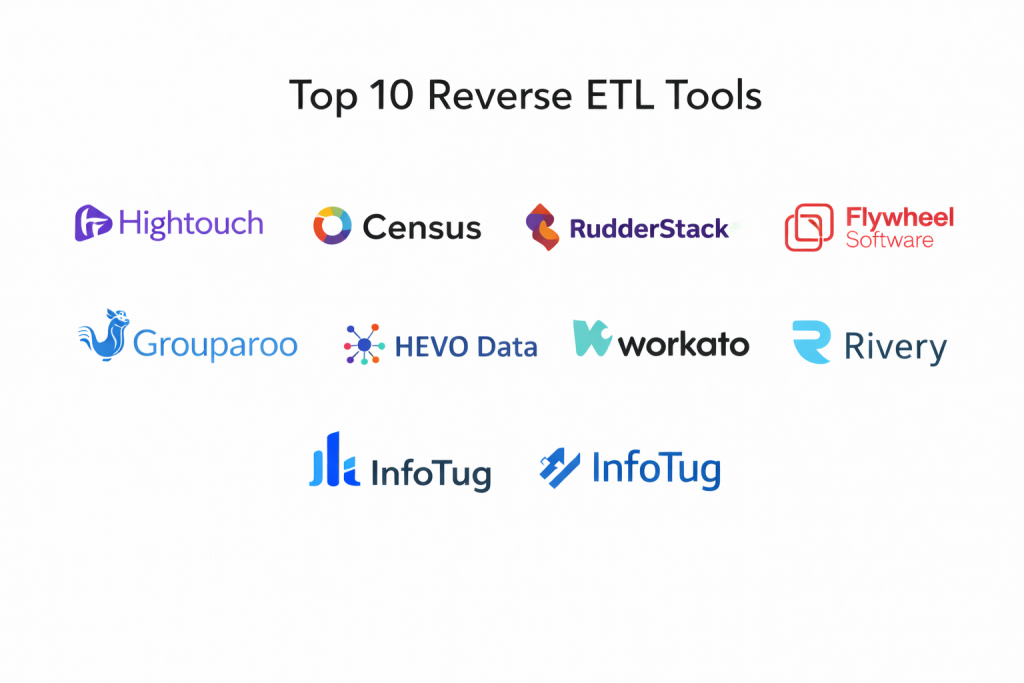
Top 10 Reverse ETL Tools
1 — Hightouch
Hightouch is widely recognized as a market leader in the Reverse ETL space, famous for its “Data Activation” philosophy. It allows teams to sync data from warehouses to over 200+ destinations without requiring complex API integrations.
- Key features:
- Visual Audience Builder: Allows non-technical marketers to create segments without writing SQL.
- Identity Resolution: Helps link disparate data points to a single customer profile.
- Git Sync: Enables version control for data sync configurations, appealing to engineers.
- Live Debugger: Provides real-time insights into sync errors and API responses.
- Personalization API: Allows for sub-second data retrieval for website personalization.
- Pros:
- Extremely fast setup; you can have your first sync running in minutes.
- Highly developer-friendly while still providing a great UI for non-coders.
- Cons:
- The pricing can scale rapidly as you add more “destination records.”
- Advanced identity resolution features are often locked behind higher-tier plans.
- Security & compliance: SOC 2 Type II, HIPAA, GDPR, and CCPA. Offers SSH tunneling and VPN options for secure warehouse connections.
- Support & community: Excellent technical documentation, a very active Slack community, and dedicated customer success managers for enterprise clients.
2 — Census
Census is often cited as the primary competitor to Hightouch. It focuses heavily on being the “operational analytics” layer, ensuring that data in your warehouse is reliably synced to the business tools your team uses every day.
- Key features:
- Entity-Based Mapping: Allows you to map warehouse data to objects like Leads, Accounts, or custom objects in SaaS tools.
- Sync Health Alerts: Granular notifications when a sync fails or data quality drops.
- dbt Integration: Deeply integrates with dbt (data build tool) to trigger syncs after models are updated.
- Segment Match: Specifically optimized for high-performance syncing to advertising platforms.
- Census Python SDK: Allows for programmatic management of syncs.
- Pros:
- Extremely reliable and robust; handles API rate limits of destination tools very intelligently.
- Strong emphasis on “Data Contract” principles, ensuring data consistency.
- Cons:
- The interface can feel a bit more technical and “engineer-centric” than some competitors.
- Pricing models have historically been based on the number of fields or connectors, which can be confusing.
- Security & compliance: SOC 2 Type II, GDPR, and HIPAA. Data is encrypted in transit and at rest.
- Support & community: Well-regarded support team and extensive documentation for technical users.
3 — RudderStack
RudderStack is a Customer Data Platform (CDP) that includes powerful Reverse ETL capabilities. It is designed for developers who want to manage their entire data pipeline—from collection to activation—in one place.
- Key features:
- Event Stream + Reverse ETL: Combines real-time event tracking with warehouse-to-app syncing.
- Warehouse-First Architecture: Does not store your data; it acts purely as a routing layer.
- RudderStack Cloud & Open Source: Offers a managed version and a self-hosted open-source version.
- Transformation Engine: Allows you to write JavaScript or Python to transform data during the sync.
- High Throughput: Optimized for moving millions of records with low latency.
- Pros:
- Incredible value for money if you need both event tracking and Reverse ETL.
- Developer-first approach with extensive API and CLI support.
- Cons:
- Might be “overkill” if you only need Reverse ETL and not the full CDP functionality.
- Steeper learning curve for non-technical team members.
- Security & compliance: SOC 2 Type II, HIPAA, and GDPR. Because it is warehouse-first, it minimizes data residency concerns.
- Support & community: Very strong community on Discord and Slack; responsive engineering-led support.
4 — Flywheel Software
Flywheel Software differentiates itself by focusing specifically on the marketing use case. It is often described as an “Audiences-first” platform rather than just a technical data pipeline tool.
- Key features:
- No-Code Audience Segmenting: Designed for marketers to build complex cohorts without SQL.
- Omnichannel Coordination: Ensures the same audience sees consistent messaging across email, ads, and SMS.
- Incrementality Testing: Built-in tools to measure the actual revenue lift of your data-driven campaigns.
- Direct Warehouse Connection: Connects directly to BigQuery, Snowflake, and Redshift.
- Customer 360 View: Provides a visual profile for every customer based on warehouse data.
- Pros:
- The most “business-friendly” tool for marketing teams.
- Strong focus on measuring ROI and business outcomes, not just technical syncs.
- Cons:
- Not as flexible for general-purpose Reverse ETL (like syncing data to an internal database).
- Smaller library of non-marketing connectors compared to Hightouch or Census.
- Security & compliance: SOC 2 Type II and GDPR compliant.
- Support & community: High-touch white-glove onboarding and dedicated strategic support.
5 — Polytomic
Polytomic is a versatile data integration platform that handles Reverse ETL, but also provides capabilities for spreadsheet syncing and internal data tool building.
- Key features:
- Standard & Bulk Syncs: Supports both small, frequent updates and massive historical loads.
- Spreadsheet Sync: Unique ability to sync warehouse data directly into Google Sheets or Excel.
- Webhook Support: Can trigger internal webhooks based on warehouse data changes.
- Custom SQL Support: Allows engineers to define the exact dataset for syncing using SQL.
- User Permissions: Fine-grained control over who can create and manage syncs.
- Pros:
- Very versatile; handles “boring” tasks like updating spreadsheets just as well as CRM syncs.
- Generally more affordable for mid-market companies than the “Big Two.”
- Cons:
- The UI is functional but lacks the “polish” of some more premium competitors.
- Community resources and third-party tutorials are less abundant.
- Security & compliance: SOC 2 Type II and GDPR compliant.
- Support & community: Known for very fast response times from their engineering team.
6 — Grouparoo (Acquired by Airbyte)
Grouparoo began as an open-source Reverse ETL framework. Since being acquired by Airbyte, its functionality is being integrated into the broader Airbyte ecosystem, making it a favorite for teams that prioritize open-source software.
- Key features:
- Declarative Configuration: Allows you to define your data syncs in JSON files for easy version control.
- Open Source Core: Can be run locally or on your own infrastructure for maximum privacy.
- Plugin Architecture: Community-driven approach to adding new destination connectors.
- UI for Non-Developers: A web-based interface for managing the “Open Source” core.
- Real-time Monitoring: Visualizes the status of every record as it moves to a destination.
- Pros:
- Zero licensing costs if you choose the self-hosted open-source version.
- Excellent for privacy-conscious industries like healthcare or government.
- Cons:
- Requires significant DevOps effort to host, scale, and maintain.
- Development of new features has shifted focus since the Airbyte acquisition.
- Security & compliance: Varies (Self-hosted allows for complete control over compliance).
- Support & community: Strong GitHub community and Airbyte Slack support.
7 — Hevo Data (Activate)
Hevo Data is primarily known as an ETL/ELT tool, but its “Hevo Activate” product provides a streamlined Reverse ETL experience, allowing users to handle both directions of data flow in one platform.
- Key features:
- Bi-directional Sync: Manage both data ingestion and data activation in one UI.
- Visual Mapping: Drag-and-drop interface for connecting warehouse columns to SaaS fields.
- Pre-built Templates: Common use cases (like PQL tracking) are pre-configured.
- Automated Deduplication: Ensures you don’t create duplicate records in your CRM.
- Near Real-Time Sync: Supports low-latency data movement for time-sensitive alerts.
- Pros:
- Excellent for teams that want to minimize their “vendor sprawl” by using one tool for all data movement.
- Very competitive pricing for smaller volumes.
- Cons:
- The Reverse ETL feature set is less mature than specialized tools like Hightouch.
- Limited customization options for complex data transformations.
- Security & compliance: SOC 2 Type II, GDPR, and HIPAA.
- Support & community: 24/7 live chat support is frequently praised by users.
8 — Workato (OData / Warehouse Connectors)
Workato is an enterprise-grade iPaaS (Integration Platform as a Service). While not a “pure-play” Reverse ETL tool, its powerful warehouse connectors allow it to perform Reverse ETL at an enterprise scale within complex workflows.
- Key features:
- Recipe-Based Automation: Allows for complex logic after the data leaves the warehouse.
- 1,000+ Connectors: The largest library of destinations in the integration market.
- Enterprise Workflow Orchestration: Can trigger human-in-the-loop approvals during a data sync.
- Zero Infrastructure: A fully managed cloud platform.
- Low-Code Interface: Designed for “Citizen Integrators” in IT and Operations.
- Pros:
- Unrivaled for complex business processes that go beyond simple data syncing.
- Extremely robust security and governance features for global enterprises.
- Cons:
- Extremely expensive; usually out of reach for SMBs.
- Can be overly complex for teams that just want to move data from A to B.
- Security & compliance: SOC 2 Type II, HIPAA, GDPR, ISO 27001, and more.
- Support & community: Global enterprise support and a massive “Recipe” library for inspiration.
9 — InfoTug
InfoTug is a newer, streamlined Reverse ETL solution that focuses on simplicity and high performance for specific marketing and sales destinations.
- Key features:
- Lightweight Sync Engine: Designed for speed and minimal overhead.
- Simplified Field Mapping: Focuses on the most common 80% of use cases.
- Real-time Error Reporting: Instant alerts when an API rejects a data point.
- Multi-Warehouse Support: Connects to Snowflake, Redshift, and Databricks.
- Audience Snapshots: Saves historical versions of synced audiences.
- Pros:
- Very affordable pricing for startups and mid-market firms.
- Zero “bloat”; easy to navigate and manage without extensive training.
- Cons:
- Much smaller connector library than the industry leaders.
- Lacks advanced features like Git-sync or complex identity resolution.
- Security & compliance: SOC 2 Type II (Standard) and GDPR.
- Support & community: Personalized support from a smaller, dedicated team.
10 — Rivery
Rivery is a comprehensive data management platform that offers ELT, workflow orchestration, and Reverse ETL in a single, unified interface.
- Key features:
- Python Rivers: Run custom Python scripts as part of your data activation flow.
- Environment Management: Easily move sync configurations between Dev, Staging, and Production.
- Automatic Scaling: Handles fluctuations in data volume without manual intervention.
- Managed Catalogs: Keep track of all data movements across the organization.
- API-First Design: Everything in the UI can be managed via API.
- Pros:
- Great for “Data Architects” who want to manage the entire lifecycle of data.
- Strong ability to handle very complex, multi-step data pipelines.
- Cons:
- The UI can be complex and intimidating for non-technical users.
- Pricing is based on “Rivery Credits,” which can be difficult to estimate upfront.
- Security & compliance: SOC 2 Type II, GDPR, and HIPAA.
- Support & community: Solid documentation and professional support services available.
Comparison Table
| Tool Name | Best For | Platform(s) Supported | Standout Feature | Rating (Gartner) |
| Hightouch | Data Activation / Marketing | Cloud-Native | Visual Audience Builder | 4.8 / 5.0 |
| Census | Operational Analytics | Cloud-Native | dbt Integration | 4.7 / 5.0 |
| RudderStack | Developers / CDPs | Cloud & Self-hosted | Event Stream Integration | 4.6 / 5.0 |
| Flywheel | High-Growth Marketing | Cloud-Native | Incrementality Testing | N/A |
| Polytomic | Mid-Market / Versatility | Cloud-Native | Spreadsheet Syncing | N/A |
| Grouparoo | Open Source / Privacy | Self-hosted | Declarative Config | N/A |
| Hevo Activate | SMBs / Bi-directional | Cloud-Native | ETL + Reverse ETL combo | 4.5 / 5.0 |
| Workato | Global Enterprise | Cloud-Native | Workflow Orchestration | 4.7 / 5.0 |
| InfoTug | Startups / Simplicity | Cloud-Native | Lightweight Speed | N/A |
| Rivery | Data Architects | Cloud-Native | Python Rivers | 4.4 / 5.0 |
Evaluation & Scoring of Reverse ETL Tools
Choosing a Reverse ETL platform involves weighing several competing priorities. We use the following scoring rubric to evaluate these tools during our internal reviews.
| Category | Weight | Evaluation Criteria |
| Core Features | 25% | Connector library, visual mapping, and identity resolution. |
| Ease of Use | 15% | Time-to-sync, UI intuitiveness, and non-technical accessibility. |
| Integrations | 15% | dbt support, Git-sync, and API availability. |
| Security & Comp. | 10% | SOC 2, HIPAA, GDPR, and secure connection methods. |
| Perf. & Reliability | 10% | Handling of API rate limits, sync latency, and uptime. |
| Support & Comm. | 10% | Response times, documentation, and community vibrancy. |
| Price / Value | 15% | Predictability of cost and feature-to-price ratio. |
Which Reverse ETL Tool Is Right for You?
Solo Users vs SMB vs Mid-Market vs Enterprise
- Solo/Small SMB: If you have very small volumes, look for the free tiers of Hightouch or Hevo Data. These allow you to get started with 1-2 destinations without an upfront cost.
- Mid-Market: Polytomic and Census offer the best balance of sophisticated features without the “Enterprise” price tag.
- Enterprise: Workato and Hightouch Enterprise provide the security, governance, and complex workflow support that large organizations require.
Budget-Conscious vs Premium Solutions
- Budget: Airbyte/Grouparoo (Open Source) is the lowest cost if you have engineering resources. InfoTug is the most affordable managed solution.
- Premium: Hightouch and Census are premium products. You are paying for the extensive connector library and the “it just works” reliability.
Feature Depth vs Ease of Use
If you need Ease of Use for your marketing team, Flywheel Software or Hightouch are the clear winners. If you need Feature Depth for complex data engineering, RudderStack or Rivery are better fits.
Frequently Asked Questions (FAQs)
1. Is Reverse ETL the same as a CDP (Customer Data Platform)?
No. A traditional CDP (like Segment) collects and stores your data. Reverse ETL assumes your data is already in your own warehouse and simply acts as a pipeline to send it elsewhere. Many teams prefer Reverse ETL because it avoids “data silos” and gives you more control.
2. Why can’t I just build my own Reverse ETL scripts?
You can, but API maintenance is a nightmare. SaaS tools change their API requirements constantly. A Reverse ETL tool handles these updates, manages rate limits, and provides error alerts so your engineers don’t have to.
3. Does Reverse ETL store my data?
Most modern Reverse ETL tools (like Hightouch, Census, and RudderStack) are “stateless.” They read from your warehouse and push to the destination, but they do not store a copy of your sensitive data in their own databases.
4. How often should I sync my data?
It depends on the use case. For marketing ads, a daily sync is often enough. For sales lead scoring or customer support context, most teams aim for hourly or “near real-time” (every 5-15 minutes).
5. Do I need to know SQL to use these tools?
While some tools offer “no-code” builders, knowing basic SQL is highly beneficial. It allows you to define exactly which data rows you want to sync from your warehouse.
6. What is “Delta Sync”?
Delta Sync is a feature where the tool only sends the changes in your data since the last sync. This is critical for avoiding hitting API rate limits in tools like Salesforce.
7. Can I sync data to Google Sheets?
Yes. Several tools, notably Polytomic and Hightouch, have specific connectors for Google Sheets, which is a very popular way to share data with non-data-literate stakeholders.
8. What happens if a sync fails?
Top-tier tools provide detailed error logs. They tell you exactly which record failed and what the destination API said (e.g., “Invalid email format”). Most tools also allow you to set up Slack or Email alerts for failures.
9. Is Reverse ETL expensive?
It can be. Most tools charge based on the number of destinations or the number of unique “records” you sync. It is important to monitor your usage to avoid surprise bills.
10. Do I need dbt to use Reverse ETL?
You don’t need it, but it is highly recommended. dbt helps you transform your raw warehouse data into clean “models” that are ready to be synced by Reverse ETL tools.
Conclusion
The era of “passive” data is over. It is no longer enough to have a data warehouse full of insights if those insights aren’t being used by your sales, marketing, and support teams. Reverse ETL Tools have emerged as the vital bridge that makes data actionable.
Whether you choose the marketing-centric approach of Hightouch, the operational reliability of Census, or the developer-friendly flexibility of RudderStack, the goal is the same: get your data out of the warehouse and into the hands of the people who can use it to grow the business. The “best” tool is simply the one that fits your current team’s technical skills and your company’s specific growth goals.

- Top 10 Email Deliverability Tools: Features, Pros, Cons & Comparison - September 6, 2026
- Top 10 Pharmacovigilance Software: Features, Pros, Cons & Comparison - September 6, 2026
- Top 10 Manufacturing Execution Systems (MES) - July 30, 2026