Introduction
As the traditional corporate network dissolves into a decentralized web of remote workers, cloud applications, and edge devices, the “castle-and-moat” security model has become obsolete. Secure Access Service Edge (SASE), a term coined by Gartner, represents the convergence of wide area networking (SD-WAN) and comprehensive network security services (such as SWG, CASB, ZTNA, and FWaaS) into a single, cloud-delivered platform. Instead of backhauling traffic to a central data center for inspection, SASE brings security closer to the user, ensuring that protection is as mobile and scalable as the modern workforce.
The importance of SASE lies in its ability to simplify management while enhancing the user experience. Real-world use cases include securing a global remote workforce without the latency of traditional VPNs, simplifying branch office connectivity, and enforcing consistent data loss prevention (DLP) policies across SaaS, IaaS, and web traffic. When evaluating SASE platforms, organizations should look for global points of presence (PoP) density, unification of the management console, SSL inspection performance, and zero-trust maturity.
Best for: Chief Information Security Officers (CISOs), Network Architects, and IT Directors in mid-market to large enterprises. It is particularly vital for organizations with distributed offices, a high reliance on cloud services (SaaS/IaaS), and industries like Finance, Healthcare, and Tech that demand high-performance security.
Not ideal for: Very small businesses with a single physical location and no remote workers, or “legacy-only” organizations that do not utilize cloud applications. In these cases, a simple Next-Generation Firewall (NGFW) is usually more cost-effective.
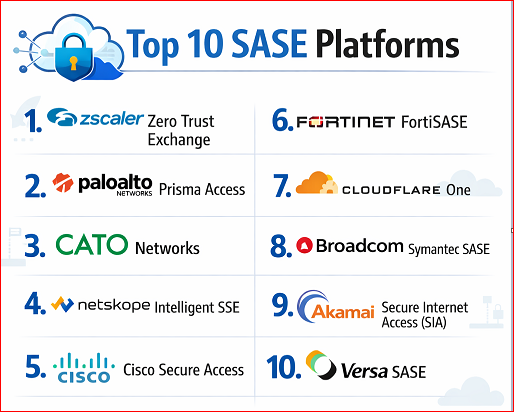
Top 10 SASE Platforms
1 — Zscaler Zero Trust Exchange
Zscaler is widely recognized as the pioneer of the cloud-native security market, offering a massive, purpose-built global exchange that eliminates the need for security appliances.
- Key Features:
- Zscaler Internet Access (ZIA): A full secure web gateway for internet and SaaS traffic.
- Zscaler Private Access (ZPA): Industry-leading ZTNA for securing private internal apps.
- Cloud-Gen Firewall: Provides Layer 7 visibility and control across all ports.
- Direct-to-Cloud Architecture: Uses over 150 global PoPs to ensure low-latency connections.
- AI-Powered Sandbox: Automatically detects and blocks zero-day malware.
- Unified DLP: Consistent data protection across all channels from a single engine.
- Pros:
- Unmatched scalability for global enterprises with hundreds of thousands of users.
- Highly mature zero-trust capabilities that effectively hide applications from the public internet.
- Cons:
- One of the most expensive solutions on the market.
- Complex configuration requires specialized expertise or professional services.
- Security & Compliance: FedRAMP High, SOC 2 Type II, ISO 27001, HIPAA, GDPR, and PCI-DSS.
- Support & Community: 24/7 global enterprise support, an extensive “Zscaler Zenith” community, and a robust certification program.
2 — Palo Alto Networks Prisma Access
Prisma Access is the industry’s most complete SASE solution, delivering the same high-end security as Palo Alto’s physical firewalls but in a fully managed, cloud-native format.
- Key Features:
- ZTNA 2.0: Provides continuous trust verification and deep content inspection.
- Autonomous DEM: Monitors end-user digital experience to troubleshoot network issues.
- Integrated SD-WAN: Seamlessly connects branch offices with Prisma SD-WAN hardware.
- WildFire Integration: Global cloud-based threat intelligence and sandboxing.
- SaaS Security: Advanced CASB capabilities to secure unsanctioned “Shadow IT” apps.
- Consistent Policy: Use the same rules for mobile users, branches, and headquarters.
- Pros:
- Best-in-class security depth; it doesn’t compromise on features for the sake of the cloud.
- Unified management via Panorama makes it ideal for existing Palo Alto customers.
- Cons:
- Management can be disjointed if you aren’t already using their ecosystem.
- High resource requirements for the global backbone can lead to premium pricing.
- Security & Compliance: FedRAMP Moderate/High, SOC 2, ISO 27001, GDPR, and HIPAA.
- Support & Community: Elite technical support, a massive community of certified engineers (PCNSE), and exhaustive documentation.
3 — Cato Networks
Cato Networks is the world’s first “True SASE” platform, built from the ground up to converge SD-WAN and a global private backbone with a full security stack.
- Key Features:
- Global Private Backbone: Over 80 PoPs connected via multiple tier-1 providers.
- Cato Socket: Zero-touch deployment hardware for branch offices.
- Converged Management: A single “pane of glass” for both networking and security.
- Cato Client: A lightweight agent for remote users providing ZTNA and SWG.
- Built-in MFA: Native multi-factor authentication for secure access.
- Cloud-Native Architecture: All inspection engines run in parallel in the Cato Cloud.
- Pros:
- Simplest deployment in the SASE category; can be up and running in days.
- Exceptional performance for global traffic compared to the public internet.
- Cons:
- Less granular “deep-dive” security settings compared to Palo Alto or Zscaler.
- Smaller market presence means fewer third-party professional service experts.
- Security & Compliance: SOC 2 Type II, ISO 27001, GDPR, HIPAA, and PCI-DSS.
- Support & Community: Highly responsive 24/7 support and a direct-to-engineer support model.
4 — Netskope Intelligent SSE
Netskope is a “data-centric” SASE provider that excels in understanding the context of data movement within cloud applications.
- Key Features:
- NewEdge Network: A massive private cloud infrastructure designed for high-capacity security.
- Cloud Confidence Index: Evaluates the risk of over 30,000 SaaS applications.
- Advanced DLP: Industry-leading data loss prevention with exact data matching (EDM).
- Remote Browser Isolation (RBI): Streams a secure version of risky websites to the user.
- Zero Trust Engine: Dynamically grants access based on user risk and device posture.
- Next-Gen SWG: Inspects all web traffic, including personal SaaS instances.
- Pros:
- The best visibility into “Shadow IT” and granular data usage within apps like Slack or Box.
- Strong performance with minimal latency through their private NewEdge PoPs.
- Cons:
- Historically lacked a native SD-WAN (though they have recently added partnerships).
- Can be complex to configure the many “contextual” data rules.
- Security & Compliance: SOC 2 Type II, ISO 27001, HIPAA, GDPR, and FedRAMP authorized.
- Support & Community: Strong professional services and an active online user forum.
5 — Cisco Secure Access
Cisco has converged its Umbrella (security) and Viptela/Meraki (networking) heritage into a unified SASE offering called Cisco Secure Access.
- Key Features:
- Duo Integration: Industry-leading identity and MFA baked into the access flow.
- Flexible SD-WAN: Supports both complex Viptela and simplified Meraki deployments.
- Talos Threat Intelligence: Backed by one of the largest private threat labs in the world.
- DNS-Layer Security: Blocks malicious requests before a connection is even made.
- Unified Agent: Uses the AnyConnect/Cisco Secure Client for all connectivity needs.
- Interactive Reporting: Granular visibility into web, cloud, and private app usage.
- Pros:
- Unmatched global scale and hardware reliability.
- Perfect for organizations that are already “Cisco Shops” and want a single vendor.
- Cons:
- Merging disparate product lines (Umbrella, Duo, Viptela) has led to some UI inconsistencies.
- Licensing can be notoriously complicated and difficult to navigate.
- Security & Compliance: FedRAMP, SOC 2, ISO 27001, HIPAA, and GDPR.
- Support & Community: Global TAC (Technical Assistance Center) and a massive worldwide community of experts.
6 — Fortinet FortiSASE
Fortinet delivers SASE by extending its “Security Fabric” to the cloud, using the same FortiOS that powers their world-famous FortiGate firewalls.
- Key Features:
- Unified Agent: FortiClient provides ZTNA, VPN, and Endpoint Protection (EPP).
- AI-Powered FortiGuard: Real-time threat intelligence updates across the platform.
- Universal ZTNA: Provides consistent access policies whether the user is on-net or off-net.
- Thin-Edge Integration: Seamlessly connects with FortiAP and FortiSwitch hardware.
- Secure SD-WAN: Built-in industry-leading SD-WAN for branch connectivity.
- Global Scalability: Uses a growing network of Fortinet-managed PoPs.
- Pros:
- The most cost-effective solution for organizations already using FortiGate hardware.
- Excellent performance-to-price ratio.
- Cons:
- Cloud PoP density is still catching up to Zscaler and Cloudflare.
- The management interface is powerful but has a “technical” feel that may be daunting for some.
- Security & Compliance: SOC 2, ISO 27001, GDPR, HIPAA, and PCI-DSS.
- Support & Community: Vast partner network and a highly detailed technical documentation portal.
7 — Cloudflare One
Cloudflare One is a SASE platform built on the same network that protects a significant portion of the entire internet, emphasizing speed and ease of use.
- Key Features:
- 1.1.1.1 Resolver: The world’s fastest DNS filtering for security and performance.
- WARP Client: A lightweight, high-performance agent for all user devices.
- Magic WAN: Replaces legacy MPLS with Cloudflare’s global Anycast network.
- Browser Isolation: High-speed RBI that doesn’t “break” modern websites.
- Zero Trust Access: Simple, identity-based access for all internal applications.
- Email Security Integration: Integrated protection against phishing and BEC attacks.
- Pros:
- Likely the fastest user experience due to their unparalleled edge network.
- Very easy to deploy and features a generous free tier for small teams.
- Cons:
- Deep enterprise DLP and CASB features are newer and less mature than Netskope.
- Targeted more at “cloud-first” teams than those with heavy on-premise hardware.
- Security & Compliance: SOC 2 Type II, ISO 27001, GDPR, HIPAA, and PCI-DSS.
- Support & Community: Massive community support and extensive self-service documentation.
8 — Broadcom Symantec SASE
Symantec SASE (formerly Blue Coat) combines a legacy of high-end proxy security with modern cloud-delivered management for global enterprises.
- Key Features:
- Web Isolation: Pioneer in isolation technology to block browser-based threats.
- Deep Content Inspection: Advanced scanning for encrypted web traffic.
- CloudSOC CASB: High-end visibility and control for SaaS applications.
- Mirror Gateway: Provides agentless security for unmanaged devices.
- Hybrid Support: Exceptional for organizations transitioning from on-prem to cloud.
- Global Intelligence Network: Analyzes billions of requests daily.
- Pros:
- Ideal for highly regulated industries (Finance/Gov) with complex proxy requirements.
- Strongest “hybrid” capabilities for those not ready to go 100% cloud.
- Cons:
- Administrative interface can feel dated and clunky.
- Broadcom’s support model is heavily focused on its largest “top-tier” customers.
- Security & Compliance: SOC 2, ISO 27001, GDPR, HIPAA, and FIPS 140-2.
- Support & Community: Extensive enterprise-grade support for large-scale deployments.
9 — Akamai Secure Internet Access (SIA)
Akamai leverages its position as the world’s largest edge network to provide a SASE platform that prioritizes resilience and malicious site blocking.
- Key Features:
- Massive Threat Intelligence: Visibility into up to 30% of all global web traffic.
- Zero-Configuration Protection: Instant blocking of known phishing and malware.
- Edge-Based ZTNA: Secure application access delivered via Akamai’s global PoPs.
- In-Line Payload Analysis: Real-time scanning for malicious files.
- Identity Integration: Works with any IdP (Okta, Azure AD, etc.).
- Pros:
- Unrivaled global resilience; the network is virtually un-stoppable.
- Very effective at blocking “the first attempt” of a phishing attack.
- Cons:
- Lacks the unified SD-WAN capabilities found in Cato or Palo Alto.
- Reporting is less granular compared to dedicated security specialists.
- Security & Compliance: SOC 2, ISO 27001, GDPR, HIPAA, and PCI-DSS.
- Support & Community: Top-tier 24/7 global support and world-class professional services.
10 — Versa SASE
Versa is a leader in the SD-WAN space that has successfully integrated a full security stack into its “Versa Operating System” (VOS).
- Key Features:
- Single-Stack Architecture: Networking and security run in a single software process.
- Multi-Tenancy: Excellent for large conglomerates or Service Providers.
- Versa Concerto: Advanced orchestration for complex network topologies.
- Integrated FWaaS: Full enterprise firewall capabilities in the cloud.
- Granular Analytics: Deep visibility into network performance and security events.
- Pros:
- The most powerful SD-WAN and routing features of any SASE provider.
- Highly flexible deployment options (cloud, on-prem, or hybrid).
- Cons:
- Very steep learning curve due to the complexity of the platform.
- Can be “overkill” for organizations that only need basic remote access.
- Security & Compliance: SOC 2, ISO 27001, GDPR, and HIPAA.
- Support & Community: Strong professional services and highly technical documentation.
Comparison Table
| Tool Name | Best For | Platform(s) Supported | Standout Feature | Rating (Gartner) |
| Zscaler | Large Enterprise | All (Win, Mac, Mobile) | Zero Trust Exchange | 4.7 / 5 |
| Palo Alto | Security Depth | All (Cloud / Hybrid) | ZTNA 2.0 + WildFire | 4.6 / 5 |
| Cato Networks | Simplicity / Speed | All (Win, Mac, Linux) | Global Private Backbone | 4.5 / 5 |
| Netskope | Data/SaaS Security | All (Win, Mac, Mobile) | Cloud Confidence Index | 4.6 / 5 |
| Cisco | Cisco Ecosystem | All (Meraki/Viptela) | Duo Identity + Talos | 4.4 / 5 |
| Fortinet | Best Value / SMB | All (Win, Mac, Mobile) | FortiGuard AI Sync | 4.6 / 5 |
| Cloudflare | Latency / Startups | All (Win, Mac, Linux) | Anycast Edge Network | 4.7 / 5 |
| Broadcom Sym | Hybrid / Proxies | All (Win, Mac, Mobile) | Mirror Gateway Tech | 4.3 / 5 |
| Akamai | High Resilience | All (Agentless/Agent) | Edge-Scale Intel | 4.5 / 5 |
| Versa | Advanced Routing | All (Hybrid/Cloud) | Single-Stack Software | 4.4 / 5 |
Evaluation & Scoring of SASE Platforms
To help you decide, we have evaluated these platforms against a weighted rubric representing the priorities of a modern IT organization.
| Category | Weight | Evaluation Rationale |
| Core Features | 25% | Convergence of SD-WAN, SWG, CASB, and ZTNA. |
| Ease of Use | 15% | Single management console and simplified policy creation. |
| Integrations | 15% | Compatibility with IdPs (Okta/Azure), SIEMs, and existing hardware. |
| Security & Compliance | 10% | Regulatory certifications (FedRAMP/HIPAA) and encryption depth. |
| Performance | 10% | Global PoP density and impact on user latency. |
| Support & Community | 10% | Quality of 24/7 technical help and documentation. |
| Price / Value | 15% | ROI for the specific target business size. |
Which SASE Platform Is Right for You?
Solo Users vs SMB vs Mid-Market vs Enterprise
- Small Business / Solo: Look at Cloudflare One (Free/Pro tiers) or NordLayer (not on the top 10 but excellent for SMB). These offer “SASE-Lite” features without the enterprise overhead.
- Mid-Market: Cato Networks or Fortinet are the winners here. They offer high performance and ease of management without requiring a team of 10 security engineers.
- Enterprise: Zscaler, Palo Alto, and Netskope are the standard-bearers for complex, global requirements where data protection is the primary driver.
Budget-Conscious vs Premium Solutions
If budget is your main constraint, Fortinet and Cloudflare typically offer the most transparent and competitive pricing models. If you are a “money is no object” organization that handles highly sensitive IP, the premium suites from Zscaler and Netskope are worth every penny for the risk reduction they provide.
Feature Depth vs Ease of Use
- Depth: Versa and Palo Alto offer the most “knobs” to turn. They are built for power users.
- Ease of Use: Cato Networks and Cloudflare are designed for the modern admin who wants to set a policy and forget about it.
Integration and Scalability Needs
If you already have a global Cisco or Fortinet footprint, the path of least resistance—and best integration—is to stay within those ecosystems. However, if you are looking to “break free” from legacy hardware, a cloud-native provider like Zscaler or Cato scales more gracefully as you add remote workers.
Frequently Asked Questions (FAQs)
Q1: What is the difference between SASE and SSE?
Answer: SSE (Security Service Edge) is the “security half” of SASE. It includes SWG, CASB, and ZTNA. SASE is the full package that adds SD-WAN (the “networking half”) to the mix.
Q2: Can SASE replace my VPN?
Answer: Yes. SASE uses ZTNA (Zero Trust Network Access) to provide a more secure, faster, and more granular way for users to access internal apps compared to a traditional “all-or-nothing” VPN.
Q3: Will SASE slow down my employees’ internet?
Answer: Generally, no. Modern SASE providers like Cloudflare and Cato use private backbones that are often faster than the public internet. However, poorly configured SSL inspection can cause slight lag.
Q4: How long does a SASE implementation take?
Answer: A “Cloud-Only” ZTNA setup can take days. A full enterprise-wide SASE migration including SD-WAN hardware for 50 branches typically takes 6 to 12 months.
Q5: Is SASE only for remote workers?
Answer: No. SASE is designed to provide identical security and performance for everyone—whether they are sitting in a headquarters office, a coffee shop, or a branch office.
Q6: What is “Shadow IT” discovery?
Answer: It is a feature (usually part of CASB) that identifies all the unauthorized cloud apps your employees are using (like personal Dropbox or ChatGPT) so you can secure the data going into them.
Q7: Do I still need an antivirus with SASE?
Answer: Yes. SASE protects your network traffic, but you still need endpoint security (EDR/AV) to protect the actual device from threats like infected USB drives or local file execution.
Q8: Can SASE handle legacy on-premise applications?
Answer: Yes. SASE providers use “Connectors” (small virtual machines) that sit in your data center and create a secure outbound tunnel to the SASE cloud to publish those legacy apps safely.
Q9: What is the biggest challenge in moving to SASE?
Answer: Organizational silos. Typically, “Networking Teams” and “Security Teams” are separate. SASE forces them to work together on a single platform, which can cause internal friction.
Q10: Is SASE more expensive than buying separate tools?
Answer: Usually, the “sticker price” is higher, but the “Total Cost of Ownership” (TCO) is lower because you spend less on hardware, power, cooling, and man-hours spent managing multiple consoles.
Conclusion
The shift to SASE Platforms is a fundamental transformation of how businesses connect and protect themselves. By merging networking and security into a single cloud-delivered service, you eliminate the complexity of the “patchwork” security stack and provide your employees with a safer, faster way to work.
When choosing your platform, remember that the “best” tool depends on where you are in your cloud journey. If you are 100% cloud-native, a solution like Cloudflare or Zscaler makes sense. If you still have a massive physical office footprint, the hardware-integrated solutions from Fortinet or Palo Alto will be your best bet. Start with a pilot of your most critical remote access needs and expand from there.

- Top 10 Email Deliverability Tools: Features, Pros, Cons & Comparison - September 6, 2026
- Top 10 Pharmacovigilance Software: Features, Pros, Cons & Comparison - September 6, 2026
- Top 10 Manufacturing Execution Systems (MES) - July 30, 2026