Introduction
A Smart City IoT Platform is the central digital brain of a modern city. It is a specialized software environment that connects thousands of physical sensors and devices—like streetlights, water meters, and traffic cameras—into a single, unified system. These platforms collect massive amounts of data from across the urban landscape, analyze it in real-time, and allow city officials to make informed decisions that improve the lives of residents.
The importance of these platforms cannot be overstated. As urban populations grow, cities face increasing pressure on resources. These tools help municipalities manage that pressure by optimizing everything from energy use to emergency response times. By breaking down “data silos,” where different departments don’t talk to each other, a smart city platform creates a holistic view of the city’s health.
Key Real-World Use Cases:
- Smart Traffic Management: Adjusting traffic light patterns based on real-time vehicle flow to reduce congestion and emissions.
- Waste Management: Using sensors in trash bins to notify collection trucks only when bins are full, saving fuel and labor.
- Environmental Monitoring: Tracking air quality and noise levels across various neighborhoods to identify and address pollution hotspots.
- Public Safety: Integrating smart lighting that brightens when it detects movement or acoustic sensors that identify the sound of a gunshot to alert police.
When choosing a platform, users should evaluate it based on connectivity options (support for 5G, LoRaWAN, etc.), scalability (the ability to add millions of devices), interoperability (working with different hardware brands), and advanced analytics (the ability to turn raw data into actionable insights).
Best for: These platforms are essential for municipal governments, urban planning departments, and public utility companies. They are designed for mid-sized to mega-cities that need to manage complex infrastructure across large geographical areas.
Not ideal for: They are generally too robust and expensive for single-building management or small private residential complexes. If you only need to manage a few smart devices in one office, a basic Building Management System (BMS) or a simple smart home hub is a much better alternative.
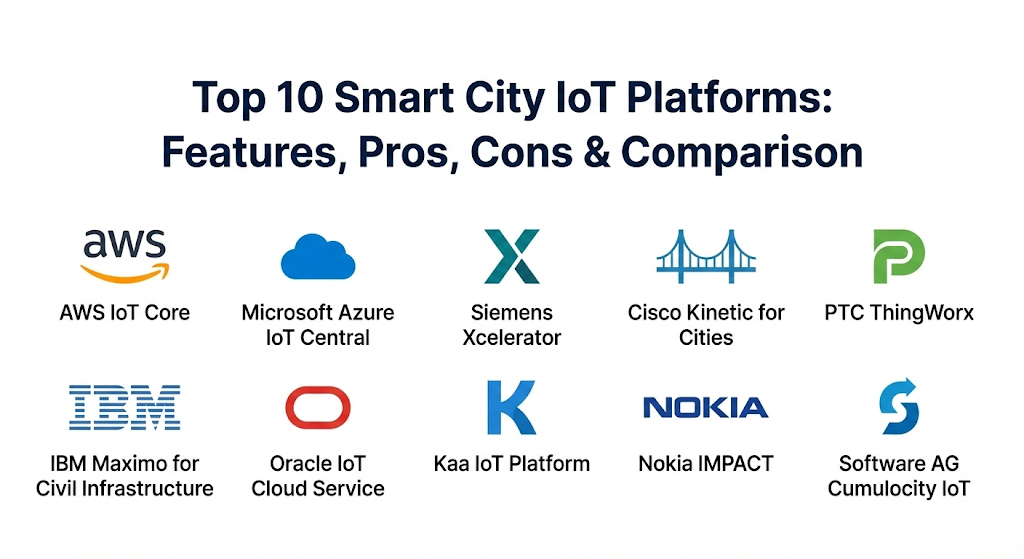
Top 10 Smart City IoT Platforms
1 — AWS IoT Core
AWS IoT Core is a massive, cloud-based platform provided by Amazon that allows cities to connect billions of devices and trillions of messages. It is designed for cities that want to build their own custom applications on top of a powerful, reliable infrastructure.
- Key Features:
- Support for multiple communication protocols like MQTT, HTTP, and LoRaWAN.
- “Device Shadow” feature that stores the last state of a device even when it is offline.
- Rules Engine that triggers actions based on data (e.g., turn on a pump if water levels rise).
- Deep integration with Amazon’s machine learning tools for predictive maintenance.
- Secure “Just-in-Time” registration for thousands of sensors at once.
- Edge computing capabilities through AWS IoT Greengrass.
- Highly customizable dashboards for different city departments.
- Pros:
- Virtually unlimited scalability; the platform grows as your city grows.
- The largest ecosystem of developer tools and third-party integrations.
- Cons:
- Requires highly skilled developers to set up and manage.
- Costs can become unpredictable if data usage is not closely monitored.
- Security & Compliance: Provides end-to-end encryption, fine-grained access control, and is compliant with SOC 2, GDPR, HIPAA, and ISO 27001.
- Support & Community: Extensive technical documentation, a global community of developers, and specialized enterprise support plans.
2 — Microsoft Azure IoT Central
Microsoft Azure IoT Central is a “managed” platform, meaning it provides much of the structure out of the box. It is perfect for cities that want to get started quickly without building every single piece of software from scratch.
- Key Features:
- Ready-made app templates specifically for smart city use cases.
- Drag-and-drop interface for creating operator dashboards.
- Seamless connection to Microsoft Power BI for high-level data visualization.
- Native “Plug and Play” support for certified hardware.
- Built-in device management and health monitoring.
- Simplified data export to other Microsoft cloud services.
- Strong support for digital twins to simulate city scenarios.
- Pros:
- Significantly reduces the time it takes to launch a smart city project.
- Easier for non-developers to understand and navigate.
- Cons:
- Less flexibility for highly unique or “outside the box” technical requirements.
- Pricing is based on a per-device model which can get expensive for massive deployments.
- Security & Compliance: Top-tier security with SSO, Microsoft Entra integration, and compliance with GDPR, SOC 1/2/3, and ISO.
- Support & Community: Comprehensive Microsoft Learn resources, large partner network, and dedicated government-grade support.
3 — Siemens Xcelerator (MindSphere)
Siemens offers a platform that focuses heavily on industrial-grade reliability. It is particularly strong in managing “hard” infrastructure like power grids, water systems, and rail networks.
- Key Features:
- Strong focus on “Digital Twins” of physical city infrastructure.
- Open API for connecting legacy industrial hardware.
- Advanced industrial analytics for predicting when a bridge or pipe might fail.
- Native integration with Siemens’ massive range of hardware sensors.
- Cloud, on-premise, or hybrid deployment options.
- Secure industrial gateways for connecting old city equipment to the internet.
- Pros:
- Unmatched expertise in physical engineering and industrial systems.
- Excellent for critical infrastructure where downtime is not an option.
- Cons:
- The user interface can feel complex and technical.
- Can be difficult to integrate with “consumer-grade” IoT devices.
- Security & Compliance: Industrial-strength security, ISO 27001 compliant, and follows strict GDPR data privacy rules.
- Support & Community: High-level engineering support, professional training certifications, and global industrial user groups.
4 — Cisco Kinetic for Cities
Cisco Kinetic is designed around the idea of “data in motion.” It is a powerhouse for cities that need to move and analyze huge amounts of data across different networks, especially for traffic and safety.
- Key Features:
- Fog computing that processes data at the “edge” (e.g., inside a traffic light).
- Strong focus on urban mobility and parking management.
- Unified dashboard that combines lighting, parking, and safety data.
- Advanced network security to prevent hackers from controlling city lights.
- Automation of data sharing between different city agencies.
- High-performance video analytics for traffic flow monitoring.
- Pros:
- Superior networking technology ensures data gets where it needs to go fast.
- Proven track record in major global city deployments.
- Cons:
- Very hardware-dependent; often works best if you use Cisco networking gear.
- High initial setup cost compared to pure cloud platforms.
- Security & Compliance: Built on Cisco’s world-class security architecture, including audit logs and encryption.
- Support & Community: Robust global partner ecosystem and extensive technical support centers.
5 — PTC ThingWorx
ThingWorx is an award-winning platform that excels at creating high-end visual applications and using Augmented Reality (AR) for city maintenance workers.
- Key Features:
- Powerful “Composer” tool for building custom city apps without coding.
- Industry-leading AR integration for field technicians.
- Anomaly detection that automatically flags unusual city data.
- Pre-built connectors for a wide range of industrial sensors.
- Scalable architecture that supports “System of Systems” management.
- Strong data modeling capabilities to define city assets clearly.
- Pros:
- The best choice for cities that want to use AR for infrastructure repair.
- Very fast application development for specific city projects.
- Cons:
- The platform has a steep learning curve for administrators.
- Can be expensive for smaller municipalities.
- Security & Compliance: Enterprise-grade security with SSO and role-based access; GDPR and SOC 2 ready.
- Support & Community: Excellent training through PTC University and a highly active expert community.
6 — IBM Maximo for Civil Infrastructure
IBM’s platform is built specifically for managing the “bones” of a city—bridges, tunnels, and roads. It combines IoT data with traditional asset management to keep a city’s foundation strong.
- Key Features:
- AI-driven insights for structural health monitoring.
- Integrated work order management for maintenance crews.
- Visual inspection tools using drones and AI to find cracks in concrete.
- Weather data integration to predict the impact of storms on city assets.
- Strong focus on regulatory compliance and safety reporting.
- Lifecycle tracking for every piece of city equipment.
- Pros:
- The gold standard for long-term maintenance of civil engineering projects.
- Powerful AI (Watson) helps find problems before humans can see them.
- Cons:
- Not as focused on “consumer” services like public Wi-Fi or citizen apps.
- Requires a significant investment in both software and specialized staff.
- Security & Compliance: Meets the highest government standards for security, including HIPAA and ISO.
- Support & Community: Vast enterprise support network and deep industry-specific expertise.
7 — Oracle IoT Cloud Service
Oracle provides a platform that is perfect for cities that already use Oracle databases for their accounting, HR, or citizen records. It makes moving data from the “street” to the “office” very easy.
- Key Features:
- Built-in integration with Oracle Enterprise Resource Planning (ERP).
- “Digital Thread” that tracks data from a sensor all the way to a financial report.
- Real-time asset tracking for city-owned vehicles and tools.
- Predictive maintenance modules for city fleets.
- Enterprise-grade data security and privacy.
- Strong support for blockchain to ensure data integrity.
- Pros:
- The best choice for connecting city operations to financial and HR data.
- Extremely secure and stable for massive data sets.
- Cons:
- Can feel rigid compared to more modern, “startup-style” platforms.
- Best suited for users already within the Oracle software ecosystem.
- Security & Compliance: Includes advanced audit logs, SSO, and encryption. Fully SOC and GDPR compliant.
- Support & Community: Global professional services and comprehensive online support portals.
8 — Kaa IoT Platform
Kaa is an open-source-based platform that offers incredible flexibility. It is often the choice for cities that want to avoid being “locked in” to one specific big-name software company.
- Key Features:
- Highly modular architecture—only use the parts you need.
- Can be deployed on any cloud or even on a city’s own servers.
- Support for virtually any hardware or communication protocol.
- Clean and modern user interface for managing devices.
- Powerful data collection and visualization widgets.
- Easy integration with existing city software via APIs.
- Pros:
- Excellent cost-to-performance ratio.
- Gives the city complete control over their own data and software.
- Cons:
- Requires an internal IT team that is comfortable with open-source tech.
- Does not come with as many “pre-built” smart city apps as competitors.
- Security & Compliance: Varies / N/A (Highly configurable by the city; supports encryption and SSO).
- Support & Community: Good documentation and professional support packages are available.
9 — Nokia IMPACT
Nokia IMPACT focuses on the “connectivity” layer of the smart city. It is designed for cities that are investing heavily in 5G and need a platform that can handle the massive speed and device density of next-generation networks.
- Key Features:
- Optimized for 5G and Narrowband IoT (NB-IoT) networks.
- Extremely efficient device management for millions of sensors.
- Strong focus on public safety and emergency communication.
- Integrated video and data analytics for crowd management.
- “White-label” options for cities to offer services to local businesses.
- Highly secure, carrier-grade platform architecture.
- Pros:
- The absolute best for high-speed, 5G-enabled smart city projects.
- Can handle more simultaneous device connections than almost anyone else.
- Cons:
- Focused more on the network side than on the “app” or “analytics” side.
- Can be complex for cities not using Nokia’s telecommunications gear.
- Security & Compliance: Carrier-grade security, audit logs, and encryption; ISO and GDPR compliant.
- Support & Community: World-class telecommunications support and global training programs.
10 — Software AG Cumulocity IoT
Cumulocity is known for its “independent” approach. It is designed to be very easy to use and to connect with any hardware, any cloud, and any existing city software without hassle.
- Key Features:
- “Self-service” IoT that allows city staff to build dashboards quickly.
- Cloud-agnostic—can run on AWS, Azure, or private servers.
- Native support for over 100 different IoT protocols.
- Excellent “thin-edge” computing for simple devices.
- Automated device onboarding and lifecycle management.
- Clean, intuitive interface for day-to-day city operators.
- Pros:
- One of the easiest platforms to learn and use.
- Prevents “vendor lock-in” by working with everything.
- Cons:
- Lacks some of the “deep” industrial engineering features of Siemens or IBM.
- The community of users is smaller than the tech giants (Amazon/Microsoft).
- Security & Compliance: Provides SSO, encryption, and audit logs. It is SOC 2 and GDPR compliant.
- Support & Community: High-quality documentation and a very helpful customer success team.
Comparison Table
| Tool Name | Best For | Platform(s) Supported | Standout Feature | Rating |
| AWS IoT Core | Custom Dev Projects | Cloud | Rules Engine & ML | 4.8/5 |
| Azure IoT Central | Rapid Deployment | Cloud | Managed App Templates | 4.7/5 |
| Siemens Xcelerator | Heavy Infrastructure | Hybrid / On-prem | Industrial Digital Twins | 4.5/5 |
| Cisco Kinetic | Traffic & Mobility | Edge / Cloud | Fog Computing | 4.6/5 |
| PTC ThingWorx | Maintenance & AR | Cloud / On-prem | Augmented Reality | 4.4/5 |
| IBM Maximo | Bridges & Civil Eng. | Cloud / Hybrid | AI Structural Health | 4.3/5 |
| Oracle IoT Cloud | Finance & Operations | Cloud | ERP Integration | 4.2/5 |
| Kaa IoT Platform | Flexibility & Control | Any | Modular Open-source | 4.5/5 |
| Nokia IMPACT | 5G-centric Cities | Carrier-grade | 5G Network Optimization | 4.4/5 |
| Cumulocity IoT | Ease of Use | Any | Vendor Independence | 4.6/5 |
Evaluation & Scoring of Smart City IoT Platforms
To help you decide, we have evaluated these platforms across several key categories using a weighted scoring system.
| Category | Weight | Why it Matters |
| Core Features | 25% | Capacity to manage devices, collect data, and run automation. |
| Ease of Use | 15% | How quickly your city staff can learn to use the system. |
| Integrations | 15% | The ability to talk to existing software like billing or HR. |
| Security & Compliance | 10% | Protecting the city from hackers and following privacy laws. |
| Performance | 10% | The speed of data processing and system uptime. |
| Support & Community | 10% | Access to help and experts when something goes wrong. |
| Price / Value | 15% | Getting the most features for every dollar of taxpayer money. |
Which Smart City IoT Platform Is Right for You?
Selecting the right platform depends on your city’s specific goals, budget, and existing technical skills.
Small Towns vs. Mid-Market vs. Mega-Cities
For a smaller town with a limited IT budget, Cumulocity IoT or Azure IoT Central are excellent choices because they are easier to set up and manage without a huge team. Mid-market cities looking for flexibility often choose Kaa IoT to keep costs down while maintaining control. Mega-cities with massive complexity and high security needs usually turn to AWS IoT Core or Nokia IMPACT for their sheer power and scalability.
Budget-Conscious vs. Premium Solutions
If you are on a tight budget, look at open-source-based solutions like Kaa or pay-as-you-go models like AWS. Be careful with the pay-as-you-go models, as they can scale quickly. For cities with a dedicated budget for critical infrastructure, IBM Maximo or Siemens are premium solutions that provide specialized engineering value that justifies their higher price.
Feature Depth vs. Ease of Use
If your primary goal is to empower non-technical city employees to create their own dashboards, Microsoft Azure IoT Central is the winner. However, if you need deep, technical features like “fog computing” inside traffic lights, you will need the depth of Cisco Kinetic, even if it is harder to learn.
Integration and Scalability Needs
Cities that already run their entire office on Microsoft or Oracle should strongly consider staying within those ecosystems (Azure or Oracle IoT) for seamless integration. If you are building a city from scratch and want the most modern, scalable system possible, AWS IoT Core is generally considered the most flexible and scalable option on the market today.
Security and Compliance Requirements
If your smart city project involves sensitive public safety data or financial transactions, security is your number one priority. Siemens, Cisco, and Nokia provide “carrier-grade” or “industrial-grade” security that is often more robust than pure software platforms. Always ensure your chosen platform is compliant with local data residency laws (like GDPR).
Frequently Asked Questions (FAQs)
1. What exactly is a “Digital Twin” in a smart city?
A Digital Twin is a virtual map or model of a physical object, like a bridge or a water system. It uses real-time data from the IoT platform to show exactly what is happening in the real world, allowing you to run “what-if” simulations without touching the actual equipment.
2. Do these platforms work with any sensor hardware?
Most platforms aim to be “hardware agnostic,” meaning they can work with many brands. However, some (like Cisco or Siemens) have a “preferred” hardware list that makes the initial connection much easier.
3. How do these platforms handle privacy for citizens?
Top-tier platforms use “data anonymization,” which removes personal details from the data. For example, a traffic camera might count the number of cars but will not record or save license plate numbers unless specifically authorized.
4. Can a city start small and grow later?
Yes. Most of these platforms allow you to start with a “pilot project” (like 50 smart streetlights) and then scale up to the entire city once you see the results.
5. Is 5G necessary for a smart city IoT platform?
No, but it helps. Many devices work fine on older 4G networks or low-power networks like LoRaWAN. 5G is only necessary for “high-bandwidth” tasks like real-time 4K video surveillance or self-driving car communication.
6. What happens if the internet goes out?
This is where “Edge Computing” comes in. Platforms like Cisco Kinetic or AWS Greengrass allow devices to keep working and making basic decisions (like changing a traffic light) even if they lose their connection to the main cloud.
7. How do these platforms help with sustainability?
They help by identifying waste. For example, smart water meters can detect a leak in a pipe immediately, preventing thousands of gallons of water from being wasted before a human ever sees the problem.
8. Do I need a team of programmers to run this?
It depends on the platform. AWS and Kaa require significant programming. Azure IoT Central and Cumulocity are designed so that regular city employees can handle most of the day-to-day work after a short training period.
9. Can multiple city departments use the same platform?
Yes, and they should! The biggest benefit of an IoT platform is that the police, the fire department, and the public works team can all see the same data, leading to much better coordination during emergencies.
10. What is the typical lifespan of a smart city platform?
A city should look for a platform that will be supported for at least 10 to 15 years. This is why many cities choose “big name” providers like Amazon, Microsoft, or Siemens to ensure the software won’t disappear next year.
Conclusion
Building a smart city is a long-term commitment to a more efficient and livable future. The IoT platform you choose today will be the foundation for how your city functions for years to come.
When making your choice, remember that the “best” tool is the one that fits your city’s current technical ability and future growth plans. If you are looking for rapid results and ease of use, Microsoft Azure IoT Central is a fantastic place to start. If you are tackling massive engineering challenges with bridges and power grids, Siemens or IBM Maximo are the leaders. For those who want the ultimate in speed and network power, Nokia IMPACT and Cisco Kinetic offer unmatched performance.
The most successful smart cities are those that start with a clear problem to solve—like traffic congestion or water waste—and choose a platform that makes solving that problem simple. By connecting your city’s physical assets to a digital brain, you are not just buying software; you are investing in a smarter, safer, and more sustainable home for your citizens.

- Top 10 Email Deliverability Tools: Features, Pros, Cons & Comparison - September 6, 2026
- Top 10 Pharmacovigilance Software: Features, Pros, Cons & Comparison - September 6, 2026
- Top 10 Manufacturing Execution Systems (MES) - July 30, 2026