Introduction
Wind farm monitoring software is the central “nervous system” of a modern renewable energy project. It is a specialized digital platform that connects to wind turbines, meteorological towers, and substations to collect real-time data on everything from wind speeds to the temperature of a gearbox. By gathering this information through Supervisory Control and Data Acquisition (SCADA) systems, the software allows operators to see exactly what is happening at a remote site without needing to be physically present. This is essential for maintaining safety, spotting mechanical issues before they lead to expensive failures, and ensuring that the turbines are producing as much clean electricity as possible.
The importance of these tools lies in their ability to turn massive amounts of raw data into actionable insights. In a real-world scenario, a monitoring tool can send an instant alert if a specific turbine starts vibrating unusually, allowing a maintenance crew to fix a small bearing issue rather than replacing an entire rotor. It is also used to manage grid compliance, ensuring that the power sent to the city is stable. When choosing a tool, users should evaluate the speed of data ingestion, the ease of creating custom reports, and how well the software integrates with different brands of turbines.
Best for: Wind farm owners, asset managers, operations and maintenance (O&M) teams, and renewable energy investors. It is particularly useful for organizations managing mixed portfolios with turbines from multiple different manufacturers.
Not ideal for: Small, single-turbine residential setups or community projects where a simple, free monitoring app provided by the manufacturer is usually enough. It may also be overkill for sites that do not require real-time grid integration or complex financial reporting.
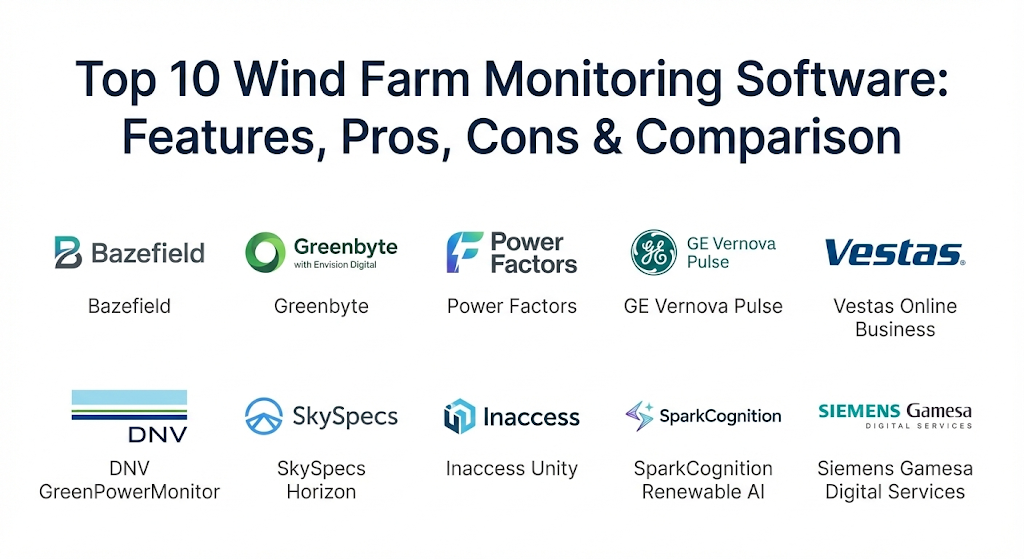
Top 10 Wind Farm Monitoring Software Tools
1 — Bazefield
Bazefield is a comprehensive, vendor-agnostic monitoring system designed to manage large-scale renewable energy portfolios. It is built to handle multiple types of clean energy assets, making it a favorite for teams managing wind, solar, and battery storage in one place.
- Key features:
- Real-time monitoring of power production and turbine status.
- Advanced “loss accounting” to see exactly why production is down.
- Automated task management for maintenance teams.
- Customizable dashboards for different roles (engineers vs. investors).
- Integrated wind speed and weather forecasting data.
- Tools for managing grid curtailment and availability reports.
- Pros:
- Excellent at handling data from many different turbine brands at once.
- The system is highly scalable, working just as well for ten turbines as for ten thousand.
- Cons:
- The interface is deep and powerful, which means it takes a long time to learn.
- Initial setup and data mapping can be a long, technical process.
- Security & compliance: SSO, ISO 27001, encryption, and full audit logs.
- Support & community: High-quality documentation, professional onboarding, and dedicated enterprise support teams.
2 — Greenbyte (Envision Digital)
Greenbyte, now part of Envision Digital, is one of the most user-friendly platforms for wind farm monitoring. It focuses on providing a clean, visual overview of a portfolio’s health, making it a top choice for asset managers who need quick answers.
- Key features:
- Visual map interface showing all global wind farm locations.
- Predictive maintenance alerts using machine learning.
- Automated reporting for investors and stakeholders.
- Mobile app for checking turbine status on the go.
- “Budget vs. Actual” financial performance tracking.
- Open API for connecting to other business software.
- Pros:
- The user interface is arguably the best in the industry—very modern and clean.
- It makes complex financial reporting surprisingly easy for non-engineers.
- Cons:
- While great for managers, it may lack some “deep-dive” technical tools for site engineers.
- Can be more expensive than basic OEM monitoring tools.
- Security & compliance: SOC 2, GDPR, SSO, and encrypted data storage.
- Support & community: Active user community, extensive video tutorials, and fast customer support.
3 — Power Factors
Power Factors is an asset performance management (APM) platform that is built specifically for the high-stakes world of industrial renewable energy. It focuses on maximizing the “bankable” data of a wind farm.
- Key features:
- High-resolution data capture for precise performance analysis.
- Event logs that help diagnose the root cause of turbine failures.
- Compliance tracking for energy market regulations.
- Collaboration tools for teams to work on the same incident.
- Asset health monitoring with specific vibration and heat metrics.
- Integration with financial planning and ERP systems.
- Pros:
- The data quality is top-tier, which is crucial for financial audits.
- Very strong technical support from people who understand the wind industry.
- Cons:
- The software can feel heavy and corporate to smaller operations.
- The learning curve for advanced analytics modules is steep.
- Security & compliance: SOC 2 Type II, ISO 27001, HIPAA (where applicable), and SSO.
- Support & community: Enterprise-level onboarding and 24/7 technical assistance.
4 — GE Vernova Pulse
GE Vernova Pulse (formerly part of GE Renewable Energy) is a digital solution built primarily to optimize wind farms using GE turbines, though it has expanded its capabilities for broader fleet management.
- Key features:
- Deep integration with GE turbine hardware for sub-second data.
- Advanced wake steering controls to maximize wind capture.
- Digital twin technology to simulate turbine wear and tear.
- Remote control capabilities to reset or stop turbines securely.
- Integrated blade health monitoring using drone and sensor data.
- Specialized tools for offshore wind environments.
- Pros:
- If you use GE turbines, the level of detail and control is unmatched.
- Outstanding at predicting gearbox and blade failures before they happen.
- Cons:
- Not as “open” as vendor-agnostic platforms when used with other brands.
- Can feel like you are locked into the GE ecosystem.
- Security & compliance: Varies (OEM-standard security, SSO, and encryption).
- Support & community: Extensive global support network and specialized training for technicians.
5 — Vestas Online Business
Vestas Online Business is the official monitoring and management platform for Vestas wind turbines. It provides the essential bridge between the physical turbine and the owner’s desktop.
- Key features:
- Real-time SCADA data for every Vestas turbine in your fleet.
- Direct access to technical turbine documentation.
- Service request management directly within the platform.
- Performance benchmarking against similar Vestas fleets.
- Tools for managing power plant controller settings.
- High-security remote access for stopping/starting turbines.
- Pros:
- It is the most reliable way to monitor Vestas hardware without data gaps.
- Very easy to use for existing Vestas service customers.
- Cons:
- Very limited features for monitoring turbines from competing brands.
- The interface is functional but lacks the “slick” feel of modern cloud platforms.
- Security & compliance: OEM internal security, encryption, and ISO standards.
- Support & community: Robust technical support and specialized Vestas user training.
6 — DNV GreenPowerMonitor
DNV’s GreenPowerMonitor is a highly technical platform designed for those who need to go deep into the data. It is often used by large engineering firms and developers who need to justify their production to banks.
- Key features:
- Extremely detailed technical reporting and data visualization.
- Grid integration tools that handle complex utility requirements.
- Portfolio-wide view that includes solar and hydro assets.
- Advanced alarm management to reduce “alarm fatigue” for operators.
- Asset lifecycle tracking from construction to decommissioning.
- High-frequency data logging for performance auditing.
- Pros:
- Backed by DNV’s massive technical expertise in the energy sector.
- The reporting tools are excellent for satisfying demanding investors.
- Cons:
- The software is very technical and may be intimidating for simple asset management.
- Setup can be slow due to the high level of technical detail required.
- Security & compliance: ISO 27001, SOC 2, GDPR, and SSO.
- Support & community: Professional technical consulting and global support availability.
7 — SkySpecs Horizon
SkySpecs Horizon takes a different approach by focusing heavily on the physical health of the turbine, particularly the blades, using drone data and digital twins.
- Key features:
- Integration of drone inspection photos into a digital turbine model.
- Automated blade damage detection using artificial intelligence.
- Timeline of repair history for every individual turbine blade.
- Predictive modeling to see how cracks might grow over time.
- Budgeting tools for long-term maintenance planning.
- Collaboration portal for sharing data with repair contractors.
- Pros:
- It is the best tool on the market for managing blade health specifically.
- The AI-driven damage analysis saves hundreds of hours of manual photo review.
- Cons:
- It is not a full-service SCADA tool; you will still need a separate monitor for electrical data.
- Can be a niche purchase if your primary concern is power production, not structural health.
- Security & compliance: SOC 2, SSO, and encrypted cloud storage.
- Support & community: Fast-moving startup-style support and good technical documentation.
8 — Inaccess Unity
Inaccess Unity is a platform that focuses on the integration of wind farms into the electricity grid. It is designed for large-scale power producers who need to act like a utility.
- Key features:
- High-speed grid controller integration.
- Real-time power plant control (active and reactive power).
- Integration with energy market pricing for smart selling.
- Support for mixed portfolios of wind and solar.
- Precise forecasting of how much power will be sent to the grid.
- Advanced cybersecurity measures for grid infrastructure.
- Pros:
- Excellent at ensuring your wind farm never violates grid rules.
- Very strong at managing the “power plant” aspect of a wind farm.
- Cons:
- Less focus on the day-to-day maintenance tasks compared to Bazefield.
- The technical interface is geared toward grid engineers, not business managers.
- Security & compliance: NERC CIP compliant, ISO 27001, and encryption.
- Support & community: Specialized technical support for grid-scale customers.
9 — SparkCognition Renewable AI
SparkCognition uses heavy-duty artificial intelligence to predict failures before they happen. It is designed for owners who want to move from “reactive” to “predictive” maintenance.
- Key features:
- AI-driven “anomaly detection” that spots tiny changes in sensor data.
- Prediction of component failures weeks or months in advance.
- Automated data cleaning to remove “bad” or missing sensor info.
- Recommendations for the best time to perform maintenance based on wind forecasts.
- Portfolio-level optimization to find underperforming sites.
- Integration with existing SCADA systems.
- Pros:
- Can significantly reduce the cost of repairs by catching issues early.
- Helps maximize production by reducing unplanned downtime.
- Cons:
- Requires a large amount of high-quality historical data to “train” the AI.
- Can be a more expensive add-on to existing monitoring software.
- Security & compliance: SOC 2, ISO 27001, and SSO.
- Support & community: Deep technical onboarding and specialized data science support.
10 — Siemens Gamesa Digital Services
Similar to GE and Vestas, Siemens Gamesa provides a powerful digital suite for owners of their turbines. It focuses on getting the absolute best performance out of Siemens Gamesa hardware.
- Key features:
- Real-time monitoring of all turbine internals.
- “Power Boost” features to safely increase output in certain conditions.
- Diagnostic tools that connect directly to Siemens Gamesa’s expert center.
- Integrated logistics tools for managing spare parts.
- Offshore-specific monitoring for harsh marine environments.
- Remote technical assistance through the software.
- Pros:
- Provides a direct line of communication with the manufacturer’s engineers.
- Essential for maximizing the efficiency of Siemens Gamesa fleets.
- Cons:
- Not a viable solution for fleets that use turbines from other manufacturers.
- User interface is more industrial and less modern than pure-software startups.
- Security & compliance: OEM internal security protocols and encryption.
- Support & community: Vast global service network and specialized technician support.
Comparison Table
| Tool Name | Best For | Platform(s) Supported | Standout Feature | Rating |
| Bazefield | Multi-brand Portfolios | Web, Cloud | Vendor-agnostic depth | N/A |
| Greenbyte | Asset Managers | Web, iOS, Android | Modern visual dashboards | N/A |
| Power Factors | Large-scale Investors | Web, Cloud | Bankable data quality | N/A |
| GE Vernova Pulse | GE Turbine Fleets | Web, Cloud | OEM digital twins | N/A |
| Vestas Online | Vestas Turbine Owners | Web, On-Premise | OEM-direct documentation | N/A |
| GreenPowerMonitor | Engineering Teams | Web, Cloud | High-precision reporting | N/A |
| SkySpecs Horizon | Blade Health | Web, Cloud | AI blade damage analysis | N/A |
| Inaccess Unity | Grid Integration | Web, On-Premise | Grid-scale plant control | N/A |
| SparkCognition | Predictive Maintenance | Web, Cloud | AI failure predictions | N/A |
| Siemens Gamesa | SG Turbine Owners | Web, Cloud | Direct OEM diagnostics | N/A |
Evaluation & Scoring of Wind Farm Monitoring Software
When selecting a platform, it is helpful to weigh your options across several core categories. Below is a weighted scoring rubric that reflects the priorities of most professional energy companies.
| Evaluation Criterion | Weight | Scoring Logic |
| Core Features | 25% | Assessment of real-time monitoring, loss accounting, and task management. |
| Ease of Use | 15% | How quickly can a new user navigate the dashboard and find what they need? |
| Integrations | 15% | Ability to connect to different turbine types, weather feeds, and financial software. |
| Security & Compliance | 10% | Adherence to standards like SOC 2, ISO 27001, and SSO availability. |
| Performance | 10% | The speed of data updates and the reliability of the platform’s uptime. |
| Support & Community | 10% | The quality of onboarding, technical documentation, and customer assistance. |
| Price / Value | 15% | Does the cost of the software make sense for the production gains it provides? |
Which Wind Farm Monitoring Software Tool Is Right for You?
Choosing the right tool is a big decision that will impact your operations for years. Here is a practical way to break down your options based on your specific situation:
Solo Users and SMBs
If you are managing a small community wind project or a handful of turbines, you should look for simplicity and low cost. Often, the OEM software (like Vestas Online or GE Pulse) that comes with your turbines is the best place to start. It avoids the high cost of third-party systems while giving you all the basic tools you need to stay safe and productive.
Mid-Market and Large Portfolios
If you own turbines from multiple different companies, you absolutely need a vendor-agnostic tool. Bazefield and Greenbyte are the clear leaders here. They allow you to see your entire fleet on one screen, regardless of whether the turbines are GE, Vestas, or Siemens. Greenbyte is better if you want a clean, simple dashboard for managers, while Bazefield is better if you want deep, technical control for engineers.
Enterprise and Institutional Investors
For large energy companies and pension funds, data accuracy and “bankability” are what matter most. Power Factors and GreenPowerMonitor are built for this. They provide the precise, audited data needed to satisfy bank requirements and manage complex energy market trades. They are a significant investment, but they pay for themselves by providing proof of performance.
Focus on Reliability and AI
If your main goal is to reduce maintenance costs, you should look at the specialists. SparkCognition is the best add-on if you want AI to predict failures. SkySpecs Horizon is the only choice if your biggest concern is managing blade inspections and structural health across thousands of turbines.
Grid and Power Plant Control
For teams that act more like a traditional utility company, Inaccess Unity is the top choice. It doesn’t just “monitor” the wind farm; it helps you actively control it to meet strict grid requirements and maximize the value of every kilowatt you sell.
Frequently Asked Questions (FAQs)
What is the difference between SCADA and monitoring software?
SCADA is the underlying system that physically talks to the turbines and gets the data. Monitoring software is the user interface and analytics tool that sits on top of the SCADA system to make the data understandable.
Can these tools monitor solar panels as well?
Many of the top platforms, such as Bazefield, Greenbyte, and Power Factors, are built to be multi-asset. This means you can see your wind, solar, and battery data all in one dashboard.
How long does it take to implement this software?
For a small site, it can take a few weeks. For a large fleet with multiple turbine brands, it can take several months to properly map all the data and set up the reports.
Do I need a sensor on every turbine to use this?
Modern turbines already come with hundreds of sensors. The software simply connects to the turbine’s internal computer to pull that existing data into the cloud.
Is my wind farm data secure in the cloud?
Professional monitoring software uses high-level encryption and security standards like SOC 2 and ISO 27001. Most are as secure as the online banking platforms used by major financial institutions.
Will this software help me predict when a turbine will break?
Yes, tools with “Predictive Maintenance” or AI features (like SparkCognition) look for tiny changes in heat or vibration to warn you of a failure weeks before it happens.
Can I control my turbines remotely with this software?
Some platforms allow for “remote control,” letting you reset, start, or stop a turbine from your office. This requires high security settings and is usually strictly controlled.
How much does wind farm monitoring software cost?
Pricing is usually based on the number of megawatts (MW) you are monitoring. It often involves a one-time setup fee followed by a monthly or annual subscription per turbine.
What is “Loss Accounting” in these platforms?
Loss accounting is a feature that tells you exactly why you didn’t produce 100% of your possible power. It breaks down losses into categories like “no wind,” “maintenance,” or “grid curtailment.”
Do these tools provide weather forecasts?
Most professional platforms integrate with global weather services to provide real-time forecasts, helping you plan maintenance for days when the wind is low and production won’t be missed.
Conclusion
In summary, the best wind farm monitoring software is the one that bridges the gap between raw data and your specific business goals. If your priority is seeing your whole fleet at a glance, a visual platform like Greenbyte is an excellent choice. If you are an engineer who needs to squeeze every ounce of performance out of a specific set of hardware, the OEM tools from GE or Vestas remain essential.
What matters most is that you choose a system that grows with your needs. The renewable energy world is moving fast, and having a tool that can integrate with new turbines, solar panels, and AI features is vital for staying competitive. Emphasize accuracy, ease of use, and integration capability when making your final decision. No single tool is a universal winner; the “best” one will always depend on whether you are looking for simple oversight, deep engineering diagnostics, or investor-grade financial reporting.

- Top 10 Email Deliverability Tools: Features, Pros, Cons & Comparison - September 6, 2026
- Top 10 Pharmacovigilance Software: Features, Pros, Cons & Comparison - September 6, 2026
- Top 10 Manufacturing Execution Systems (MES) - July 30, 2026