Introduction
AI Governance & Policy Tools are specialized software platforms designed to help organizations oversee, manage, and secure their artificial intelligence deployments. As AI shifts from experimental projects to core business operations, these tools act as the “guardrails” for the enterprise. They provide a structured framework to ensure that AI models—whether developed in-house or sourced from third parties—operate within legal, ethical, and corporate boundaries. These platforms automate the tracking of model versions, monitor for bias, manage data privacy, and ensure compliance with emerging global regulations like the EU AI Act.
The importance of these tools cannot be overstated. Without them, companies face significant risks, including “hallucinations” leading to bad business decisions, unintended discriminatory bias, and massive regulatory fines. Key real-world use cases include automated risk assessments for HR algorithms, compliance auditing for financial service bots, and transparency reporting for healthcare diagnostic AI. When evaluating these tools, users should look for regulatory mapping (linking policies to specific laws), bias detection capabilities, explainability features, and seamless integration with MLOps pipelines.
Best for: Chief Risk Officers (CROs), Data Privacy Officers, Legal Counsel, and Enterprise AI Leads within highly regulated industries such as finance, healthcare, and government. It is essential for mid-market to large enterprises managing multiple AI models.
Not ideal for: Small startups with a single, non-sensitive AI implementation, or individual developers who can manage basic model monitoring through open-source libraries without the need for high-level policy orchestration.
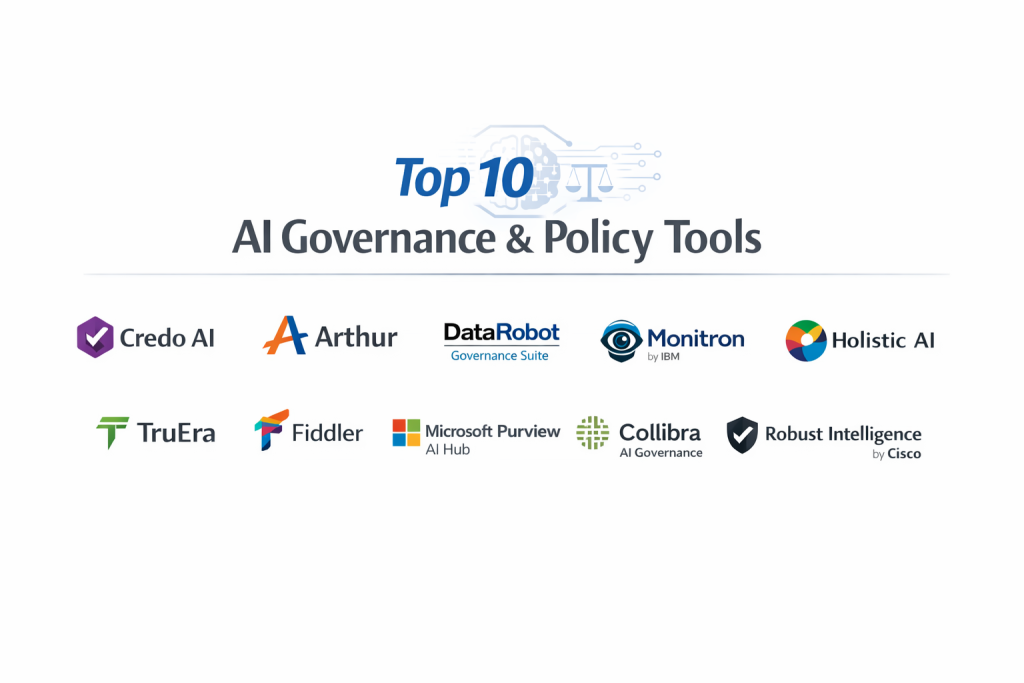
Top 10 AI Governance & Policy Tools
1 — Credo AI
Credo AI is a leading Governance, Risk, and Compliance (GRC) platform specifically tailored for the AI era. It focuses on bridging the gap between technical teams and policy-making stakeholders.
- Key Features:
- Policy Intelligence: Automatically maps AI deployments to global regulations like the EU AI Act and NIST.
- Governance Workflows: Standardized templates for Risk Impact Assessments (RIAs).
- Technical Guardrails: Sets thresholds for bias and performance that models must meet before deployment.
- Multi-stakeholder Portals: Custom views for legal, data science, and executive teams.
- Automated Reporting: Generates transparency reports for auditors and regulators.
- Pros:
- Excellent at translating complex legal requirements into technical requirements.
- Strong focus on “Responsible AI” as a business differentiator, not just a checkbox.
- Cons:
- Can be resource-intensive to set up initially across multiple departments.
- The high level of detail might be overwhelming for smaller AI teams.
- Security & Compliance: SOC 2 Type II, GDPR compliant, SSO integration, and robust audit trails.
- Support & Community: High-touch enterprise onboarding, dedicated customer success managers, and extensive regulatory whitepapers.
2 — Arthur
Arthur is an AI performance and governance platform that provides a “central nervous system” for monitoring and safeguarding models in production.
- Key Features:
- Arthur Scope: A visual interface to detect and mitigate bias in real-time.
- Arthur Shield: A firewall for Large Language Models (LLMs) to prevent prompt injection and data leakage.
- Explainability Engine: Provides clear reasons for specific model outputs to satisfy “Right to Explanation” laws.
- Data Drift Alerts: Notifies teams when production data deviates from training data.
- Customizable Dashboards: Tailored reporting for technical and non-technical oversight.
- Pros:
- Exceptional real-time protection for generative AI applications.
- The explainability features are among the most robust in the industry.
- Cons:
- Focuses more on performance monitoring than high-level legal policy management.
- Pricing scales quickly with the number of models monitored.
- Security & Compliance: SOC 2 compliant, encryption at rest/transit, and detailed audit logs.
- Support & Community: Strong technical documentation, active webinars, and professional services for custom model types.
3 — DataRobot (Governance Suite)
DataRobot is an end-to-end AI platform that includes a specialized suite for governing the entire model lifecycle from creation to retirement.
- Key Features:
- Centralized Model Registry: A “single source of truth” for every version of every model.
- Automated Documentation: Generates a full compliance report with one click.
- Humand-in-the-Loop Approvals: Customizable approval gates for moving models to production.
- Bias Mitigation: Built-in algorithms to automatically adjust model parameters for fairness.
- Continuous Monitoring: Tracks accuracy, drift, and fairness metrics simultaneously.
- Pros:
- Highly integrated; if you use DataRobot for MLOps, governance is native.
- Excellent for large-scale “Model Factories” managing hundreds of live services.
- Cons:
- Best value is found only if you use the entire DataRobot ecosystem.
- Interface can be complex for purely legal or compliance roles.
- Security & Compliance: SOC 2, ISO 27001, HIPAA compliant, and support for air-gapped deployments.
- Support & Community: Extensive DataRobot University, global user groups, and 24/7 enterprise support.
4 — Monitron (by IBM)
IBM has long been a proponent of “Trustworthy AI,” and their governance tools (part of the watsonx platform) emphasize transparency and regulatory alignment.
- Key Features:
- Automated Factsheets: Like a “nutrition label” for AI, documenting data sources and intended use.
- Regulatory Compliance Mapping: Built-in hooks for specific regional AI mandates.
- Lifecycle Tracking: Visual timeline of model changes and developer access.
- Fairness Monitoring: Real-time checking for disparate impact against protected groups.
- Enterprise Integration: Connects seamlessly with IBM Cloud and other major cloud providers.
- Pros:
- Deep expertise in legacy enterprise requirements and global standards.
- The “Factsheet” concept is a pioneer in the industry for external auditing.
- Cons:
- Can feel slower and more “corporate” than newer, agile startups.
- Pricing is generally at the high end of the market.
- Security & Compliance: IBM-grade security, FIPS 140-2, HIPAA, SOC 2, and GDPR compliant.
- Support & Community: Professional services, massive global community, and extensive academic partnerships.
5 — Holistic AI
Holistic AI is a specialized platform that focuses on the auditing and risk management of AI systems, particularly for those concerned with ethics and accountability.
- Key Features:
- Risk Discovery: Scans your AI inventory to identify hidden risks in datasets or algorithms.
- Algorithm Auditing: Conducts third-party style audits for compliance with NYC AEDT or EU AI Act.
- Governance Scorecards: Visual “health” ratings for AI initiatives across the company.
- Bias & Impact Tools: Specialized modules for HR and financial services risk management.
- Collaborative Risk Register: A shared space for legal and technical teams to log concerns.
- Pros:
- Often used by regulators themselves, lending the platform high credibility.
- Specifically designed for “impact assessments,” not just technical monitoring.
- Cons:
- Less emphasis on the “technical monitoring” (latency, throughput) of models.
- Smaller model-provider integration library compared to DataRobot.
- Security & Compliance: GDPR and ISO 27001 focused; standard enterprise security protocols.
- Support & Community: Boutique-style consulting and high-quality thought leadership in AI ethics.
6 — TruEra
TruEra focuses on “Model Quality,” providing a platform that bridges performance monitoring with governance and fairness testing.
- Key Features:
- Quality Analytics: Deep dives into why a model’s performance may be degrading.
- Fairness Testing: Stress-tests models against edge cases to find hidden biases.
- Root Cause Analysis: Pinpoints exactly which data points are causing model failures.
- Lifecycle Governance: Standardized workflows for model validation.
- Open Compatibility: Works with any model built in Python, R, or via platforms like SageMaker.
- Pros:
- Excellent for technical “validation” teams who need to sign off on model safety.
- Provides the “Why” behind model failure, not just the “What.”
- Cons:
- The interface is very technical and may exclude non-developer stakeholders.
- Documentation for niche integrations can be sparse.
- Security & Compliance: SOC 2 Type II, GDPR, and data encryption.
- Support & Community: Active technical blog, Slack community, and direct engineer-to-customer support.
7 — Fiddler AI
Fiddler AI specializes in “AI Observability,” emphasizing the importance of trust and explainability in the AI development lifecycle.
- Key Features:
- Model Monitoring: High-fidelity tracking of performance and drift.
- Explainable AI (XAI): Uses proprietary techniques to explain black-box model predictions.
- Bias Detection: Proactively identifies discrimination in model outputs.
- Fiddler Auditor: An open-source tool for testing the robustness of LLMs.
- Security Guardrails: Detects and flags adversarial attacks on AI models.
- Pros:
- One of the best tools for visualizing “Model Explainability.”
- Very fast time-to-value for teams with existing production models.
- Cons:
- Primarily focused on the production stage; less on the pre-deployment policy phase.
- High volume data ingestion can lead to significant storage costs.
- Security & Compliance: SOC 2, HIPAA, and GDPR compliant; robust data isolation.
- Support & Community: Comprehensive “Fiddler Academy” and active leadership in AI safety groups.
8 — Microsoft Purview (AI Hub)
Purview is Microsoft’s expansive data governance suite, which has been recently upgraded with an AI Hub specifically to manage and secure the use of Copilots and custom AI.
- Key Features:
- Data Sensitivity Labeling: Automatically identifies and protects sensitive data used by AI.
- AI Risk Management: Provides a centralized view of all AI apps interacting with your data.
- Usage Auditing: Tracks who is using which AI model and for what purpose.
- Policy Enforcement: Prevents users from sending confidential info to public LLMs.
- Azure Integration: Native hooks into all Azure AI services and Microsoft 365.
- Pros:
- The best option for organizations already embedded in the Microsoft ecosystem.
- Strongest focus on the “Data Governance” aspect of AI.
- Cons:
- Limited usefulness if you use models hosted outside of Azure or AWS.
- Can feel like a “compliance” tool rather than an “innovation” tool.
- Security & Compliance: Microsoft Cloud-grade security; meets nearly all global certifications.
- Support & Community: Microsoft Enterprise Support and a massive network of global partners.
9 — Collibra (AI Governance)
Collibra is a titan in the data governance world, and their AI Governance module allows companies to treat AI models as “data assets” with associated risks and policies.
- Key Features:
- Model Catalog: A searchable directory of all AI models with metadata and ownership info.
- Workflow Orchestration: Automated “Step-by-step” approval flows for model development.
- Risk Scoring: Assigns a risk level to models based on data sensitivity and use case.
- Stewardship Tools: Defines exactly who is responsible for a model’s performance and ethics.
- Data Lineage: Tracks the data from its source through the model to the final output.
- Pros:
- Unmatched for pure “Asset Management” and high-level corporate governance.
- Bridges AI governance with existing data governance seamlessly.
- Cons:
- Not a technical monitoring tool; you will need another tool for real-time drift detection.
- Complex enterprise setup requires dedicated administrative staff.
- Security & Compliance: SOC 2, ISO 27001, FedRAMP authorized, and GDPR compliant.
- Support & Community: Collibra University and a professional services arm for enterprise scale.
10 — Robust Intelligence (by Cisco)
Recently acquired by Cisco, Robust Intelligence focuses on the automated stress-testing and security of AI systems to ensure they are policy-compliant.
- Key Features:
- Continuous Validation: Automatically tests models against thousands of adversarial scenarios.
- Model Firewall: Wraps models in a protective layer to block “bad” inputs in real-time.
- Regulatory Guardrails: Ensures models don’t violate specific compliance rules during execution.
- Pre-deployment Testing: A “Stress-Test” that provides a letter grade for model readiness.
- LLM Security: Specific protections against prompt injection and PII leakage.
- Pros:
- The strongest tool for “Adversarial Defense” and security-focused governance.
- Excellent automated “Red Teaming” for AI systems.
- Cons:
- Focus is heavily on “Security” rather than “Business Ethics” or “Asset Management.”
- Pricing is enterprise-level and reflects the high-end security nature of the tool.
- Security & Compliance: SOC 2, ISO 27001, and specialized security certifications through Cisco.
- Support & Community: Deep technical documentation and world-class cybersecurity support.
Comparison Table
| Tool Name | Best For | Platform(s) Supported | Standout Feature | Rating (Gartner) |
| Credo AI | Regulatory Compliance | Web, API | Policy Intelligence Engine | 4.8 / 5 |
| Arthur | Real-time Guardrails | Web, SDK | Arthur Shield (Firewall) | 4.7 / 5 |
| DataRobot | Lifecycle Management | Web, Cloud, On-Prem | Automated Documentation | 4.6 / 5 |
| IBM watsonx | Corporate Transparency | Web, Hybrid Cloud | AI Factsheets | 4.5 / 5 |
| Holistic AI | Ethical Auditing | Web | External Impact Assessments | N/A |
| TruEra | Model Validation | Web, SDK | Quality & Root Cause Analysis | 4.4 / 5 |
| Fiddler AI | Explainable AI (XAI) | Web, Cloud | XAI Visualizer | 4.6 / 5 |
| MS Purview | Data-centric Security | Azure, Windows | Data Sensitivity Labeling | 4.5 / 5 |
| Collibra | Asset Stewardship | Web | Model Inventory & Lineage | 4.3 / 5 |
| Robust Intel | Adversarial Security | Web, API | Automated Red Teaming | 4.7 / 5 |
Evaluation & Scoring of AI Governance Tools
Evaluating these tools requires looking beyond the marketing and into how they handle the friction between “legal” and “code.”
| Category | Weight | Evaluation Criteria |
| Core Features | 25% | Multi-regulatory mapping, bias detection, explainability, and registry. |
| Ease of Use | 15% | The “UI gap” between lawyers (policy) and data scientists (code). |
| Integrations | 15% | Support for AWS/Azure/GCP and common MLOps tools like MLflow. |
| Security & Compliance | 10% | SOC 2/ISO status and the ability to prevent data leakage. |
| Performance | 10% | Latency added by “firewalls” and the speed of report generation. |
| Support & Community | 10% | Access to regulatory experts and technical documentation. |
| Price / Value | 15% | The cost of the tool vs. the cost of a potential regulatory fine. |
Which AI Governance Tool Is Right for You?
Solo Users vs SMB vs Mid-Market vs Enterprise
- Solo Users/SMBs: You likely don’t need an enterprise GRC. Focus on open-source libraries like Fairlearn or AIF360. If you must have a tool, Fiddler’s lightweight monitoring may be enough.
- Mid-Market: TruEra or Arthur provide excellent value by focusing on performance and security without the heavy overhead of a massive data governance suite.
- Enterprise: Credo AI, IBM, or Collibra are the standard. They provide the high-level reporting that a Board of Directors or global regulators expect.
Budget-Conscious vs Premium Solutions
If budget is a concern, Holistic AI offers modular pricing focused on specific audits. For “blank check” premium requirements where failure is not an option (e.g., global banking), Cisco/Robust Intelligence or IBM provide the highest levels of security and support.
Feature Depth vs Ease of Use
If you want Ease of Use, Vellum (for prompts) or Microsoft Purview (for ecosystem) are winners. If you need Feature Depth—specifically the math behind explainability—Fiddler AI and Arthur are top-tier.
Integration and Scalability Needs
For those with hundreds of models, DataRobot and Collibra are built for the “Asset Management” scale. If your stack is 100% Azure, Purview is an effortless addition to your existing security posture.
Security and Compliance Requirements
If you are worried about “Prompt Injection” and LLM safety, prioritize Arthur Shield or Robust Intelligence. If your primary concern is the EU AI Act, Credo AI is currently the industry leader in regulatory mapping.
Frequently Asked Questions (FAQs)
Q1: What is the EU AI Act and do these tools support it?
Answer: The EU AI Act is the first comprehensive AI law. Yes, top tools like Credo AI and Holistic AI have specific modules to ensure your models are categorized correctly (High Risk vs. Limited Risk) and meet the requirements.
Q2: Can these tools stop an AI from “hallucinating”?
Answer: They can’t stop the model from being creative, but “firewalls” like Arthur Shield can detect when an output is nonsensical or deviates from a provided knowledge base, flagging it for review.
Q3: How much does AI governance software cost?
Answer: For enterprises, it typically starts at $20k–$50k per year and can go into the several hundreds of thousands depending on the number of models and the depth of monitoring required.
Q4: Do these tools require me to share my data with them?
Answer: Most offer “VPC” or “On-Prem” deployments where your sensitive data never leaves your infrastructure. Only the “metadata” (metrics) is sent to the governance dashboard.
Q5: Is AI governance the same as MLOps?
Answer: No. MLOps is about the efficiency of building models. AI Governance is about the safety and compliance of those models. They are two sides of the same coin.
Q6: What is “Explainable AI” (XAI)?
Answer: XAI is a set of tools (found in platforms like Fiddler) that explains why an AI made a decision—for example, why it denied a loan—using human-readable charts instead of raw math.
Q7: Can I use these for third-party tools like ChatGPT?
Answer: Yes. Tools like Microsoft Purview and Arthur are designed to monitor “Shadow AI” (employees using unapproved bots) and secure corporate use of public LLMs.
Q8: What is “Model Drift”?
Answer: Drift happens when the real world changes and your model’s training data becomes outdated. These tools monitor your model’s accuracy 24/7 to catch this before it impacts revenue.
Q9: Who is usually responsible for these tools in a company?
Answer: Usually a “Cross-functional AI Committee” involving IT (for implementation), Legal (for policy), and the AI/Data Science team (for technical maintenance).
Q10: Are there free versions of these tools?
Answer: Most have a “Demo” mode, but few offer a permanent free tier. For free options, look at open-source frameworks like Giskard or Arize Phoenix, which provide basic governance capabilities.
Conclusion
Building AI is easy; building responsible AI that won’t bankrupt your company through fines or lawsuits is hard. AI Governance & Policy Tools are the essential bridge between the wild potential of LLMs and the rigid requirements of corporate safety.
When choosing your tool, remember that the “best” framework is the one that actually gets used by both your developers and your legal team. Whether you choose the regulatory precision of Credo AI, the security focus of Robust Intelligence, or the ecosystem convenience of Microsoft Purview, the goal remains the same: ensuring that AI remains a tool for progress, not a source of liability.

- Top 10 Email Deliverability Tools: Features, Pros, Cons & Comparison - September 6, 2026
- Top 10 Pharmacovigilance Software: Features, Pros, Cons & Comparison - September 6, 2026
- Top 10 Manufacturing Execution Systems (MES) - July 30, 2026
This is a comprehensive and insightful comparison of the top AI governance and policy tools, and it clearly explains the core features alongside balanced pros and cons. Highlighting aspects like policy automation, compliance tracking, risk assessment, and reporting capabilities gives readers a practical framework for evaluating which solution best fits their organizational needs. The breakdown helps both policy teams and technical leaders understand how different tools support transparency, accountability, and ethical AI practices in real‑world deployments. Overall, this guide is a valuable resource for anyone looking to strengthen AI governance and ensure responsible use across teams and systems.