Introduction
AI Safety & Evaluation Tools are specialized software frameworks and platforms designed to rigorously test, monitor, and safeguard Artificial Intelligence systems. As Large Language Models (LLMs) and autonomous agents become integrated into the core of business operations, these tools act as the critical “quality assurance” layer. They go beyond simple accuracy checks, focusing on detecting “hallucinations,” preventing prompt injections, mitigating algorithmic bias, and ensuring that AI outputs remain aligned with human values and corporate policies.
The importance of this category has surged alongside global regulatory pressure and the inherent unpredictability of generative AI. Without robust evaluation, enterprises risk reputational damage, legal liabilities, and operational failures. Key real-world use cases include automated red-teaming to find security holes, bias auditing in recruitment algorithms, and real-time toxicity filtering for customer-facing chatbots. When choosing a tool, users should evaluate the breadth of safety benchmarks, real-time monitoring latency, multi-model compatibility, and the ability to provide explainable “why” metrics rather than just a pass/fail grade.
Best for: AI safety researchers, machine learning engineers, compliance officers, and CTOs at organizations handling sensitive data or customer-facing AI. It is essential for industries like finance, healthcare, and legal tech where the cost of a single incorrect AI output is exceptionally high.
Not ideal for: Hobbyists building non-commercial, low-risk creative applications or developers working purely with narrow, non-generative ML models where standard statistical validation (like RMSE) is sufficient.
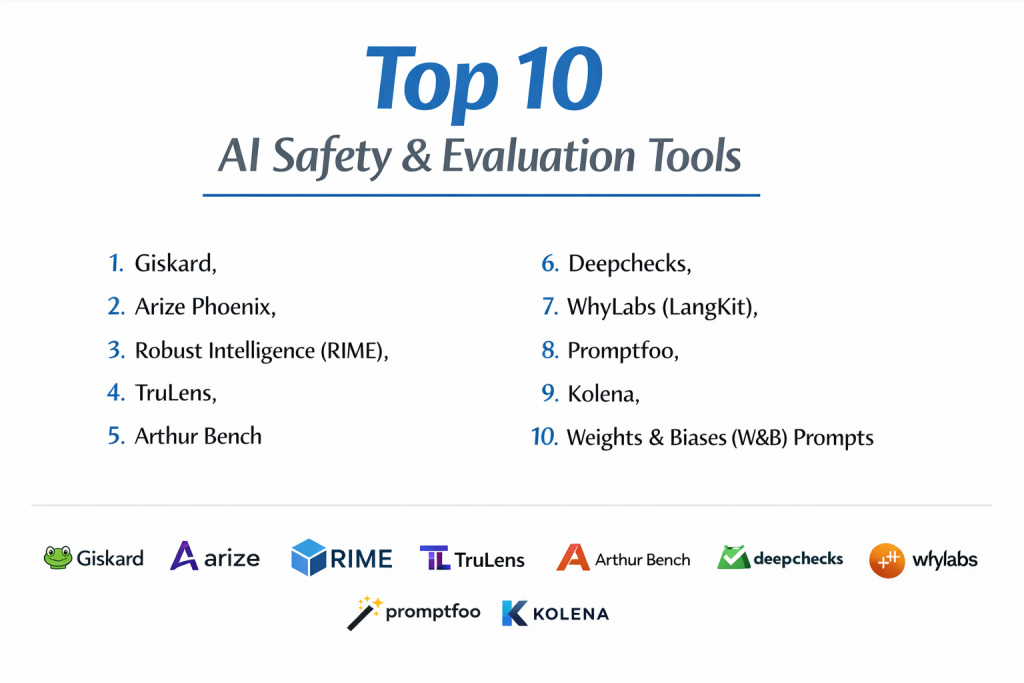
Top 10 AI Safety & Evaluation Tools
1 — Giskard
Giskard is an open-source testing framework specifically built for LLMs and tabular models. It aims to bridge the gap between AI development and business requirements by identifying vulnerabilities before deployment.
- Key Features:
- Automated Scan: Automatically detects common issues like performance bias, unrobustness, and data leakage.
- LLM Jailbreak Detection: Specifically tests for prompt injections and malicious manipulation.
- Collaborative Quality Assurance: Allows non-technical stakeholders to review and “sign off” on model behavior.
- Custom Domain Tests: Users can define specific “business rules” the AI must never violate.
- CI/CD Integration: Plugs into GitHub Actions or GitLab to prevent “risky” models from being merged.
- Pros:
- The open-source nature allows for deep customization and local hosting for privacy.
- Excellent visual interface for debugging specific model failures.
- Cons:
- Requires a significant amount of manual setup for niche, domain-specific test cases.
- The managed cloud version can be pricey for smaller startups.
- Security & Compliance: GDPR compliant; SOC 2 (for cloud version); supports air-gapped deployments.
- Support & Community: Active Discord community, comprehensive technical documentation, and enterprise-tier support available.
2 — Arize Phoenix
Arize Phoenix is a specialized tool for LLM observability and “evals.” It focuses on the internal mechanics of a model—specifically tracing and retrieval-augmented generation (RAG) evaluation.
- Key Features:
- Embedding Visualization: Projects high-dimensional data into 3D maps to find “clusters” where the model fails.
- RAG Evaluation: Specifically measures “faithfulness” and “relevancy” of retrieved data.
- Tracing: Follows the path of a complex AI chain to see exactly where logic breaks down.
- Hallucination Detection: Uses mathematical “distance” metrics to flag likely false statements.
- Model Comparison: Side-by-side performance metrics for different versions or prompt templates.
- Pros:
- The industry leader for visualizing “why” a model is behaving in a certain way.
- Extremely fast and can be run entirely in a Jupyter Notebook.
- Cons:
- Very technical interface; may be difficult for compliance or legal teams to navigate.
- Heavy focus on RAG, which might be overkill for simple text-generation tasks.
- Security & Compliance: SOC 2 Type II, HIPAA, and GDPR compliant.
- Support & Community: Strong YouTube tutorial presence, massive Slack community, and professional onboarding.
3 — Robust Intelligence (RIME)
Robust Intelligence (now a part of Cisco) provides an end-to-end “AI Firewall” and stress-testing platform designed to protect models from adversarial attacks and operational risks.
- Key Features:
- AI Stress Testing: Subjects models to thousands of “stressors” to find breaking points.
- AI Firewall: A real-time wrapper that blocks toxic or insecure prompts before they reach the model.
- Governance Workflows: Built-in templates for NIST and EU AI Act compliance.
- Data Privacy Vault: Identifies and masks PII (Personally Identifiable Information) in real-time.
- Continuous Monitoring: Alerts teams if a model’s safety profile degrades over time.
- Pros:
- One of the few platforms that provides both pre-deployment testing and real-time protection.
- Highly automated; requires less manual prompt engineering for tests.
- Cons:
- High cost of entry; strictly an enterprise-grade solution.
- Can add minor latency to AI responses due to the firewall filtering.
- Security & Compliance: ISO 27001, SOC 2 Type II, HIPAA, and GDPR compliant.
- Support & Community: White-glove enterprise support and dedicated regulatory experts for clients.
4 — TruLens
TruLens is an open-source library that allows developers to evaluate and track the performance of LLM-based applications using the “TruEra Triad” of evaluation.
- Key Features:
- The RAG Triad: Measures Context Relevance, Groundedness, and Answer Relevance.
- Feedback Functions: Allows developers to programmatically score LLM outputs using other LLMs.
- Dashboarding: A clean UI to visualize how different versions of your app improve over time.
- Integration with LlamaIndex/LangChain: Built-in hooks for the most popular orchestration frameworks.
- Custom Feedback: Write your own scoring logic in Python.
- Pros:
- Deeply integrated into the developer workflow; very easy to add to existing code.
- Provides a very clear “scorecard” that is easy to explain to management.
- Cons:
- The open-source version lacks advanced collaborative features for large teams.
- Relying on “LLMs to grade LLMs” can sometimes lead to recursive errors.
- Security & Compliance: Varies / N/A (Standard for local libraries); Enterprise version is SOC 2 compliant.
- Support & Community: Strong GitHub contributor base and detailed documentation for Python devs.
5 — Arthur Bench
Arthur Bench is an open-source tool for comparing different LLMs, prompts, and configurations to determine which is safest and most effective for a specific use case.
- Key Features:
- Prompt Comparison: See how a single prompt performs across GPT-4, Claude, and Gemini.
- Scoring Rubrics: Provides pre-built rubrics for summarization, Q&A, and creative writing.
- Data Analysis: Statistical breakdown of where models diverge in their safety profiles.
- Leaderboards: Internal tracking to see which model configuration is “winning” on your data.
- Local Execution: Can be run locally to ensure your test datasets never leave your server.
- Pros:
- Excellent for “model selection” during the early phases of a project.
- Very transparent; users can see exactly how scores are calculated.
- Cons:
- Less focused on “real-time” production monitoring than other tools.
- Smaller library of pre-built “adversarial” tests compared to Robust Intelligence.
- Security & Compliance: SOC 2 compliant; focuses on data privacy through local hosting.
- Support & Community: Active technical blog and direct support for enterprise users.
6 — Deepchecks
Deepchecks is a comprehensive testing suite for machine learning that has expanded into “Deepchecks LLM,” focusing on the validation and monitoring of generative AI.
- Key Features:
- Automated Interaction Analysis: Checks for inconsistencies in multi-turn conversations.
- Golden Set Management: Allows teams to curate “perfect” answer sets to test models against.
- Properties-based Testing: Evaluate models on properties like brevity, tone, and refusal rate.
- Data Drift Detection: Identifies when the topics users are asking about have shifted.
- Custom Heuristics: Define rules like “Never mention a competitor’s name.”
- Pros:
- Very holistic; covers the model from the research phase to the production phase.
- Excellent UI for exploring specific “failed” conversations.
- Cons:
- Can be resource-heavy for high-volume, real-time streaming applications.
- The setup for “Golden Sets” can be time-consuming for large projects.
- Security & Compliance: GDPR and SOC 2 Type II compliant; offers on-premise deployment.
- Support & Community: Large community of ML practitioners and robust documentation.
7 — WhyLabs (LangKit)
WhyLabs is a data and AI observability platform. Their open-source tool, LangKit, is designed to extract “signals” from text to monitor for safety and quality.
- Key Features:
- Telemetry Extraction: Pulls metrics on sentiment, toxicity, and PII leakage without manual labeling.
- Zero-Knowledge Monitoring: Tracks model behavior without needing access to the raw data (for privacy).
- Constraint Validation: Set guardrails (e.g., “toxicity must stay below 0.1”).
- LLM Profiling: Understand the “semantic fingerprint” of your model’s outputs.
- Seamless WhyLabs Platform Integration: Cloud dashboard for long-term trend analysis.
- Pros:
- Best-in-class for privacy; can monitor data without actually seeing the text content.
- Low latency, making it ideal for high-scale production environments.
- Cons:
- The open-source library requires the WhyLabs cloud for the best visualization experience.
- Less focused on “deep” reasoning evaluation and more on “surface” safety (toxicity/PII).
- Security & Compliance: SOC 2 Type II, HIPAA, and GDPR compliant.
- Support & Community: Strong Slack support and detailed documentation for data engineers.
8 — Promptfoo
Promptfoo is a CLI-first tool that focuses on “test-driven development” for prompts. It allows developers to run systematic evaluations against their prompts and models.
- Key Features:
- Matrix Testing: Test 50 prompts against 10 models with one command.
- Assertion Library: Supports regex, LLM-based, and Javascript-based assertions.
- CI/CD Integration: Fail builds if a prompt change increases toxicity or decreases accuracy.
- Caching: Saves money by not re-running identical tests.
- Web UI: An optional, lightweight local web view to browse results.
- Pros:
- The favorite choice for developers who prefer the command line over a heavy GUI.
- Extremely fast and highly automatable.
- Cons:
- Not designed for “monitoring” live production traffic; it is a pre-deployment tool.
- Requires comfort with YAML and JSON configurations.
- Security & Compliance: Varies / N/A (Local-first tool).
- Support & Community: Very active GitHub community and rapid feature release cycles.
9 — Kolena
Kolena is a high-end AI testing and validation platform that emphasizes “rigor” and “granularity” in model evaluation across images, text, and audio.
- Key Features:
- Hidden Bias Discovery: Finds subsets of data where your model performs significantly worse.
- Scenario-based Testing: Create specific “test cases” (e.g., “noisy audio” or “slang-heavy text”).
- Model Comparison: Advanced analytics on where one model outperforms another.
- Audit Trails: Detailed logs for every test run for regulatory compliance.
- Multi-modal Support: One of the few platforms that handles vision and audio safety.
- Pros:
- The most detailed “slice-and-dice” analytics available in the safety space.
- Perfect for industries like autonomous driving or medical imaging.
- Cons:
- Significant learning curve due to the complexity of the analytics.
- More expensive than simpler “eval-only” tools.
- Security & Compliance: SOC 2 Type II compliant; supports single sign-on (SSO) and encryption.
- Support & Community: Dedicated technical account managers and professional services.
10 — Weights & Biases (W&B) Prompts
Weights & Biases is a staple in ML experiment tracking. Their “Prompts” tool brings that same level of rigor to LLM safety and evaluation.
- Key Features:
- Trace Tables: See the full history of a prompt’s evolution and its safety scores.
- Collaborative Review: Leave comments and ratings on model outputs for team alignment.
- Integration with W&B Ecosystem: Link your safety evals directly to your model training logs.
- Visual Diffs: Highlight exactly what changed in a model output when you changed a prompt.
- Cost Tracking: Monitor the token cost associated with your safety evaluation runs.
- Pros:
- If you already use W&B for model training, this is a seamless addition.
- Extremely stable and built to handle massive enterprise scale.
- Cons:
- Can feel “bolted on” if you aren’t using the rest of the W&B platform.
- The UI is built for data scientists, not necessarily for non-technical policy officers.
- Security & Compliance: SOC 2 Type II, ISO 27001, and HIPAA compliant.
- Support & Community: Large “Fully Connected” community site and high-quality enterprise support.
Comparison Table
| Tool Name | Best For | Platform(s) Supported | Standout Feature | Rating (Gartner/True) |
| Giskard | Open-source QA | Python, Web | Automated Security Scan | 4.7 / 5 |
| Arize Phoenix | RAG & Tracing | Python, Web | Embedding Visualization | 4.8 / 5 |
| Robust Intel | Enterprise Security | API, Cloud, On-Prem | Real-time AI Firewall | 4.8 / 5 |
| TruLens | RAG Development | Python, SDK | The RAG Triad Scorer | 4.5 / 5 |
| Arthur Bench | Model Comparison | Python, Open-source | Multi-model Benchmarking | 4.6 / 5 |
| Deepchecks | Lifecycle Testing | Python, Web | Golden Set Management | 4.7 / 5 |
| WhyLabs | Privacy-first Monitoring | API, Cloud | Zero-Knowledge Metrics | 4.6 / 5 |
| Promptfoo | CI/CD & CLI Devs | CLI, Local Web | Matrix Testing | 4.9 / 5 |
| Kolena | Granular Validation | Web, API | Hidden Bias Discovery | 4.5 / 5 |
| W&B Prompts | Teams & MLOps | Web, Python | Visual Trace Tables | 4.8 / 5 |
Evaluation & Scoring of AI Safety & Evaluation Tools
Determining the value of an AI safety tool requires a balanced look at technical capability and operational reality. We use a weighted rubric to score these tools based on professional requirements.
| Category | Weight | Evaluation Criteria |
| Core Features | 25% | Presence of adversarial tests, bias detection, and RAG-specific evals. |
| Ease of Use | 15% | Onboarding speed, CLI vs GUI quality, and documentation clarity. |
| Integrations | 15% | Support for popular frameworks (LangChain, LlamaIndex) and models. |
| Security & Compliance | 10% | SOC 2/HIPAA status and ability to run in air-gapped environments. |
| Performance | 10% | Latency added to the inference loop and dashboard responsiveness. |
| Support & Community | 10% | Frequency of updates and active community forums. |
| Price / Value | 15% | Open-source flexibility vs. the ROI of enterprise managed services. |
Which AI Safety & Evaluation Tool Is Right for You?
Solo Users vs SMB vs Mid-Market vs Enterprise
- Solo Users/Developers: Promptfoo is the gold standard here. It’s free, local, and incredibly fast for optimizing prompts.
- SMBs: Giskard or TruLens provide the right balance. They offer enough “visual” reporting to show stakeholders that the AI is safe without requiring a six-figure enterprise contract.
- Enterprise: Robust Intelligence or Weights & Biases are the clear choices. These platforms offer the governance, audit logs, and security certifications (like HIPAA/SOC 2) that large corporations require.
Budget-Conscious vs Premium Solutions
If you have a zero-dollar budget, the open-source versions of Arize Phoenix, Giskard, and Promptfoo provide world-class capabilities. For companies where a single “unsafe” output could result in millions in fines, the premium “Firewall” features of Robust Intelligence are a justifiable insurance policy.
Feature Depth vs Ease of Use
If you want Ease of Use, WhyLabs (LangKit) is excellent because it can generate metrics automatically with very little configuration. If you need Feature Depth—like finding out exactly which specific demographic group your model is biased against—Kolena offers the most rigorous analytical tools.
Integration and Scalability Needs
For teams heavily invested in the “LangChain” or “LlamaIndex” ecosystems, TruLens and Arize Phoenix offer the best native “hooks.” For high-volume streaming data where you need to monitor 100 million requests a day, WhyLabs is architected for that level of scalability.
Security and Compliance Requirements
If your data cannot leave your servers, prioritize tools that are “local-first” or offer “On-Premise” deployments, such as Giskard or Agenta. For those specifically needing to meet EU AI Act requirements, Robust Intelligence has the most built-in compliance mapping.
Frequently Asked Questions (FAQs)
Q1: What is “Red-Teaming” in AI safety?
Answer: Red-teaming is the process of intentionally trying to make an AI model fail. This involves using “adversarial prompts” to trick the model into revealing private data, generating toxic content, or bypassing its own safety filters.
Q2: Can I use an LLM to evaluate another LLM?
Answer: Yes, this is common and often called “LLM-as-a-judge.” Tools like TruLens use this method. However, you must be careful, as the “judge” model can also have biases or make mistakes.
Q3: Is “hallucination detection” 100% accurate?
Answer: No. Current tools use “groundedness” (checking if the answer is in the source text) or “semantic uncertainty” to estimate the chance of a hallucination, but they cannot guarantee 100% factual accuracy.
Q4: Do these tools work with image-generating AI (like Midjourney)?
Answer: Most tools in this list focus on text/LLMs. However, platforms like Kolena are specifically designed to handle multi-modal safety, including vision and audio.
Q5: How does a “Firewall” for AI work?
Answer: An AI firewall (like Robust Intelligence) sits between the user and the LLM. It scans the incoming prompt for threats and scans the outgoing response for sensitive data or toxicity, blocking the transaction if it’s unsafe.
Q6: What is “Data Drift” in the context of AI safety?
Answer: Data drift occurs when the type of questions users ask changes over time, or when the model’s environment changes. This can cause a once-safe model to start producing inaccurate or unsafe results.
Q7: Is it expensive to run AI evaluations?
Answer: It can be. If you are using a model like GPT-4 to “judge” thousands of responses, your API costs will rise. This is why tools like Promptfoo include caching to prevent redundant tests.
Q8: Can these tools help me comply with the EU AI Act?
Answer: Yes. Many of these tools (especially Robust Intelligence and Giskard) are specifically mapping their test suites to the requirements of the EU AI Act and other global standards.
Q9: Do I need a safety tool if I’m using a “safe” model like Claude?
Answer: Yes. Even “safe” models can be “jailbroken” or produce incorrect information (hallucinations) when given specific, complex business data.
Q10: What is the most common mistake in AI evaluation?
Answer: Testing only for accuracy. Many teams forget to test for robustness (will the AI still work if there’s a typo?) and adversarial safety (can a user trick it?).
Conclusion
The “wild west” era of unmonitored AI is rapidly coming to an end. As organizations move from experimental pilots to production-scale applications, AI Safety & Evaluation Tools have become the indispensable bridge between innovation and responsibility.
The “best” tool is not necessarily the one with the most features, but the one that aligns with your specific risk profile. If you are a developer iterating quickly, Promptfoo is your best friend. If you are a Chief Risk Officer at a global bank, the comprehensive protection of Robust Intelligence is likely your standard. Regardless of which you choose, the goal is the same: building AI that is not just smart, but safe and trustworthy.

- Top 10 Email Deliverability Tools: Features, Pros, Cons & Comparison - September 6, 2026
- Top 10 Pharmacovigilance Software: Features, Pros, Cons & Comparison - September 6, 2026
- Top 10 Manufacturing Execution Systems (MES) - July 30, 2026
This is a highly informative and well‑organized comparison of the top AI safety evaluation tools, and it does a great job of highlighting key features alongside balanced pros and cons. Emphasizing aspects such as bias detection, robustness testing, interpretability, and compliance support gives readers a practical framework for choosing the right tool based on their safety and governance needs. The breakdown helps both researchers and engineers understand how different solutions address critical challenges in responsible AI deployment, such as fairness, transparency, and risk mitigation. Overall, this guide is a valuable resource for anyone focused on building and evaluating safe, trustworthy AI systems.