Introduction
Accelerating digital transformation demands continuous innovation, robust security, and seamless collaboration across complex cloud environments. Consequently, engineering organizations often struggle to translate high-level technical concepts into efficient, real-world deployment workflows. Partnering with a dedicated DevOps Trainer provides technical teams with hands-on experience, clear architectural guidance, and battle-tested industry practices.
Furthermore, static online tutorials rarely address complex multi-cloud deployments or enterprise governance requirements. Direct mentorship helps developers, system administrators, and infrastructure engineers master interconnected toolchains effectively. Ultimately, targeted technical coaching accelerates release velocity, eliminates operational friction, and instills complete software delivery confidence.
What Does a DevOps Trainer Do?
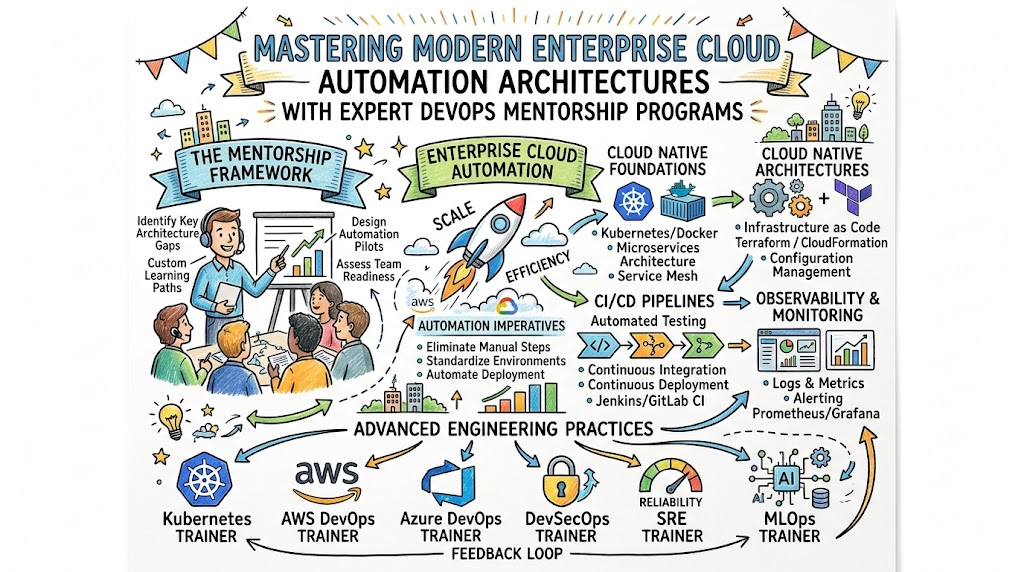
A specialized DevOps Trainer acts as an active technical mentor and strategic advisor. Instead of relying on static presentation slides, a skilled instructor designs interactive sandbox environments that mirror production systems. As a result, engineers gain practical experience configuring CI/CD pipelines, writing Infrastructure as Code, and managing containerized workloads.
Additionally, the instructor audits current team workflows, identifies technical skill gaps, and aligns learning modules with strategic business goals. By introducing realistic failure scenarios—including pipeline rollbacks, cluster outages, and security breaches—the mentor prepares developers for production challenges. Therefore, structured coaching converts theoretical knowledge into real-world operational capability.
| Operational Parameter | Self-Paced Video Courses | Instructor-Led Mentorship |
|---|---|---|
| Feedback Loop | Delayed or non-existent | Immediate troubleshooting and live Q&A |
| Curriculum Flexibility | Rigid, generic content | Tailored to custom enterprise tech stacks |
| Lab Environments | Basic local setups | Replicated production cloud architectures |
| Knowledge Retention | Passive absorption (10-20%) | Active hands-on practice (70-80%) |
Why Practical DevOps Learning Matters
Theoretical knowledge alone cannot recover failing production clusters or repair broken deployment pipelines during high-traffic events. Therefore, practical, laboratory-based learning remains essential for mastering modern software delivery. Engineers must complete hands-on exercises covering version control, automated testing frameworks, container orchestration, and real-time monitoring tools.
Furthermore, interactive practice builds muscle memory and sharpens analytical troubleshooting instincts. When professionals resolve pipeline errors or fix misconfigured service meshes in controlled sandboxes, they develop confidence for production management. Consequently, hands-on skill development directly correlates with reduced mean time to recovery (MTTR) and higher release reliability.
What Should You Look for in a DevOps Trainer?
Selecting an effective instructor requires evaluating real-world engineering accomplishments rather than relying on basic certifications alone. First and foremost, verify that the mentor possesses extensive field experience managing production cloud platforms and automated delivery pipelines. Industry credentials validate baseline knowledge, but real operational experience ensures practical value.
Additionally, assess their communication agility and teaching methods. A superior mentor adapts explanations for various experience levels, balancing granular code mechanics with high-level architectural strategy. Moreover, ensure they offer customized lab scenarios, live code reviews, and ongoing mentorship to maximize skill retention.
Corporate DevOps Training: What Makes It Different?
Targeted Corporate DevOps Training differs from generic public workshops by focusing exclusively on an organization’s proprietary tech stack and business objectives. Instead of reviewing abstract examples, corporate programs integrate your specific version control systems, cloud providers, security policies, and deployment frameworks directly into the coursework.
Moreover, enterprise programs align historically isolated internal teams. Developers, quality assurance engineers, security specialists, and system administrators learn side-by-side using unified tools and shared operational processes. Consequently, this collaborative approach establishes a unified technical culture, eliminates operational silos, and accelerates release velocity across departments.
How to Plan Effective Corporate DevOps Training
Executing a high-impact upskilling initiative requires a structured, step-by-step framework:
- Assess Current Capabilities: Evaluate team skill levels, identify pipeline bottlenecks, and pinpoint architectural challenges.
- Define Strategic Goals: Establish clear operational targets, such as reducing deployment lead time, lowering error rates, or accelerating microservice adoption.
- Tailor the Curriculum: Collaborate with the mentor to select relevant tools, cloud platforms, and security standards for your environment.
- Build Sandbox Labs: Construct dedicated testing environments that mirror actual production setups without risking customer data.
- Deliver Phased Modules: Conduct instructional sessions in manageable chunks paired with practical assignments to ensure deep retention.
- Track Operational Impact: Measure team progress through practical skill evaluations and gather feedback to refine upcoming topics.
DevOps Trainer in India: What Should Organizations Consider?
Organizations searching for a DevOps Trainer in India must evaluate key operational factors to guarantee successful knowledge transfer. India features a vast pool of engineering talent, making it crucial to select mentors who combine deep technical expertise with clear instructional communication. Verify that the instructor understands local developer dynamics alongside international delivery standards.
Furthermore, consider scheduling flexibility, language preferences, and delivery options. Whether you require on-site classroom instruction in major technology hubs or hybrid virtual setups, clear operational alignment ensures successful technical upskilling across distributed engineering teams.
Online DevOps Trainer: When Remote Learning Works Well
Partnering with an Online DevOps Trainer offers exceptional flexibility and scalability for modern, distributed workforces. Remote learning eliminates geographical barriers, allowing enterprise leaders to connect global engineering teams with top-tier technical experts. Furthermore, virtual formats support flexible scheduling that accommodates sprint commitments and multi-region time zones.
To maximize engagement, virtual programs should incorporate cloud-hosted lab environments, screen sharing, real-time chat support, and interactive digital architecture boards. As a result, remote engineers receive immersive, practical instruction without incurring travel expenses or administrative delays.
Kubernetes Trainer: Building Cloud-Native Skills
Container orchestration forms the foundation of modern cloud-native architecture, generating strong demand for expert guidance. An experienced Kubernetes Trainer leads technical teams through cluster setup, pod networking, ingress routing, persistent storage, and automated scaling. Engineers learn how to package applications efficiently while maintaining cluster stability.
In addition, advanced modules cover Helm chart creation, custom resource definitions, cluster hardening, and production monitoring. By mastering orchestration fundamentals through guided exercises, engineering groups manage resilient, auto-scaling container environments with minimal operational overhead.
AWS DevOps Trainer: Connecting Cloud and Delivery Automation
Amazon Web Services provides an extensive ecosystem of cloud infrastructure tools that require precise automation skills. A dedicated AWS DevOps Trainer helps teams master AWS CodePipeline, Elastic Kubernetes Service (EKS), CloudFormation, IAM security policies, and Terraform integration.
Furthermore, engineers learn to design elastic infrastructure while optimizing cloud expenses and monitoring system health via CloudWatch. Consequently, structured AWS instruction empowers teams to build automated, scalable infrastructure pipelines that align with AWS Well-Architected Framework principles.
Azure DevOps Trainer: Improving Microsoft Cloud Delivery
For organizations operating within the Microsoft cloud ecosystem, an Azure DevOps Trainer delivers targeted instruction on Azure Pipelines, Azure Kubernetes Service (AKS), ARM templates, and Bicep. Developers learn to automate application releases across hybrid cloud environments efficiently.
Additionally, instruction addresses integrated governance, secret management using Azure Key Vault, and application monitoring through Azure Monitor and Application Insights. Thus, technical teams optimize their Microsoft cloud stack while establishing seamless coordination between development and cloud operations.
DevSecOps Trainer: Bringing Security Into Delivery
Security considerations can no longer remain an isolated, downstream phase in software development. A specialized DevSecOps Trainer teaches engineering teams how to embed security validation directly into automated CI/CD pipelines. As a result, developers identify and resolve vulnerabilities early in the software development lifecycle.
The curriculum covers static and dynamic application security testing (SAST/DAST), container image scanning, secrets management, and compliance-as-code automation. By integrating security into daily developer workflows, organizations reduce risk exposure without sacrificing release momentum.
+------------------------------------------------------------------------+
|                      DevSecOps Integrated Pipeline                     |
+------------------------------------------------------------------------+
|  [Code Commit]  -->  [SAST / Linting]   -->  [Container Security]      |
|                                                      |                 |
|  [Production]   <--  [DAST / Compliance] <--  [Secrets Audit]          |
+------------------------------------------------------------------------+
SRE Trainer: Improving Reliability
Maintaining high uptime and system performance requires adopting site reliability engineering principles. An experienced SRE Trainer helps organizations establish actionable Service Level Indicators (SLIs), Service Level Objectives (SLOs), and Error Budgets to balance feature releases with system stability.
Furthermore, SRE instruction focuses on centralized observability, automated incident response, blameless post-mortems, and chaos engineering practices. By applying these methodologies, engineering departments transition from reactive firefighting to proactive system reliability management.
MLOps Trainer: Applying DevOps Principles to Machine Learning
Deploying machine learning models to production introduces unique challenges regarding data versioning, model drift, and tracking. An expert MLOps Trainer bridges data science and systems engineering by implementing automated ML pipelines, continuous evaluation, and scalable inference infrastructure.
Engineers learn to leverage tools like Kubeflow, MLflow, and feature stores to automate model training, validation, and deployment. Consequently, organizations transition from manual experimental notebooks to robust, reproducible production machine learning pipelines.
How DevOps Tools Fit Together
Understanding individual tools provides value, but integrating them into an end-to-end framework unlocks true operational agility. Comprehensive mentorship shows how version control, containerization, orchestration, and monitoring unite into a single delivery engine.
+------------------------------------------------------------------------+
|                   Unified DevOps Toolchain Pipeline                    |
+------------------------------------------------------------------------+
| Source Control  : Git / GitHub / GitLab                                |
| CI/CD Engine    : Jenkins / GitHub Actions / Azure Pipelines             |
| Containerization: Docker / Buildah                                     |
| Orchestration   : Kubernetes / Helm                                    |
| IaC Automation  : Terraform / Ansible                                  |
| Observability   : Prometheus / Grafana                                 |
+------------------------------------------------------------------------+
When teams connect these platforms effectively, code updates move smoothly from local development environments to live production servers, verified by continuous testing and protected by automated monitoring.
Common Mistakes When Choosing DevOps Training
Organizations frequently make strategic errors when selecting upskilling programs for technical staff:
- Choosing Lecture-Heavy Seminars: Selecting passive courses that lack realistic, hands-on lab environments.
- Ignoring Stack Alignment: Purchasing generic courses that fail to reflect the company’s real-world tools or cloud environment.
- Overlooking Security and Observability: Focusing solely on build scripts while neglecting security gates and system monitoring.
- Omitting Progress Evaluations: Skipping pre- and post-training assessments required to quantify skill growth and return on investment.
- Treating Learning as a Single Event: Expecting total culture transformation without providing ongoing mentorship or follow-up workshops.
How to Measure Training Results
Quantifying the return on investment for technical upskilling requires tracking specific performance indicators over time. First, evaluate team velocity by measuring changes in deployment frequency and lead time for changes following the instructional program.
Second, analyze stability metrics, including change failure rates and mean time to recovery (MTTR). A successful learning initiative results in faster release cycles alongside fewer production outages, proving that engineers have successfully absorbed modern reliability and delivery practices.
Questions to Ask Before Hiring a DevOps Trainer
Before engaging an external consultant or instructor, evaluate their qualifications by asking these direct questions:
- Which enterprise production environments have you managed during your active engineering career?
- How will you customize lab exercises to mirror our specific cloud architecture and security controls?
- Do you provide cloud-hosted sandbox environments for live troubleshooting during instructional sessions?
- How do you evaluate and track individual learner progress throughout the program?
- What post-training support or continuous coaching options do you offer our team?
Who Can Benefit From a DevOps Trainer?
Targeted technical instruction delivers immediate value across diverse engineering roles:
- Software Developers: Learn containerization, local pipeline testing, and automated release practices.
- System Administrators: Transition from manual server management to automated Infrastructure as Code.
- QA & Test Engineers: Automate testing frameworks and embed test suites directly into CI/CD pipelines.
- Security Specialists: Embed automated security scanning, policy gates, and secrets management into build workflows.
- Engineering Managers: Understand modern delivery metrics, team workflows, and cloud architectural patterns.
Building a Long-Term DevOps Learning Strategy
Upskilling technical staff requires sustained organizational commitment rather than a single workshop. Technology organizations must build ongoing learning pathways, allocating dedicated time for experimentation, internal knowledge sharing, and advanced technical deep-dives.
Furthermore, pairing junior engineers with senior technical mentors accelerates skill adoption across the enterprise. By organizing regular architecture reviews, innovation hackathons, and recurring technical workshops, businesses maintain a competitive engineering edge.
Choosing the Right Expert for the Job
Selecting an exceptional instructor requires balancing deep technical competency with proven instructional delivery. The right mentor demonstrates a track record of guiding engineering departments through successful delivery modernization and cultural transformation.
Ultimately, spending time vetting potential candidates ensures your organization receives practical, high-impact instruction that yields smoother deployments, heightened infrastructure stability, and superior business agility.
DevOpsTrainer as a Trainer Discovery Resource
DevOpsTrainer functions as a premier platform connecting businesses and technical professionals with verified subject matter experts across all cloud and automation disciplines. Whether your team requires specialized coaching in Kubernetes orchestration, DevSecOps integration, or site reliability engineering, the network simplifies expert selection.
By connecting directly with vetted instructors, organizations can quickly arrange customized corporate workshops, remote mentorship, or hands-on bootcamps structured around their precise architectural needs and business objectives.
Frequently Asked Questions About DevOpsTrainer
- Understanding how DevOpsTrainer supports enterprise technology upskilling?The platform connects organizations and technical professionals with expert mentors who deliver practical, hands-on cloud and automation instruction.
- Can instructors tailor corporate programs to match specific tech stacks?Yes, mentors customize corporate curricula to incorporate your company’s exact cloud platforms, repository tools, security protocols, and deployment environments.
- Which delivery formats do instructors offer for corporate clients?Instructors offer flexible formats, including live interactive online sessions, on-site corporate workshops, and blended learning models.
- What hands-on practical exercises do learners complete during training?Engineers work inside cloud-hosted sandbox environments, completing real-world labs, pipeline configurations, and interactive troubleshooting scenarios.
- How does the platform verify instructor qualifications and experience?Instructors undergo evaluation based on their real-world production experience, enterprise project background, industry certifications, and teaching track record.
- Which engineering roles gain the most value from corporate coaching?Programs benefit software developers, system administrators, QA automation engineers, cloud architects, security analysts, and IT operational leads.
- How long do typical mentorship engagements last?Engagements range from intensive multi-day deep-dive workshops to multi-week structured programs, depending on team goals and curriculum scope.
- Do instructors offer post-training support for engineering groups?Many mentors provide post-program Q&A sessions, code reviews, and ongoing coaching options to assist teams during production implementations.
- Can small teams and individual engineers access training programs?Yes, options exist for both large enterprise departments and smaller technical units seeking specialized skill development.
- How can our organization get started with booking an expert mentor?You can review verified instructor profiles, submit your specific technical requirements, and connect directly with qualified mentors to plan your program.
Final Thoughts
Elevating technical capabilities across engineering teams transforms software delivery into a continuous competitive advantage. By partnering with seasoned subject matter experts, technology leaders upskill their teams, streamline automated delivery pipelines, and establish robust operational workflows. Investing in structured, hands-on mentorship remains a powerful strategy for driving enterprise agility, system reliability, and long-term technical excellence.

- Accelerating Modern Business Growth Through Intelligent Software Engineering And Scalable Cloud Architectures - September 5, 2026
- Building Resilient Enterprise Cloud Platforms Through Automation And Modern Reliability Engineering - September 5, 2026
- Building Resilient Software Platforms Through Modern Engineering And Enterprise Automation - September 4, 2026