Introduction
Rapid code deployment drives business growth, but unprotected delivery pipelines expose modern enterprises to severe infrastructure attacks. Developers frequently view late-stage security audits as frustrating roadblocks that delay feature releases and disrupt agile momentum.
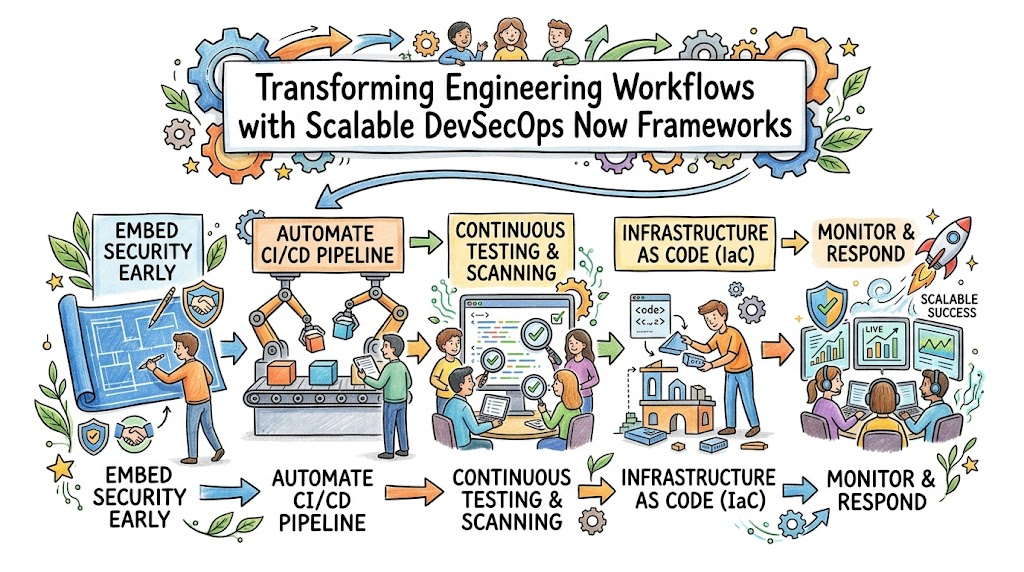
Smart engineering organizations overcome this friction by weaving continuous automated validation directly into their continuous integration workflows. Shifting security left empowers developers to discover and fix system defects instantly, transforming routine risk governance into an automated launchpad for rapid innovation.
What Is DevSecOpsnow?
DevSecOpsNow delivers an end-to-end operational blueprint that injects defensive guardrails straight into everyday developer toolchains. This modern platform unites software developers, infrastructure engineers, and compliance analysts under one collaborative delivery workflow.
Rather than running isolated post-build security checks, this system automates static code reviews, configuration enforcement, and vulnerability tracking across all repositories. Consequently, development organizations maintain high release velocity while preserving airtight defense standards across complex cloud environments.
Why DevSecOps Matters
Cloud-native ecosystems depend heavily on microservices, dynamic containers, and extensive third-party open-source components. Industry research proves that fixing critical security defects during live production burns thirty times more developer hours and budget than correcting them during the initial design phase.
Traditional Bottleneck:  [ Write Code ] ➔ [ Build Package ] ➔ [ Deploy to Cloud ] ➔ [ Manual Security Block 🛑 ]
DevSecOps Acceleration:  [ Threat Model ] ➔ [ Code + SAST ] ➔ [ Build + SCA ] ➔ [ Deploy + Runtime Watch ✅ ]
When engineering leaders neglect proactive pipeline protection, simple configuration oversights trigger severe data breaches and destroy consumer trust. Establishing automated pipeline defenses safeguards corporate reputation while keeping software releases fast, predictable, and resilient.
Core Building Blocks of a DevSecOps Program
Constructing an enterprise DevSecOps program requires coordinating continuous automation, actionable developer feedback, and shared engineering ownership across the delivery pipeline. High-velocity engineering teams focus on four foundational pillars:
- Automated Guardrails: Build pipelines trigger continuous SAST, DAST, SCA, secrets detection, and container security scans on every commit.
- Policy as Code: Deployment engines validate infrastructure manifests and container specifications against strict corporate compliance policies before launch.
- Continuous Feedback: Pull request bots deliver instant remediation steps directly within developers’ native version control consoles.
- Shared Accountability: Development, operations, and security specialists monitor unified indicators for pipeline speed and vulnerability remediation.
| Core Dimension | Tactical Focus | Primary Toolchain | Operational Value |
|---|---|---|---|
| Code Governance | Static Syntax & Secrets Detection | Semgrep, SonarQube, Gitleaks | Removes dangerous flaws and exposed credentials |
| Artifact Defense | Dependency Auditing & SBOM Creation | Trivy, Grype, Syft, Snyk | Blocks compromised third-party packages |
| Infrastructure Guard | Template Linting & Policy Rules | Checkov, tfsec, OPA Gatekeeper | Prevents cloud misconfigurations before rollout |
| Runtime Protection | System Observability & Threat Tracking | Falco, Cilium Tetragon, ModSecurity | Stops active exploits in production clusters |
DevSecOps and Cloud Security
Modern cloud architectures create dynamic attack vectors through ephemeral compute workloads, intricate identity permissions, and complex software networks. Engaging expert Cloud Security Consulting Services enables organizations to secure multi-cloud environments across Amazon Web Services, Microsoft Azure, and Google Cloud Platform.
Similarly, container clusters require specialized Kubernetes Security Consulting Services to harden admission controllers, pod identity configurations, and cluster network policies. For instance, platform engineers restrict container privilege levels and enforce namespace isolation to neutralize container breakout risks.
Software Supply Chain Security
Commercial software relies heavily on open-source dependencies, public registries, and external code packages. Technology leaders therefore hire dedicated Software Supply Chain Security Services to construct comprehensive Software Bills of Materials and verify artifact signatures.
Additionally, sophisticated threat actors routinely infiltrate build infrastructure, package dependencies, and automated pipeline scripts to inject malicious payloads. Development teams must verify artifact provenance and enforce cryptographic verification to protect code pipelines against unauthorized tampering.
Security Testing Across the SDLC
Protecting modern web applications requires combining multi-layered automated scanning engines with deep manual validation. High-velocity teams combine automated CI/CD pipeline scanners with professional Penetration Testing Services across cloud infrastructure, APIs, and microservices.
Phase 1: Code Authoring (SAST & Secrets Scanning)
   └── Identifies insecure syntax and exposed API credentials during pull requests.
Phase 2: Build Orchestration (SCA & SBOM Analysis)
   └── Validates external packages and creates software inventory records.
Phase 3: Pre-Production Staging (DAST & Penetration Testing)
   └── Simulates realistic exploit payloads against running application endpoints.
Phase 4: Production Runtime (Admission Control & Threat Detection)
   └── Enforces cluster guardrails and identifies anomalous system behaviors.
Automated test suites catch common coding errors quickly, while seasoned penetration testers uncover complex authorization flaws and business logic vulnerabilities.
DevSecOps Assessment: Finding the Starting Point
Launching an application security transformation without measuring existing capability gaps leads to wasted software budgets and developer frustration. Leveraging objective DevSecOps Assessment Services enables leadership teams to uncover release friction, visibility blindspots, and unpatched attack surfaces.
Following a thorough evaluation, security advisors provide an actionable, prioritized roadmap aligned with organizational delivery targets. Consequently, technology executives allocate engineering resources where they deliver maximum operational security.
DevSecOps Consulting Services
Designing modern software security requires deep technical experience across containerization, pipeline automation, and regulatory standards. Retaining professional DevSecOps Consulting Services helps organizations architect durable security controls without disrupting everyday feature velocity.
Furthermore, trusted consultants partner with internal teams to establish threat modeling baselines and optimize toolchains. Businesses eliminate technical debt and establish reliable operational guardrails that support smooth enterprise expansion.
DevSecOps Implementation Services
Integrating security controls into production CI/CD architectures requires careful pipeline orchestration, custom automation, and precise alert tuning. Through dedicated DevSecOps Implementation Services, engineering organizations deploy automated SAST, DAST, SCA, container scanners, and policy engines.
Active Developer Cycle:
[ Developer Git Push ] ➔ [ Automated Pipeline Verification ]
                                     │
                         ┌───────────┴───────────┐
                         ▼                       ▼
                  [ Code Approved ]       [ Rule Violation ]
                         │                       │
                         ▼                       ▼
                [ Production Merge ]    [ Rapid Inline Fix ]
Moreover, implementation experts calibrate severity thresholds to eliminate false positives and alert noise. Software developers concentrate on resolving genuine vulnerabilities without losing valuable delivery time.
DevSecOps Managed Services
Many expanding companies struggle to recruit and retain skilled cloud security practitioners in a competitive hiring market. Choosing DevSecOps Managed Services equips companies with round-the-clock platform engineering, policy management, vulnerability mitigation, and continuous system optimization.
Additionally, external engineering specialists monitor live clusters, refine scanning rules, and assist during urgent incident responses. In-house developers focus completely on creating commercial product features without compromising system reliability.
DevSecOps Training for Professionals
Individual software developers, DevOps practitioners, and platform engineers must regularly modernize their hands-on defensive engineering skills. Completing practical DevSecOps Training empowers technical professionals to master pipeline automation, infrastructure hardening, and container runtime visibility.
Furthermore, direct lab exercises guide engineers through configuring policy engines and patching real-world application flaws. Participating engineers advance their technical careers and champion robust security practices across their development teams.
Corporate DevSecOps Training
Building an enduring culture of security requires upskilling cross-functional delivery teams in a coordinated program. Deploying structured Corporate DevSecOps Training aligns product developers, operations engineers, and security analysts around shared delivery standards.
- Developer Tracks: Master secure coding frameworks, dependency auditing, and local IDE security linting.
- DevOps Tracks: Build hardened pipelines, integrate automated test suites, and configure policy engines.
- Platform Tracks: Enforce Kubernetes cluster hardening, cloud configuration baselines, and runtime protection.
- Security Tracks: Automate regulatory compliance audits, execute threat models, and streamline vulnerability triage.
Engaging enterprise workshops replace dry compliance lectures with interactive coding challenges and hands-on pipeline configurations. Engineering velocity accelerates because teams design secure code naturally throughout every sprint.
Common DevSecOps Mistakes
Organizations encounter significant friction when they execute automated security transformations without proper planning. Sidestepping these common operational mistakes prevents massive workflow disruptions:
- Tool Dumping: Procuring disconnected security scanners without embedding them directly into developer workflows.
- Alert Fatigue: Overwhelming software developers with thousands of minor warnings and unverified scanner findings.
- Late Ingestion: Executing security scans only during final production packaging rather than inside early code reviews.
- Siloed Responsibilities: Treating security as an isolated compliance function instead of a shared engineering goal.
How to Build a Sustainable DevSecOps Culture
Advanced tools and pipeline scripts fail without an open, collaborative engineering environment. Engineering leaders must nurture a blame-free atmosphere where developers openly analyze, remediate, and learn from application flaws.
Additionally, top-performing enterprises create Security Champion programs by embedding motivated developers inside individual product squads. These internal champions advocate for secure design principles, assist peer code reviews, and streamline cross-departmental collaboration.
DevSecOpsNow as a Practical Resource
DevSecOpsNow functions as a primary educational guide and operational partner for progressive engineering organizations worldwide. The platform publishes implementation blueprints, architecture designs, and actionable technical guides for cloud-native delivery teams.
Whether an organization demands maturity assessments, end-to-end scanner rollouts, or ongoing managed engineering, expert advisory delivers dependable results. Technology leaders transform compliance overhead into a clear competitive advantage.
A Practical DevSecOps Roadmap
Executing an enterprise security transformation requires a structured, phase-based operational approach:
- Discovery and Threat Modeling: Inventory all digital workloads, dependencies, data pipelines, and compliance targets.
- Foundational Automation: Connect static analysis and secrets scanning directly to git pull request workflows.
- Pipeline Enforcement: Embed container scanning, dependency validation, and policy checks into continuous build runners.
- Runtime Defense & Testing: Implement runtime threat visibility, schedule penetration tests, and automate response runbooks.
Frequently Asked Questions About DevSecOpsNow
1. What primary features separate DevSecOps from standard DevOps workflows?
DevSecOps embeds automated vulnerability validation, compliance controls, and threat monitoring directly across every phase of the development lifecycle instead of relying on post-build audits.
2. Why do engineering leaders mandate comprehensive baseline security assessments?
Assessments pinpoint architectural gaps, high-priority vulnerabilities, and workflow bottlenecks, ensuring engineering leaders direct tooling budgets toward the highest operational risks.
3. Which critical security scanners belong inside continuous delivery pipelines?
Complete delivery pipelines execute static application testing, software composition analysis, secrets detection, infrastructure-as-code linting, and container vulnerability scanning.
4. In what ways does policy-as-code secure cloud infrastructure environments?
Policy-as-code evaluates Terraform scripts, CloudFormation templates, and Kubernetes manifests against security baselines before cloud providers provision live infrastructure.
5. Why must development teams maintain an accurate Software Bill of Materials?
Maintaining an accurate Software Bill of Materials tracks external packages and nested dependencies, helping engineers locate and patch newly disclosed vulnerabilities instantly.
6. Which key responsibilities define the daily role of a Security Champion?
Security Champions guide secure coding practices, conduct peer architecture reviews, and facilitate seamless technical collaboration between developers and core security analysts.
7. How do managed engineering services assist internal delivery teams?
Managed services provide specialized security engineering capacity, continuous pipeline maintenance, vulnerability remediation support, and live system monitoring without costly internal recruitment.
8. When should technology leaders arrange professional penetration tests?
Organizations should execute penetration tests periodically, following significant architecture migrations, or before launching critical web applications to evaluate defenses against skilled attackers.
9. Why does corporate training increase continuous delivery speed?
Educating engineers on secure coding prevents flaws during initial authoring, eliminating expensive code rework and keeping deployment pipelines clear.
10. Which performance metrics prove that a security transformation succeeded?
Successful programs track shrinking Mean Time to Remediate, higher automated test coverage, lower change failure rates, and accelerating release cadence.
Final Thoughts
Sustainable application resilience demands an intentional combination of automated scanners, continuous developer enablement, and shared operational ownership. Engineering organizations that integrate automated guardrails directly into everyday delivery cycles achieve faster release cadences, reduced compliance stress, and resilient defenses.
Evaluating maturity gaps, automating pipeline controls, and empowering technical teams converts traditional security friction into a major competitive strength. Deploying modern DevSecOps methodologies today guarantees your organization builds dependable cloud applications that expand securely without disruption.

- Accelerating Modern Business Growth Through Intelligent Software Engineering And Scalable Cloud Architectures - September 5, 2026
- Building Resilient Enterprise Cloud Platforms Through Automation And Modern Reliability Engineering - September 5, 2026
- Building Resilient Software Platforms Through Modern Engineering And Enterprise Automation - September 4, 2026