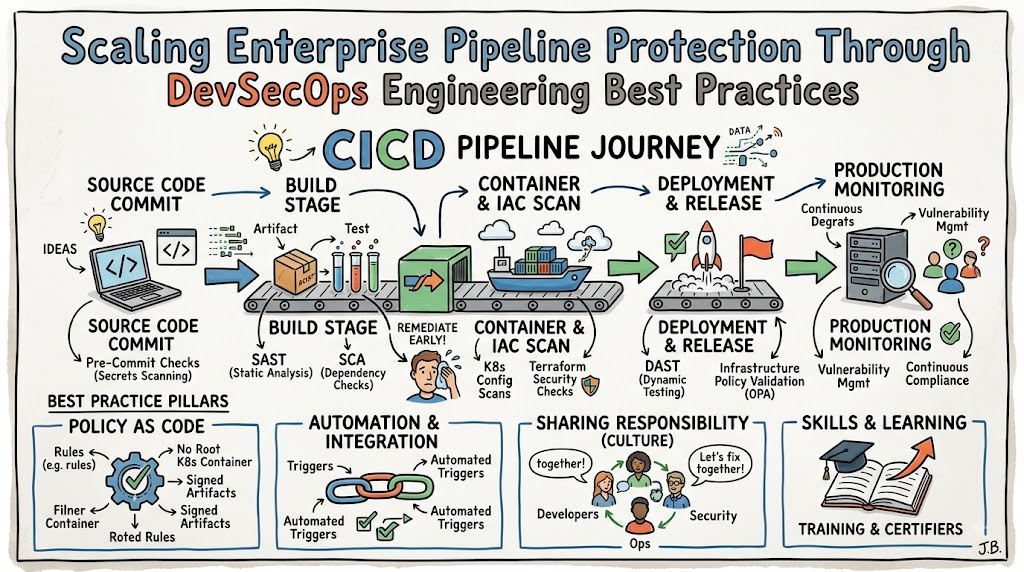
Introduction
Accelerating development velocity without robust guardrails exposes modern organizations to severe software supply chain compromises. Engineering leaders resolve this critical vulnerability by embedding security controls directly into the daily programming rhythm.
Instead of delaying deployments for manual compliance sign-offs, development and operations teams now enforce automated testing across every commit. Developers analyze code syntax, operators validate cloud templates, and architects enforce least-privilege policies continuously. Securing specialized knowledge in these automation practices equips engineers with the tools necessary to eliminate security debt permanently.
Transforming Security Through DevSecOps Principles
Modern enterprises deploy distributed microservices across dynamic cloud environments using continuous delivery pipelines. Unfortunately, rapid release cadences introduce severe operational risks whenever teams treat security verification as an isolated manual task. DevSecOps overcomes this hurdle by integrating automated defensive gates directly into source control repositories and continuous integration runners.
+-------------------------------------------------------------------+
|               CONTINUOUS INTEGRATION DEFENSE SUITE                |
|                                                                   |
|   Developer Commit  -->  Pull Request  -->  Automated Runners     |
|   (Pre-commit Hook)      (Code Review)      (Security Audit)      |
|           |                    |                    |             |
|     Secret Scanners       Static Analysis     Container Scans     |
|     & Syntax Linters       & Code Quality      & Dependency CVEs  |
+-------------------------------------------------------------------+
Developers receive actionable defect reports within minutes of submitting code changes. Consequently, engineering squads fix security flaws during initial development sprints, drastically reducing remediation expenses while protecting live enterprise systems.
Core Security Scanning Layers Across the Delivery Pipeline
Comprehensive security programs deploy automated verification tooling across each tier of the software construction process. Engineering teams create robust defense-in-depth frameworks by orchestrating static scanners, dependency analyzers, dynamic test suites, and cryptographic secret vaults inside unified continuous delivery workflows.
| Security Domain | Operational Function | Primary Tool Ecosystem |
|---|---|---|
| Static Code Inspection (SAST) | Identifies software bugs, logic flaws, and injection vectors | SonarQube, Semgrep, Checkmarx |
| Software Composition (SCA) | Identifies vulnerable third-party libraries and license risks | Snyk, Trivy, OWASP Dependency-Check |
| Dynamic Application Probing (DAST) | Discovers live endpoint flaws and runtime vulnerabilities | OWASP ZAP, Burp Suite, Nuclei |
| Secrets Management | Protects API tokens, manages keys, and prevents credential leaks | HashiCorp Vault, GitGuardian, Trufflehog |
| Infrastructure Scanners | Validates Terraform templates against compliance baselines | Checkov, tfsec, Terrascan |
Building Automated Quality Gates in CI/CD
Platform teams design automated guardrails inside tools like Jenkins, GitHub Actions, and GitLab CI to fail non-compliant builds immediately. Configuring these automated decision engines guarantees that only cryptographically signed, thoroughly evaluated binaries advance into production environments.
+-------------------------------------------------------------------------+
|                  CONTINUOUS PIPELINE EXECUTION FLOW                     |
|                                                                         |
|  [ Code Push ] ---> [ Static Analysis ] ---> [ Dependency Checks ]      |
|                             |                          |                |
|                             v                          v                |
|  [ Deploy Live ] <-- [ Policy Gate ] <--- [ Container Inspection ]      |
|    (Release)           (Pass/Fail)             (Trivy / Snyk)           |
+-------------------------------------------------------------------------+
Step-by-Step CI/CD Hardening Procedures:
- Enforce Repository Controls: Mandate signed commits, branch protection rules, and local pre-commit secret scanners across all repositories.
- Run Static Code Scanners: Trigger automated static analyzers on every pull request to identify code defects prior to compilation.
- Scan Container Layers: Inspect base container images for outdated packages and critical CVEs before publishing them to registries.
- Sign Application Binaries: Attach digital signatures to build artifacts to guarantee code provenance across production clusters.
Completing structured DevSecOps Certification Training teaches practitioners how to implement these robust automation architectures in complex production environments.
Enforcing Policy as Code Guardrails
Cloud platform engineers translate governance policies into declarative code instead of relying on outdated internal wikis. Policy as Code converts compliance rules into versioned, testable logic that runs automatically prior to cloud resource provisioning.
+-------------------------------------------------------------------------+
|                     POLICY AS CODE DECISION FLOW                        |
|                                                                         |
|   Deployment Plan  --->  [ Open Policy Agent (OPA) ]                    |
|                                   |                                     |
|               +-------------------+-------------------+                 |
|               |                                       |                 |
|               v                                       v                 |
|      [ Compliance Passed ]                  [ Policy Violation ]        |
|       (Deploy Resources)                     (Reject Pull Request)      |
+-------------------------------------------------------------------------+
Using policy engines like Open Policy Agent (OPA), Kyverno, and Rego, engineers enforce strict constraints over cloud infrastructure. These tools evaluate deployment manifests in real time, automatically rejecting configurations that fail to meet corporate security baselines.
Hardening Container and Kubernetes Workloads
Container orchestration environments demand comprehensive defense across API control planes, compute nodes, and pod network interfaces. Completing rigorous Kubernetes Security Training enables engineers to secure container clusters against privilege escalation and malicious lateral movement.
+-------------------------------------------------------------------------+
|                   KUBERNETES LAYERED DEFENSE MATRIX                     |
|                                                                         |
|  [ Control Plane API ]    --> Enforce RBAC & Admission Webhooks         |
|  [ Container Workloads ]  --> Enforce Read-Only Filesystems & Rootless  |
|  [ Network Layer ]        --> Implement NetworkPolicies & Service Mesh  |
|  [ Host Kernel Layer ]    --> Monitor System Calls via Falco & eBPF     |
+-------------------------------------------------------------------------+
Core Kubernetes Defense Strategies:
- Enforce Strict RBAC: Restrict service account permissions and eliminate wildcard access rules across all cluster namespaces.
- Deploy Admission Controllers: Reject pods that attempt to run with root privileges or mount sensitive host directories.
- Isolate Network Traffic: Block unauthorized East-West pod communication using declarative Kubernetes network policies.
- Monitor Kernel Events: Capture suspicious system calls and abnormal process activity using eBPF runtime monitors like Falco.
Securing Cloud Infrastructure and Declarative Code
Cloud platform engineers manage infrastructure declaratively using Terraform, OpenTofu, and CloudFormation. Scanning these infrastructure templates during the build cycle prevents misconfigured storage buckets, open ports, and overly permissive identity roles.
+-------------------------------------------------------------------------+
|               INFRASTRUCTURE AS CODE VALIDATION LIFECYCLE               |
|                                                                         |
|  [ Terraform Code ] ---> [ Static IaC Scanners ] ---> [ Cloud Apply ]   |
|     (Developer PR)         (Checkov / tfsec)          (Secure State)    |
+-------------------------------------------------------------------------+
Static analysis tools like Checkov and tfsec validate infrastructure templates against established center-for-internet-security benchmarks. In addition, Cloud Security Posture Management platforms continuously monitor deployed assets, alerting teams whenever live configurations drift away from baseline standards.
Prioritizing Vulnerabilities with Exploit Intelligence
Top-tier engineering teams avoid scanner fatigue by focusing on true exploitability rather than raw alert volume. Unifying static analysis outputs, dependency reports, and cloud alerts into a single dashboard accelerates incident triage and keeps developers focused.
+-------------------------------------------------------------------------+
|                  VULNERABILITY PRIORITIZATION PIPELINE                  |
|                                                                         |
|  Raw Scanner Alerts ---> EPSS Score Filter ---> Asset Criticality --->  |
|  (Trivy / Snyk Logs)     (Active Exploits)      (High-Value Targets)    |
|                                                      |                  |
|                                                      v                  |
|                                            [ Immediate Patching ]       |
+-------------------------------------------------------------------------+
Combining CVSS severity ratings with the Exploit Prediction Scoring System (EPSS) allows engineers to resolve active threats first. This data-driven strategy shrinks remediation windows while enabling product teams to maintain high release velocity.
Automating Continuous Regulatory Compliance
Manual compliance audits consume excessive engineering time and produce outdated point-in-time assessments. Automated compliance frameworks transform regulatory standards such as SOC 2, HIPAA, and ISO 27001 into executable continuous tests.
+-------------------------------------------------------------------------+
|                    CONTINUOUS COMPLIANCE PIPELINE                       |
|                                                                         |
|  [ Compliance Standard ] ---> [ Automated Tests ] ---> [ Audit Logs ]   |
|      (ISO / SOC 2)               (InSpec / OPA)          (Live Proof)   |
+-------------------------------------------------------------------------+
Continuous integration pipelines execute compliance verification alongside functional tests, capturing immutable digital proof on every release. As a result, engineering teams generate audit-ready evidence continuously without delaying feature delivery deadlines.
Cultivating an Engineering Security Culture
Security automation succeeds only when leadership builds an organizational culture centered on shared accountability. Establishing a Security Champions network distributes practical security expertise directly across individual development squads.
+-------------------------------------------------------------------------+
|                 SECURITY CHAMPIONS COLLABORATION MODEL                  |
|                                                                         |
|  [ Core Security Team ] <====== Standards & Tooling Guidance ======>    |
|                                                                         |
|      +-----------------+   +-----------------+   +-----------------+    |
|      |  Feature Squad  |   | Platform Squad  |   | Cloud Ops Squad |    |
|      | [Security Champ]|   | [Security Champ]|   | [Security Champ]|    |
|      +-----------------+   +-----------------+   +-----------------+    |
+-------------------------------------------------------------------------+
Security champions assist their teammates during design reviews and conduct initial threat modeling sessions. Furthermore, engineering leaders reinforce positive outcomes by celebrating fast remediation rather than penalizing developers when scanners discover flaws.
Avoiding Common Implementation Pitfalls
Organizations often encounter severe roadblocks when rolling out security automation by inundating developers with too many noisy alerts at once. Teams must introduce scanners gradually, configuring initial quality gates to fail builds only on high-severity, exploitable vulnerabilities.
+-------------------------------------------------------------------------+
|                  EFFECTIVE ADOPTION VS COMMON ERRORS                    |
|                                                                         |
|  INEFFECTIVE PRACTICES            SUCCESSFUL STRATEGIES                 |
|  ---------------------            ---------------------                 |
|  Failing builds on low flaws  --> Block strictly on High/Critical CVEs  |
|  Hiding scanner output        --> Surface actionable errors inside IDE  |
|  Leaving default scanner rules--> Fine-tune rulesets to remove noise    |
|  Mandating tools without labs --> Provide comprehensive practical labs  |
+-------------------------------------------------------------------------+
Providing targeted training helps developers interpret scanner outputs and remediate root causes quickly. As engineers build operational competence, teams can expand scan coverage without interrupting delivery schedules.
Building Capabilities with Comprehensive Training
Securing modern cloud platforms requires extensive hands-on experience with production-grade tooling. Enrolling in structured DevSecOps Training gives engineers the practical knowledge needed to tackle complex architectural challenges.
Completing an immersive DevSecOps Course ensures that developers and operations specialists gain direct experience configuring live CI/CD pipelines, container environments, and cloud infrastructure. Through practical lab exercises, students master policy automation, pipeline hardening, and application risk elimination.
Strategic Upskilling Across Technical Teams
Modern security transformations require close collaboration across multiple engineering disciplines:
- Software Developers: Master secure coding practices, eliminate injection vulnerabilities, and triage static analysis findings directly within their IDEs.
- DevOps Specialists: Construct automated pipelines, manage container images, enforce secrets protection, and automate infrastructure audits.
- Cybersecurity Analysts: Develop scripting proficiency, automate policy controls, and integrate security verification into continuous delivery systems.
- Cloud Architects: Design resilient cloud architectures that incorporate policy-as-code guardrails, automated auditing, and robust access governance.
Upskilling Through Online Training Platforms
Distributed engineering teams require flexible access to enterprise-grade lab environments to build practical security competencies. Participating in structured DevSecOps Online Training combines live expert mentorship with on-demand interactive cloud sandboxes.
Students construct automated pipelines, configure policy engines, and analyze real software vulnerabilities from any location. Expert guidance ensures that learners overcome technical challenges quickly and master complex enterprise integrations.
Enterprise Training in Indian Tech Hubs
Rapid expansion across global technology centers has created unprecedented demand for skilled security engineers. Enrolling in recognized DevSecOps Training in India provides local professionals and organizations with world-class curriculum aligned to global engineering benchmarks.
Furthermore, forward-looking enterprises utilize customized Corporate DevSecOps Training to upskill development, operations, and platform engineering teams simultaneously. This targeted training accelerates digital modernization while building internal security expertise.
Proving Expertise with Engineer Certification
Securing an industry-recognized credential validates an engineer’s ability to implement automated security controls in production environments. Earning a DevSecOps Engineer Certification confirms hands-on technical proficiency over multiple-choice theory.
Candidates demonstrate their capabilities by building secure deployment pipelines, remediating container flaws, and enforcing policy guardrails. Hiring managers look for certified engineers to lead modernization initiatives and protect cloud infrastructure.
Reaching Certified DevSecOps Professional Status
Achieving the status of a Certified DevSecOps Professional represents complete mastery over automated security architecture and governance. This credential validates deep expertise in multi-cloud security, compliance automation, and runtime container defense.
+-------------------------------------------------------------------------+
|                  PROFESSIONAL MASTERY ROADMAP                           |
|                                                                         |
|  [ Foundation Level ]     [ Practitioner Level ]    [ Expert Level ]    |
|  - SAST / SCA Basics      - Secure CI/CD Pipelines  - Multi-Cloud Ops   |
|  - Git Guardrails         - Kubernetes Hardening    - eBPF Runtime      |
|  - Container Scans        - Policy as Code (OPA)    - Threat Modeling   |
+-------------------------------------------------------------------------+
Certified professionals guide engineering teams through complex security transformations, establish resilient infrastructure baselines, and protect enterprise platforms against evolving attack vectors.
Selecting an Industry-Leading Learning Program
Choosing the right training program requires evaluating curriculum depth, practical lab availability, and instructor background. High-impact programs emphasize active engineering over passive slide presentations.
Key Program Indicators:
- Toolchain Depth: Ensure the curriculum covers essential tools like SonarQube, Trivy, Semgrep, Checkov, Vault, OPA, and Kubernetes.
- Live Cloud Labs: Verify that learners practice inside real cloud sandboxes rather than restricted local emulators.
- Practitioner Instructors: Select programs taught by active cybersecurity practitioners with enterprise experience.
- Continuous Support: Look for programs that offer active technical forums, updated course materials, and career guidance.
DevSecOpsSchool Applied Learning Methodology
DevSecOpsSchool delivers comprehensive training designed to build genuine, production-ready engineering capabilities. Rather than teaching abstract concepts, the curriculum immerses students in real-world scenarios, complete pipelines, and industry-standard security tools.
Students configure automated scanners, write granular Rego policies, and harden container clusters from the ground up. Combining expert mentorship with intensive lab sessions allows DevSecOpsSchool to prepare engineers to implement automated security with total confidence.
Frequently Asked Questions About DevSecOpsSchool
- Which foundational skills help candidates succeed in this program?Candidates benefit from basic familiarity with Linux command-line tools, Git version control workflows, and foundational containerization or DevOps concepts.
- Where does DevSecOps differ from traditional security gatekeeping?DevSecOps integrates automated security checks directly into continuous delivery pipelines, whereas traditional security relies on manual audits right before release.
- What specific automated scanning utilities do students configure in the program?Students work directly with industry-standard tools including SonarQube, Semgrep, OWASP ZAP, Snyk, Trivy, Checkov, HashiCorp Vault, and Open Policy Agent.
- Does the certification evaluation test practical skills or theoretical memory?The certification exam evaluates candidates through practical, scenario-based lab challenges where students must secure pipelines, fix vulnerabilities, and enforce compliance policies.
- Can businesses organize customized corporate learning programs for internal teams?Yes, organizations can tailor corporate training programs to match their specific cloud providers, internal technology stacks, and operational delivery pipelines.
- What career paths become available after securing this credential?Graduates step into roles such as DevSecOps Engineer, Cloud Security Specialist, Application Security Engineer, and Security Automation Architect.
- How does the training program cover Kubernetes workload protection?The program provides comprehensive modules on container image scanning, admission controllers, RBAC enforcement, network segmentation, and eBPF runtime monitoring.
- Do students receive live cloud sandbox environments for lab exercises?Yes, students receive dedicated cloud sandbox access to build secure pipelines, configure policy engines, and remediate realistic security flaws.
- How often do instructors update the technical curriculum and lab materials?Instructors update course materials continuously to incorporate emerging security tools, modern cloud features, evolving threat vectors, and new compliance standards.
- What mentorship and community support resources do learners access during training?Learners access live instructor office hours, collaborative technical chat rooms, interactive discussion boards, and real-time troubleshooting assistance throughout the program.
Final Thoughts
Constructing scalable cloud applications requires an unyielding commitment to automated defense mechanisms. When organizations treat security checks as continuous automated tests, development velocity and system reliability reinforce each other naturally.
Mastering advanced pipeline automation, container hardening, and declarative policy engines positions engineering teams to safeguard critical enterprise assets against emerging threat landscapes. Taking decisive action to upskill technical staff ensures that your organization ships resilient code rapidly and maintains an unshakable security posture.

- Accelerating Modern Business Growth Through Intelligent Software Engineering And Scalable Cloud Architectures - September 5, 2026
- Building Resilient Enterprise Cloud Platforms Through Automation And Modern Reliability Engineering - September 5, 2026
- Building Resilient Software Platforms Through Modern Engineering And Enterprise Automation - September 4, 2026