Introduction
Retrieval-Augmented Generation (RAG) has rapidly become the cornerstone of enterprise AI, providing a critical bridge between the reasoning capabilities of Large Language Models (LLMs) and the private, ever-changing data of an organization. Unlike traditional AI models that rely solely on their internal training data, RAG tooling enables systems to “look up” relevant information from external sources—such as PDFs, databases, and wikis—before generating a response. This process ensures that AI outputs are grounded in reality, up-to-date, and significantly less prone to “hallucinations.”
As businesses shift toward automation-first operations, RAG tools have become essential for building intelligent systems that can handle complex research, legal document review, and high-accuracy customer support. When selecting the right RAG tooling, users must evaluate orchestration flexibility, the efficiency of data indexing, integration depth, and stringent security controls. A robust RAG pipeline not only improves the quality of AI interactions but also ensures that proprietary data remains secure and manageable at scale.
Best for:
RAG tooling is ideal for developers, data engineers, and enterprise leaders who need to build AI applications that require access to specific, private, or real-time data. It is particularly valuable for industries like legal, healthcare, finance, and technical support where accuracy and citations are non-negotiable.
Not ideal for:
These tools may not be necessary for users seeking simple creative writing or general-purpose chatbots that don’t require external data. Organizations without technical resources might find the setup of professional RAG pipelines overly complex compared to using “out-of-the-box” AI assistants.
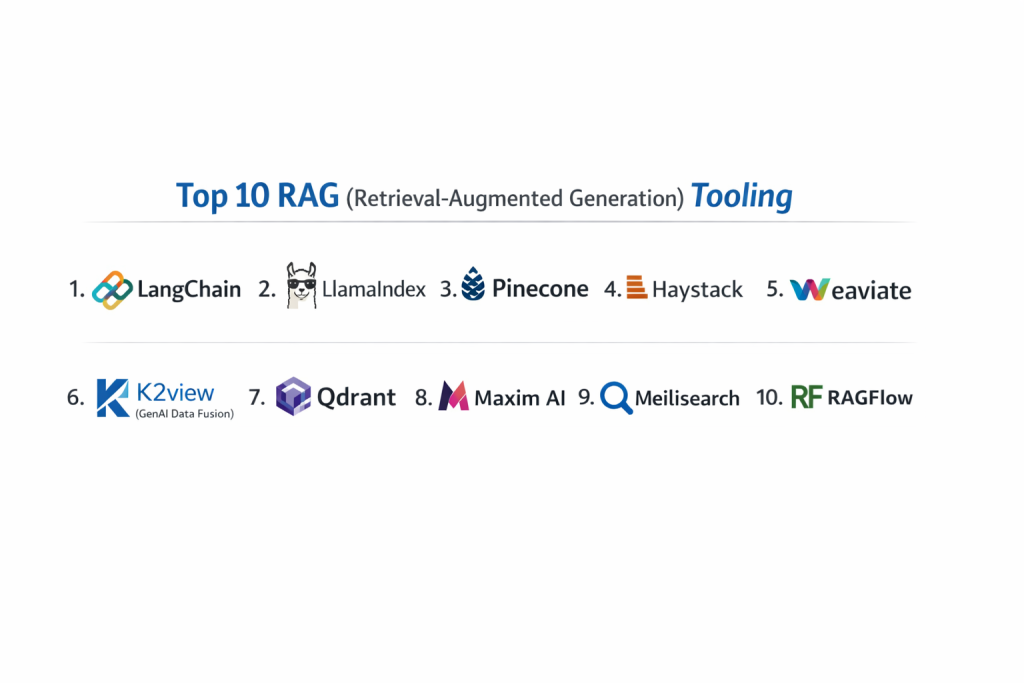
Top 10 RAG (Retrieval-Augmented Generation) Tools
1 — LangChain
Short description:
The most popular open-source orchestration framework designed to “chain” together various AI components, LLMs, and vector stores into complex RAG workflows.
- Key features
- Extensive library of document loaders (PDF, Slack, Notion).
- Modular “chains” for multi-step reasoning.
- Integrated memory management for long conversations.
- Support for nearly every major LLM and Vector DB.
- LangGraph for building stateful, agentic RAG systems.
- Pros
- Unmatched flexibility and ecosystem support.
- Largest community for troubleshooting and pre-built templates.
- Cons
- Significant learning curve for beginners.
- Can feel overly “verbose” or complex for simple retrieval tasks.
- Security & compliance:Varies by deployment; supports SOC 2 via LangSmith and private VPC hosting.
- Support & community:Massive open-source community, comprehensive documentation, and professional support through LangChain’s paid tiers.
2 — LlamaIndex
Short description:
A data-centric framework specifically optimized for connecting, indexing, and querying large or complex datasets for LLM applications.
- Key features
- Advanced data indexing (Tree, List, Vector, and Keyword).
- Query engines tailored for high-accuracy retrieval.
- Intelligent “chunking” strategies for better context.
- Native connectors for 100+ data sources.
- Support for “Agentic RAG” which can navigate data autonomously.
- Pros
- Generally faster and more accurate for search-heavy tasks than LangChain.
- Simpler API for getting started with “Chat with your PDF” use cases.
- Cons
- Less focus on general-purpose AI agent workflows.
- Smaller library of non-data-related integrations.
- Security & compliance:Varies / N/A; depends on the underlying infrastructure used for deployment.
- Support & community:Active Discord, high-quality technical blog, and growing enterprise adoption.
3 — Pinecone
Short description:
A managed, serverless vector database that serves as the “long-term memory” for RAG applications by storing and searching high-dimensional embeddings.
- Key features
- Serverless architecture with zero infrastructure management.
- Ultra-low latency similarity search at scale.
- Hybrid search (keyword + semantic) capabilities.
- Namespaces for multi-tenant data isolation.
- Live index updates and vertical scaling.
- Pros
- Simplifies production deployment by removing “DBA” overhead.
- Industry-leading performance for high-concurrency applications.
- Cons
- Proprietary SaaS model (no self-hosting option).
- Costs can scale quickly with high vector counts.
- Security & compliance:SOC 2 Type II, HIPAA, and GDPR compliant; supports encryption at rest.
- Support & community:Dedicated enterprise support tiers and excellent developer documentation.
4 — Haystack
Short description:
An open-source Python framework designed for building production-ready search systems and RAG pipelines using a modular, component-based approach.
- Key features
- Component-based architecture for clean code.
- Advanced “Rankers” to refine retrieval results.
- Deep integration with Elasticsearch and OpenSearch.
- Pipeline visualizer for debugging complex flows.
- Multilingual support for global applications.
- Pros
- Built for stability and enterprise-grade performance.
- Excellent documentation and clear, readable API design.
- Cons
- Smaller integration marketplace than LangChain.
- Steep learning curve for those unfamiliar with traditional search concepts.
- Security & compliance:Varies / N/A; standard open-source license.
- Support & community:Strong developer community in Europe and active GitHub maintenance.
5 — Weaviate
Short description:
An open-source vector database that combines vector search with a structured knowledge graph, allowing for highly relational RAG queries.
- Key features
- Multi-modal support (search images, text, and video).
- GraphQL and REST API support.
- Built-in modules for popular LLM providers.
- Hybrid search and keyword filtering.
- Scalable to billions of data objects.
- Pros
- Very developer-friendly with an intuitive schema system.
- Can be self-hosted on-premise for maximum data sovereignty.
- Cons
- Resource-intensive to host for small-scale projects.
- Management of the self-hosted version requires DevOps expertise.
- Security & compliance:SOC 2 Type II, ISO 27001; enterprise cloud offers full RBAC.
- Support & community:Active Slack community and a well-regarded “Weaviate Academy.”
6 — K2view (GenAI Data Fusion)
Short description:
An enterprise-first platform that organizes fragmented data into unified “Business Entity” views specifically for RAG applications.
- Key features
- Real-time data fusion from legacy systems.
- Dynamic data masking for privacy compliance.
- Specialized for structured and semi-structured data.
- Built-in data governance and lineage.
- High-scale operational data delivery.
- Pros
- Solves the “messy data” problem in large enterprises.
- Strongest focus on data privacy and PII protection.
- Cons
- Not suitable for solo developers or lightweight apps.
- Complex initial configuration and higher price point.
- Security & compliance:SOC 2, GDPR, HIPAA, and ISO 27001 compliant.
- Support & community:High-touch enterprise support and professional service offerings.
7 — Qdrant
Short description:
A high-performance vector similarity search engine written in Rust, optimized for speed and efficient metadata filtering.
- Key features
- Written in Rust for memory safety and performance.
- Advanced payload filtering during search.
- Distributed deployment for horizontal scaling.
- Binary quantization for reduced memory footprint.
- Simple and clean REST/gRPC API.
- Pros
- Extremely fast retrieval even with complex metadata filters.
- Cost-efficient resource usage compared to other vector DBs.
- Cons
- UI/Dashboard is less feature-rich than Pinecone.
- Smaller ecosystem of pre-built “wrappers.”
- Security & compliance:GDPR compliant; supports API-key authentication and TLS.
- Support & community:Growing open-source community and managed cloud options available.
8 — Maxim AI
Short description:
A RAG evaluation and observability platform designed to test, monitor, and improve the quality of AI responses in production.
- Key features
- Playground++ for side-by-side RAG strategy testing.
- Automated evaluation metrics (Faithfulness, Relevance).
- Distributed tracing for multi-step retrieval flows.
- Real-time quality alerts and monitoring.
- Versioning for prompts and RAG configurations.
- Pros
- Provides the “visibility” needed to prevent hallucinations.
- Essential for teams moving from prototype to production.
- Cons
- It is an observability layer, not a storage or orchestration tool.
- Adds an additional step (and cost) to the development stack.
- Security & compliance:SOC 2 Type II; enterprise SSO and audit logs.
- Support & community:Direct Slack support for enterprise teams and extensive technical guides.
9 — Meilisearch
Short description:
A user-facing search engine that has expanded into RAG by offering ultra-fast hybrid search and typo tolerance.
- Key features
- Typo-tolerant, “search-as-you-type” experience.
- Hybrid search (BM25 keyword + Vector).
- Multilingual support for over 20 languages.
- Instant indexing for real-time applications.
- Lightweight and easy to host.
- Pros
- Best-in-class performance for search applications where speed is key.
- Very easy to configure without deep ML knowledge.
- Cons
- Vector features are newer and less mature than specialized vector DBs.
- Limited advanced AI agent features.
- Security & compliance:SOC 2 Type II (Cloud); API key management.
- Support & community:Excellent documentation and a very helpful community on GitHub.
10 — RAGFlow
Short description:
An open-source RAG engine focused on deep document understanding and “truthful” question-answering with visible citations.
- Key features
- Deep document parsing for complex PDF layouts.
- Visual chunking tool to see how data is split.
- Built-in “Agentic” workflows for complex tasks.
- Support for citations and source grounding.
- Docker-based deployment for easy setup.
- Pros
- Excellent for research-heavy tasks where source transparency is vital.
- User-friendly UI for non-technical users to manage data.
- Cons
- Newer tool with a smaller community.
- Less flexible than LangChain for custom coding.
- Security & compliance:Varies / N/A; depends on the user’s hosting environment.
- Support & community:Rising GitHub popularity and active open-source contributors.
Comparison Table
| Tool Name | Best For | Platform(s) Supported | Standout Feature | Rating |
| LangChain | Developers | Python, JS | Modular Chaining | N/A |
| LlamaIndex | Data Indexing | Python, JS | Semantic Search Depth | N/A |
| Pinecone | Managed Scaling | Cloud (SaaS) | Zero-maintenance DB | 4.8 / 5 |
| Haystack | Industrial Search | Python | Search Pipelines | N/A |
| Weaviate | Knowledge Graphs | Self-host, Cloud | Multi-modal Search | 4.7 / 5 |
| K2view | Enterprise Data | On-prem, Cloud | PII Masking/Fusion | 4.9 / 5 |
| Qdrant | Performance | Self-host, Cloud | Rust-based Speed | 4.8 / 5 |
| Maxim AI | RAG Evaluation | Cloud (SaaS) | Quality Observability | N/A |
| Meilisearch | Fast Search | Self-host, Cloud | Typo-tolerant Hybrid | 4.6 / 5 |
| RAGFlow | Deep Parsing | Docker (OSS) | Visual Chunking | N/A |
Evaluation & Scoring of RAG Tooling
| Tool | Core Features (25%) | Ease of Use (15%) | Integrations (15%) | Security (10%) | Performance (10%) | Support (10%) | Price/Value (15%) | Total Score |
| LangChain | 24 | 10 | 15 | 8 | 8 | 9 | 13 | 87 |
| LlamaIndex | 23 | 12 | 13 | 8 | 9 | 8 | 13 | 86 |
| Pinecone | 22 | 14 | 14 | 10 | 10 | 9 | 10 | 89 |
| K2view | 21 | 9 | 12 | 10 | 9 | 10 | 11 | 82 |
| Qdrant | 22 | 11 | 11 | 9 | 10 | 8 | 14 | 85 |
Which RAG Tool Is Right for You?
Choosing the right tool is a balance between your technical skill set and the complexity of your data.
- Solo Users & Prototyping: If you are just starting, LlamaIndex or Meilisearch are the most rewarding. They offer the fastest “time-to-value” and have clear paths for simple RAG applications.
- SMBs & Growth Teams: A combination of LangChain for logic and Pinecone for storage is the industry standard for a reason. It scales seamlessly as your user base grows.
- Mid-market & High-Performance: If latency is your primary concern, look toward Qdrant. Its Rust-based core ensures your AI stays snappy even as your database expands to millions of records.
- Enterprise & Regulated Industries: For those in healthcare or finance, K2view or self-hosted Weaviate are the top choices. These provide the governance and data masking required to pass strict security audits.
- Budget-conscious: Stick to open-source frameworks like Haystack or RAGFlow and host them on your own infrastructure to avoid the “SaaS tax.”
Frequently Asked Questions (FAQs)
- What is RAG tooling?
It is a set of software frameworks and databases that allow an AI model to retrieve factual information from external sources before generating a response. - How does RAG differ from traditional AI search?
Traditional search gives you a list of links; RAG tooling uses those links to find specific answers and synthesizes them into a single, natural-sounding response. - Do I need a vector database for every RAG project?
For small projects (under 100 documents), simple keyword search can work, but for anything larger, a vector database is essential for maintaining speed and accuracy. - Is RAG secure for sensitive company data?
Yes, provided you use tools with enterprise-grade security like SOC 2 compliance or host the tools on your own private servers (on-premise). - Does RAG eliminate AI hallucinations completely?
It significantly reduces them by grounding the AI in facts, but it doesn’t eliminate them entirely—proper evaluation and “re-ranking” tools are still needed. - Can I use RAG without any coding skills?
Yes, tools like RAGFlow or Zapier’s AI integrations allow for no-code RAG, though they offer less flexibility than code-based frameworks. - Which programming language is most common for RAG?
Python is the primary language for RAG tooling, followed by JavaScript/TypeScript, due to the extensive AI and data science libraries available in those ecosystems. - What is “Hybrid Search” in RAG?
It is a technique that combines keyword matching (finding exact words) with semantic search (finding meanings), resulting in much more reliable information retrieval. - How expensive is it to run a RAG system?
Open-source tools are free, but you will pay for “tokens” (AI usage) and managed database hosting, which can range from $20 to thousands per month depending on scale. - Can RAG tools handle images and videos?
Yes, multi-modal RAG tools like Weaviate can index and search through visual data just as easily as text-based documents.
Conclusion
The landscape of RAG (Retrieval-Augmented Generation) tooling is maturing rapidly, moving from experimental scripts to production-grade infrastructure. While there is no single “best” tool, the right choice involves aligning your data’s complexity with the platform’s orchestration power. For developers seeking flexibility, LangChain remains king; for enterprises seeking security, K2view is the gold standard.
Ultimately, the goal of any RAG pipeline is to turn static data into actionable intelligence. By carefully selecting your storage, orchestration, and evaluation layers, you can build an AI system that doesn’t just talk, but truly knows and understands your business.
Meta Description: Compare the top 10 RAG (Retrieval-Augmented Generation) tools of 2026. Explore features, pros, and cons of LangChain, LlamaIndex, Pinecone, and more to build a rank-ready AI application.

- Top 10 Email Deliverability Tools: Features, Pros, Cons & Comparison - September 6, 2026
- Top 10 Pharmacovigilance Software: Features, Pros, Cons & Comparison - September 6, 2026
- Top 10 Manufacturing Execution Systems (MES) - July 30, 2026
Thanks for this detailed comparison of RAG tooling—this is a really valuable resource for anyone working with generative AI! Retrieval‑Augmented Generation (RAG) enhances large language models (LLMs) by incorporating relevant external data before generating output, which helps improve accuracy, reduce hallucinations, and ground responses in real information rather than only training data. RAG tools typically handle tasks like indexing data, performing vector and semantic search, feeding context to LLMs, and enabling scalable pipelines, making them especially useful in applications like domain‑specific chatbots, personalized recommendations, and enterprise knowledge systems. By outlining key features as well as the pros and cons of these tools, this article gives readers practical insights to evaluate options based on integration capabilities, performance, scalability, and ease of use—making it easier to choose the right RAG stack for real‑world AI projects.
This is a very timely and informative comparison of the top RAG (Retrieval‑Augmented Generation) tooling options, clearly outlining the core features alongside practical pros and cons. Highlighting aspects like retrieval quality, integration with LLMs, support for custom data sources, and latency considerations gives readers a solid framework for evaluating which solution best fits their specific use cases. The balanced analysis helps both developers and decision‑makers understand trade‑offs such as ease of deployment versus flexibility, which is essential when building production‑grade RAG systems for enterprise search, chatbots, or knowledge assistants. Overall, this guide is a valuable resource for anyone exploring modern RAG architectures and tooling choices.