Introduction
In the digital-first economy, the gateway to your business isn’t a physical storefront—it’s your login screen. Customer Identity and Access Management (CIAM) is a specialized subset of identity management designed specifically for external users. Unlike traditional IAM, which focuses on employee productivity and internal security, CIAM is built to balance high-level security with a frictionless, personalized user experience. It manages how customers sign up, sign in, and control their profiles across web and mobile applications.
The importance of CIAM stems from its direct impact on revenue and customer trust. A clunky login process leads to abandoned shopping carts, while a security breach involving customer data can result in irreparable brand damage and massive regulatory fines. Key real-world use cases include social login integration (signing in with Google or Apple), progressive profiling (asking for user data incrementally over time), and omnichannel synchronization, where a user has a single identity across a brand’s mobile app, website, and in-store kiosk. When evaluating tools, organizations should prioritize scalability to millions of users, compliance with data privacy laws (GDPR/CCPA), fraud detection capabilities, and ease of integration for developers.
Best for: Product Managers, Marketing Directors, and App Developers in consumer-facing industries like e-commerce, retail, digital banking, and media. It is essential for any business that needs to securely manage thousands or millions of external user identities while maintaining a branded experience.
Not ideal for: Internal-only business operations or tiny B2B companies with a handful of clients. If you only need to manage employee access to internal tools like Slack or HR portals, a standard Workforce IAM solution is a more appropriate and cost-effective choice.
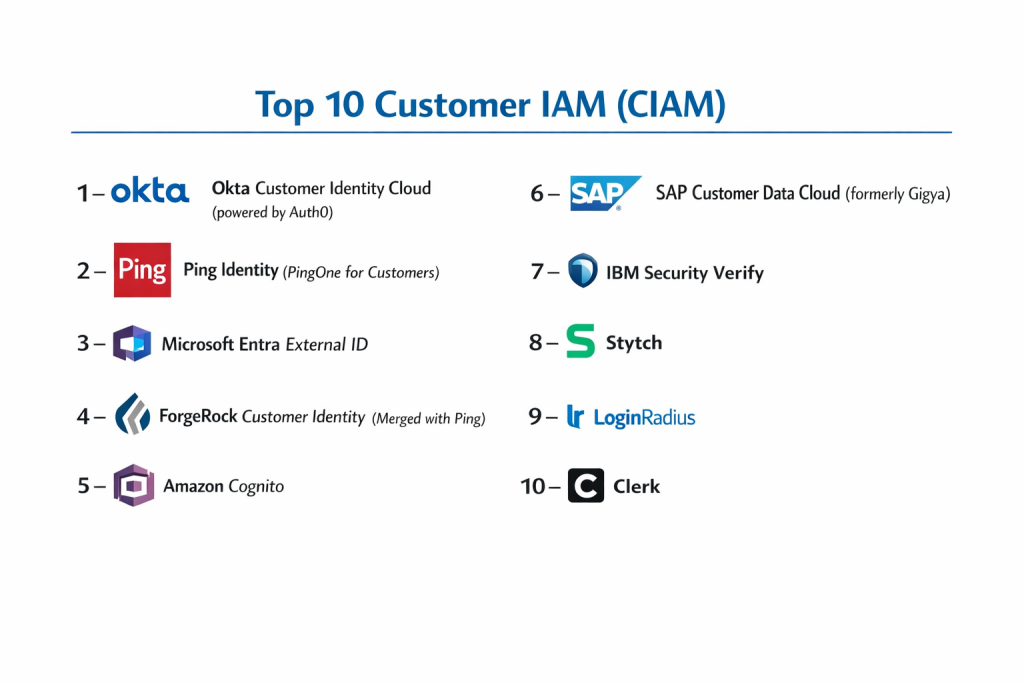
Top 10 Customer IAM (CIAM) Tools
1 — Okta Customer Identity Cloud (powered by Auth0)
Okta’s acquisition of Auth0 combined the world’s leading identity platform with the most developer-friendly CIAM engine available. It is designed for rapid deployment and high customization.
- Key Features:
- Extensible “Actions”: Allows developers to write custom JavaScript to modify the authentication flow.
- Universal Login: A pre-built, highly secure login page that works across all devices and platforms.
- Social Connections: One-click integration for dozens of social providers (Google, Facebook, Apple, etc.).
- Breached Password Detection: Automatically alerts users if their credentials appear in known data leaks.
- Passwordless Authentication: Support for Magic Links, SMS codes, and WebAuthn/FIDO2.
- Advanced Rate Limiting: Protects against brute-force attacks and credential stuffing at scale.
- Pros:
- The best documentation in the industry, making it the favorite for software engineers.
- Exceptional flexibility; you can build almost any logic into the login pipeline.
- Cons:
- Costs can escalate quickly as your Monthly Active User (MAU) count grows.
- The vast number of features can lead to configuration “analysis paralysis.”
- Security & Compliance: SOC 2 Type II, ISO 27001, HIPAA, GDPR, and PCI DSS.
- Support & Community: World-class developer community, extensive SDK library, and 24/7 premium enterprise support.
2 — Ping Identity (PingOne for Customers)
Ping Identity specializes in high-scale, high-complexity environments, making it the top choice for global enterprises and financial institutions.
- Key Features:
- DaVinci Orchestration: A low-code visual designer to create complex customer “journeys” and workflows.
- Fraud & Risk Intelligence: Uses AI to detect behavioral anomalies like bots or session hijacking.
- Self-Service Profile Management: Secure portals where customers can manage their own data and consents.
- Highly Scalable Directory: Designed to handle hundreds of millions of identities without latency.
- Identity Proofing: Integrated tools to verify government IDs and “liveness” during sign-up.
- Pros:
- The visual orchestration tool (DaVinci) is a game-changer for non-technical product managers.
- Strongest focus on “Zero Trust” customer security in the category.
- Cons:
- Generally carries a higher price tag than SMB-focused solutions.
- Integration can be more complex for teams without dedicated identity architects.
- Security & Compliance: SOC 2, ISO 27001, GDPR, HIPAA, and FIPS 140-2.
- Support & Community: High-touch enterprise support and professional services for global deployments.
3 — Microsoft Entra External ID
Microsoft’s CIAM offering is a evolution of Azure AD B2C, providing a deeply integrated experience for organizations already using Azure cloud services.
- Key Features:
- Custom Policies: Uses XML-based Identity Experience Framework for deep logic customization.
- Massive Scale: Built on the same infrastructure that powers Microsoft 365, ensuring high availability.
- Identity Protection: Leverages Microsoft’s global threat intelligence to block malicious logins.
- Branded Login: Full control over the CSS and HTML of the user-facing pages.
- Native Integration: Seamlessly connects with Azure Functions and other Microsoft developer tools.
- Pros:
- Extremely cost-effective for organizations already committed to the Azure ecosystem.
- Unmatched reliability and global footprint.
- Cons:
- The “Custom Policy” setup is notoriously difficult and requires specialized XML knowledge.
- The administrative portal (Azure Portal) is dense and aimed at IT pros, not product teams.
- Security & Compliance: Global leader in compliance (SOC, ISO, HIPAA, GDPR, FedRAMP).
- Support & Community: Vast ecosystem of Microsoft partners and extensive documentation on Microsoft Learn.
4 — ForgeRock Customer Identity (Merged with Ping)
ForgeRock is a developer-centric powerhouse known for its ability to handle millions of requests per second and its flexible deployment options.
- Key Features:
- Intelligent Access Trees: A visual interface to build branched logic for user authentication.
- IoT Integration: Can manage identities for devices, cars, and sensors alongside human users.
- User-Managed Access (UMA): Allows customers to control exactly which third parties can see their data.
- Multi-Cloud Deployment: Can run on-premise, in any cloud, or as a managed SaaS.
- Privacy and Consent: Built-in tools specifically designed for GDPR and CCPA compliance.
- Pros:
- The most flexible deployment options (Kubernetes, DevOps-friendly).
- Excellent for managing “Non-Person Entities” (IoT) alongside customers.
- Cons:
- Recent merger with Ping Identity may create roadmap uncertainty for some users.
- High technical barrier to entry; requires significant engineering resources.
- Security & Compliance: SOC 2, ISO 27001, HIPAA, and GDPR.
- Support & Community: Large developer community and highly technical support teams.
5 — Amazon Cognito
Amazon Cognito is the go-to CIAM for developers building applications within the Amazon Web Services (AWS) ecosystem.
- Key Features:
- User Pools: A managed user directory that handles sign-up, sign-in, and profile management.
- Identity Pools: Provides temporary AWS credentials to users to access other AWS services (like S3 or DynamoDB).
- Lambda Triggers: Allows you to execute custom code during various stages of the login process.
- Multi-Factor Authentication (MFA): Built-in support for SMS and TOTP codes.
- Social & SAML Login: Support for Google, Amazon, Facebook, and Apple logins.
- Pros:
- If your app is on AWS, the integration and security “handshake” are seamless.
- Highly competitive “Free Tier” (up to 50,000 MAUs for some features).
- Cons:
- The UI/UX for the “Hosted UI” is basic and often requires custom development to look modern.
- Customer support is tied to your AWS support plan, which can be expensive.
- Security & Compliance: SOC 1/2/3, ISO 27001, HIPAA, GDPR, and PCI DSS.
- Support & Community: Massive AWS documentation library and community forums (AWS re:Post).
6 — SAP Customer Data Cloud (formerly Gigya)
SAP’s CIAM is built with a “marketing-first” mindset, focusing on gathering user data and building long-term customer profiles.
- Key Features:
- Progressive Profiling: Gathers user information over time to reduce friction at sign-up.
- Consent Management: Centralized dashboard for managing marketing preferences and legal consents.
- Identity Exchange: Syncs customer data across the entire SAP business suite and CRM.
- Social Login & Sharing: Deep features for social engagement and referral tracking.
- Risk-Based Authentication: Adjusts security requirements based on the user’s current risk profile.
- Pros:
- The best choice for marketing teams that need to turn identity into actionable data.
- Strongest focus on compliance and “Preference Management” in the industry.
- Cons:
- Can feel like a “black box” to developers compared to Auth0 or ForgeRock.
- Deeply optimized for the SAP ecosystem, which may not fit non-SAP shops.
- Security & Compliance: ISO 27001, SOC 2, GDPR, and HIPAA.
- Support & Community: Global enterprise support and integration services via SAP partners.
7 — IBM Security Verify
IBM’s CIAM solution leverages “Big Blue’s” massive investment in AI (Watson) to provide intelligent, risk-aware customer security.
- Key Features:
- Behavioral Biometrics: Analyzes how a user types or moves their mouse to detect fraud.
- Adaptive Risk Scoring: Calculates a real-time risk score for every login attempt.
- Digital Trust: Focuses on creating a seamless experience across web, mobile, and IoT.
- Developer SDKs: Modern tools to embed IBM security into native mobile applications.
- Privacy Consent: Automated workflows for managing “Right to be Forgotten” requests.
- Pros:
- Leading-edge AI fraud detection that goes beyond simple password checks.
- Highly reliable for massive-scale government and banking applications.
- Cons:
- The setup and administration can be complex for smaller, agile teams.
- The branding and UI are more corporate than some of the “hip” SaaS competitors.
- Security & Compliance: SOC 2, ISO 27001, HIPAA, GDPR, and FIPS.
- Support & Community: Extensive global support and professional consulting services.
8 — Stytch
Stytch is a newer, “API-first” entrant that is disrupting the market by focusing almost exclusively on passwordless and modern auth flows.
- Key Features:
- Passwordless focus: Built from the ground up for Magic Links, OTPs, and WebAuthn.
- Seamless Onboarding: Designed to eliminate the “sign-up wall” that kills conversion.
- Session Management: Robust APIs to handle how long users stay logged in across devices.
- B2B & B2C Support: Can handle both standard consumers and complex multi-tenant B2B clients.
- High-Quality SDKs: Very clean code libraries for JavaScript, React, and mobile.
- Pros:
- The absolute fastest way to implement a “Passwordless” experience.
- Very modern, clean developer experience (DX).
- Cons:
- Newer company with a shorter track record than the industry giants.
- Fewer “out-of-the-box” integrations for legacy enterprise systems.
- Security & Compliance: SOC 2 Type II, GDPR, and HIPAA compliant.
- Support & Community: Responsive Slack community and direct access to engineering support.
9 — LoginRadius
LoginRadius is an all-in-one CIAM platform that prides itself on being “turnkey” for businesses that want a full-featured system without heavy coding.
- Key Features:
- Customer Analytics: Built-in charts and data on user behavior and demographics.
- Over 40 Social Providers: One of the largest libraries of social login integrations.
- Single Sign-On (SSO): Connects multiple brand websites into a single identity pool.
- Security Audit Logs: Detailed records of all user and admin activity.
- Deployment Flexibility: Offers cloud, private cloud, and on-premise options.
- Pros:
- Great “Time-to-Market” for businesses that want features without a year of development.
- Very transparent and scalable pricing models.
- Cons:
- Less “low-level” control for developers who want to customize every API call.
- The dashboard can feel a bit overwhelming due to the sheer number of features.
- Security & Compliance: SOC 2, ISO 27001/27017/27018, GDPR, and HIPAA.
- Support & Community: 24/7 dedicated support and a very comprehensive knowledge base.
10 — Clerk
Clerk is a rapidly growing CIAM specifically optimized for the “Next.js” and modern web developer ecosystem.
- Key Features:
- Pre-built Components: Drop-in React components for UserProfile, SignUp, and UserButton.
- Organization Management: Built-in support for B2B “teams” and multi-tenancy.
- Instant Webhooks: Easy way to sync user data to your own database in real-time.
- Multi-session support: Allows users to be logged into multiple accounts simultaneously.
- Edge-ready: Built to work with modern edge computing platforms (Vercel, Netlify).
- Pros:
- The best “Drop-in” UI components in the business; looks beautiful out of the box.
- Optimized for modern frameworks like Next.js and Remix.
- Cons:
- Primarily focused on the JavaScript/TypeScript ecosystem.
- Might be too opinionated for enterprises that need to build a 100% custom UI from scratch.
- Security & Compliance: SOC 2 Type II, GDPR, and HIPAA.
- Support & Community: Highly active Discord community and very responsive support.
Comparison Table
| Tool Name | Best For | Platform(s) Supported | Standout Feature | Rating (Gartner) |
| Okta/Auth0 | Developer Flexibility | All / Cloud | Custom “Actions” | 4.5 / 5 |
| Ping Identity | Complex Enterprise | All / Hybrid | DaVinci Orchestration | 4.6 / 5 |
| Microsoft Entra | Azure Ecosystem | All / Cloud | Global Infrastructure | 4.3 / 5 |
| ForgeRock | IoT & High Scale | All / Hybrid | Intelligent Access Trees | 4.4 / 5 |
| Amazon Cognito | AWS Developers | All / Cloud | Identity Pools | 3.9 / 5 |
| SAP (Gigya) | Marketing & Data | Web / Mobile | Progressive Profiling | 4.1 / 5 |
| IBM Verify | Fraud Detection | All / Cloud | Behavioral Biometrics | 4.2 / 5 |
| Stytch | Passwordless Auth | API-first | Fast Passwordless API | N/A |
| LoginRadius | Turnkey Features | All / Cloud | Customer Analytics | 4.4 / 5 |
| Clerk | Modern Web (React) | Web / Mobile | Drop-in UI Components | 4.8 / 5 |
Evaluation & Scoring of Customer IAM (CIAM)
To help you choose the right partner, we have evaluated the CIAM market against a weighted scoring rubric.
| Category | Weight | Evaluation Criteria |
| Core Features | 25% | Social login, MFA, progressive profiling, and passwordless support. |
| Ease of Use | 15% | Developer experience (DX), quality of SDKs, and admin UI. |
| Integrations | 15% | Breadth of social providers, CRM sync, and API extensibility. |
| Security & Compliance | 10% | Encryption, SOC 2, GDPR tools, and fraud detection. |
| Performance | 10% | Latency during login and reliability at massive scale. |
| Support & Community | 10% | Documentation quality and technical support responsiveness. |
| Price / Value | 15% | Pricing transparency and “Free Tier” accessibility. |
Which Customer IAM (CIAM) Tool Is Right for You?
Solo Users vs SMB vs Mid-Market vs Enterprise
- Solo Developers / Startups: Clerk or Stytch are the winners here. They allow you to get a world-class login system running in hours, not weeks, often for free.
- Small Business (SMB): LoginRadius or Amazon Cognito provide the features you need with predictable pricing models.
- Mid-Market: Okta (Auth0) is the standard. It provides the perfect balance of “it just works” and “we can customize everything.”
- Enterprise: Ping Identity or ForgeRock are required for the massive scale and “Zero Trust” requirements of global corporations.
Budget-Conscious vs Premium Solutions
If you are building on AWS or Azure, using their native tools (Cognito or Entra) is almost always the cheapest route. However, the “premium” cost of Auth0 or Ping often pays for itself through saved developer hours and higher customer conversion rates.
Feature Depth vs Ease of Use
- Depth: Ping Identity and ForgeRock have the most “knobs to turn.” If you need to manage a fleet of smart cars and millions of users in one system, go here.
- Ease of Use: Clerk and Auth0. These tools understand that security should be invisible to the user and easy for the developer.
Integration and Scalability Needs
If your primary goal is marketing data, SAP Customer Data Cloud is built for you. If your goal is high-frequency web performance, Clerk or Stytch are optimized for the modern edge.
Frequently Asked Questions (FAQs)
Q1: What is the main difference between IAM and CIAM?
Answer: IAM is for employees (focus on productivity and strict control). CIAM is for customers (focus on user experience, branding, and massive scale).
Q2: Why not just build my own login system?
Answer: “Don’t roll your own auth” is a mantra for a reason. Handling security, MFA, social login, and password resets is complex and risky. CIAM providers do this 24/7 so you don’t have to.
Q3: How does CIAM help with GDPR?
Answer: CIAM tools provide centralized “Consent Managers” and “Preference Centers” where users can delete their data or opt-out of tracking, helping you meet legal requirements automatically.
Q4: What is “Progressive Profiling”?
Answer: It’s a technique where you don’t ask for a user’s address and phone number at sign-up. Instead, you ask for them on their third or fourth visit, increasing your initial conversion rate.
Q5: Can CIAM reduce my costs?
Answer: Yes. By providing “Self-Service” password resets and profile management, you significantly reduce the number of customer support tickets your team has to handle.
Q6: What is “Social Login”?
Answer: It allows users to sign up using an existing account (like Google or Apple). It is the #1 way to increase sign-up rates on mobile apps.
Q7: Is CIAM only for cloud apps?
Answer: No. While most providers are SaaS-based, tools like ForgeRock and Ping Identity can be deployed on-premise or in private clouds for maximum data control.
Q8: What is “Credential Stuffing”?
Answer: It’s an attack where hackers use lists of leaked passwords from other sites to try and break into your customers’ accounts. Top CIAM tools have built-in “Bot Protection” to stop this.
Q9: Does CIAM work with my CRM?
Answer: Yes. Most top-tier CIAM tools have direct connectors to Salesforce, HubSpot, and Microsoft Dynamics to keep your customer data in sync.
Q10: What are “Magic Links”?
Answer: A form of passwordless auth where a user enters their email and receives a link. Clicking the link logs them in instantly—no password required.
Conclusion
The “best” Customer IAM (CIAM) tool is ultimately the one that removes the most friction from your customer’s journey while keeping their data safe. For modern web developers, Clerk and Stytch are redefining speed. For the enterprise, the power of Ping Identity and Okta remains unmatched.
Choosing a CIAM is more than a technical decision; it’s a customer service decision. By picking a platform that prioritizes a seamless, branded, and secure entry point, you are setting the stage for a long-term, trust-based relationship with your users.

- Top 10 Email Deliverability Tools: Features, Pros, Cons & Comparison - September 6, 2026
- Top 10 Pharmacovigilance Software: Features, Pros, Cons & Comparison - September 6, 2026
- Top 10 Manufacturing Execution Systems (MES) - July 30, 2026