Introduction
In the complex landscape of modern cybersecurity, simply managing “who can log in” is no longer enough. Identity Governance and Administration (IGA) is a sophisticated policy-based approach to managing user identities and access rights across an entire organization. While standard Identity and Access Management (IAM) focuses on the technical execution of authentication (like passwords or MFA), IGA focuses on the strategy and oversight. It answers the critical questions: Who has access to what? Who should have access? And how is that access being used?
IGA is essential for maintaining a secure environment because it automates the lifecycle of a user—from onboarding to role changes and eventual offboarding. By implementing IGA, organizations can reduce “entitlement creep,” where users accumulate excessive permissions over time. Key real-world use cases include automated access certifications, compliance reporting for audits (SOC 2, HIPAA), and enforcing Separation of Duties (SoD) to prevent fraud. When evaluating tools, organizations should look for AI-driven automation, integration depth with legacy and cloud apps, user-friendly request portals, and robust reporting engines.
Best for: Information Security Officers (CISOs), IT Auditors, and Compliance Managers in large-scale enterprises or highly regulated industries (Finance, Healthcare, Energy). It is vital for companies managing thousands of employees, contractors, and diverse software ecosystems.
Not ideal for: Early-stage startups or small businesses with limited staff and a handful of SaaS applications. For these organizations, basic IAM tools with built-in provisioning (like Okta or Google Workspace) are usually sufficient without the overhead of a full governance suite.
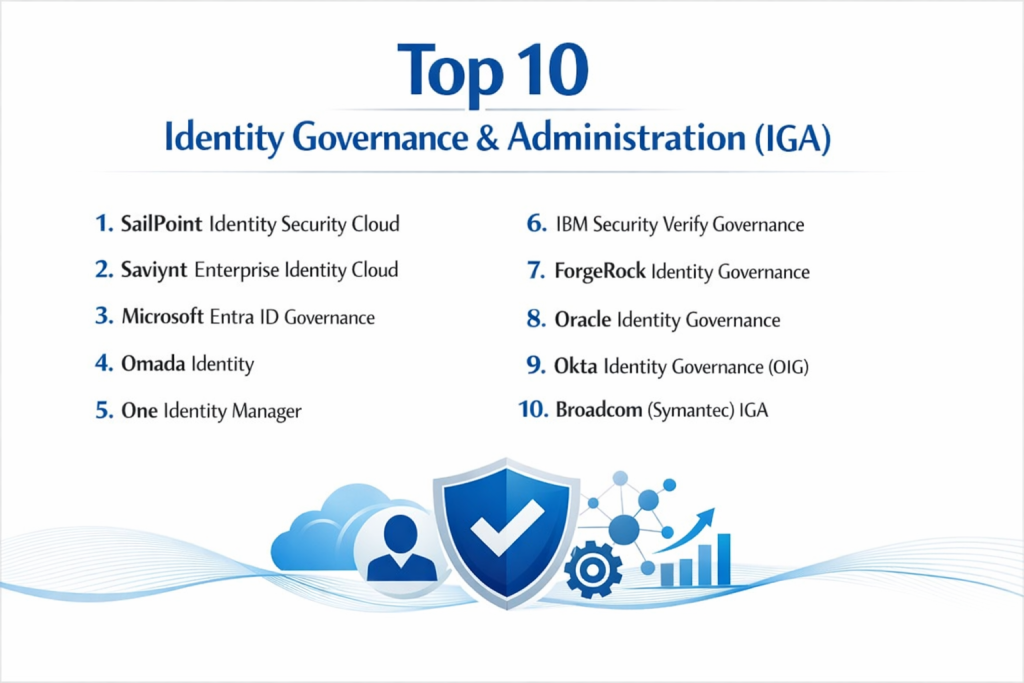
Top 10 Identity Governance & Administration (IGA) Tools
1 — SailPoint Identity Security Cloud
SailPoint is widely considered the industry leader in the IGA space, known for its deep feature set and advanced use of artificial intelligence to manage complex identity ecosystems.
- Key Features:
- AI-Driven Recommendations: Uses machine learning to suggest whether to approve or deny access requests based on peer behavior.
- Access Certifications: Automates the periodic review of user permissions to ensure they remain appropriate.
- Separation of Duties (SoD): Built-in policy engine to identify and block conflicting permissions that could lead to fraud.
- Lifecycle Management: Fully automates the joiner-mover-leaver process across hundreds of applications.
- Data Access Governance: Extends governance beyond applications to unstructured data in files and folders.
- Pros:
- Unrivaled depth of functionality for massive, complex organizations.
- The most sophisticated AI/ML integration in the market for risk detection.
- Cons:
- Highly complex to implement, often requiring expensive third-party consultants.
- Premium pricing that can be prohibitive for mid-market companies.
- Security & Compliance: SOC 2 Type II, ISO 27001, GDPR, HIPAA, and FedRAMP authorized.
- Support & Community: Extensive “Compass” community portal, dedicated training through SailPoint University, and global enterprise-grade support.
2 — Saviynt Enterprise Identity Cloud
Saviynt is a cloud-native platform that prides itself on providing “converged” identity, combining IGA with privileged access and application security.
- Key Features:
- Cloud-First Architecture: Built specifically for the cloud, making it highly scalable for modern SaaS-heavy environments.
- Control Exchange: A library of over 200 pre-built controls for compliance frameworks like PCI and HIPAA.
- Risk-Based Governance: Automatically elevates high-risk access requests for extra scrutiny.
- Unified Portal: A single interface for IGA, PAM (Privileged Access), and Third-Party Access.
- External Identity Management: Specialized tools for managing contractors, vendors, and bots.
- Pros:
- Excellent “out-of-the-box” compliance templates that save time during setup.
- Lower maintenance overhead compared to legacy on-premise governance tools.
- Cons:
- Some users report that the UI can be unintuitive for non-technical managers.
- Reporting capabilities, while powerful, can have a steep learning curve.
- Security & Compliance: SOC 1/2/3, ISO 27001, HIPAA, GDPR, and FedRAMP.
- Support & Community: Strong professional services network and a growing online knowledge base and user forum.
3 — Microsoft Entra ID Governance
Microsoft has rapidly expanded its identity suite to include high-level governance, making it an attractive choice for organizations already utilizing the Microsoft 365 ecosystem.
- Key Features:
- Entitlement Management: Uses “Access Packages” to bundle permissions for specific projects or roles.
- Access Reviews: Integrated workflows for managers to verify their team’s access.
- Privileged Identity Management (PIM): Controls high-level admin access with time-bound activations.
- Lifecycle Workflows: Customizable logic for automating employee transitions (e.g., automated “Welcome” emails and access grants).
- Machine Learning Insights: Detects “stale” accounts and suggests removals.
- Pros:
- Deeply integrated with Microsoft 365 and Azure; no need for a separate platform.
- Familiar interface for IT teams already using the Microsoft Entra (Azure AD) portal.
- Cons:
- Governing non-Microsoft, on-premise, or niche legacy applications can be more difficult.
- Requires higher-tier licensing (Entra ID P2 or specific Governance add-ons).
- Security & Compliance: Global compliance leader (SOC, ISO, HIPAA, GDPR, DoD SRG).
- Support & Community: Massive global community, extensive “Learn” documentation, and tiered Microsoft Enterprise support.
4 — Omada Identity
Based in Europe, Omada focuses on “IdentityProcess+”—a standardized approach to IGA that emphasizes efficiency and rapid deployment.
- Key Features:
- Configurable over Programmable: Aims to reduce custom coding by using flexible configuration options.
- Omada Identity Cloud: A full SaaS offering that handles the infrastructure management for the customer.
- Survey-Based Certifications: Simple, user-friendly forms for business managers to review access.
- Comprehensive Audit Trails: Keeps a permanent record of every access change for regulatory proof.
- Role Mining: Helps organizations discover and define roles based on existing user permissions.
- Pros:
- Strong emphasis on a clean, modern user experience for business users.
- Very high adherence to European data privacy standards (GDPR).
- Cons:
- Not as widely known in the North American market as SailPoint or Saviynt.
- Smaller third-party integrator ecosystem.
- Security & Compliance: ISO 27001, SOC 2, and GDPR compliant.
- Support & Community: Excellent training academy and a high-touch customer success model for enterprise clients.
5 — One Identity Manager
One Identity (a Quest Software company) offers a modular platform that excels at bridging the gap between legacy on-premise systems and modern cloud apps.
- Key Features:
- Modular Design: Users can start with basic governance and add modules for PAM or IGA as they grow.
- Strong On-Premise Support: Excellent for industries with deep roots in legacy hardware and data centers.
- Automated Provisioning: Connects to a vast array of systems to ensure access is granted instantly.
- Attestation Workflows: Highly customizable review cycles for sensitive data.
- Identity Manager Portal: A self-service shop for users to request access.
- Pros:
- Highly flexible; if you have a legacy system, One Identity likely has a way to govern it.
- Very stable and mature platform with decades of history.
- Cons:
- Can feel “heavy” and traditional compared to cloud-native startups.
- Upgrades can be complex for heavily customized on-premise installations.
- Security & Compliance: SOC 2, HIPAA, GDPR, and ISO 27001.
- Support & Community: Robust professional services, One Identity University, and a long-standing partner network.
6 — IBM Security Verify Governance
IBM brings its massive enterprise experience to IGA, offering a tool focused on risk modeling and deep data analysis.
- Key Features:
- Business Activity Monitoring: Links technical permissions to actual business activities.
- Risk Analytics: Identifies “Toxic Combinations” of access that violate company policy.
- Recertification Campaigns: Automated triggers for access reviews based on high-risk events.
- Virtual Appliance Deployment: Can be deployed in the cloud or as a virtual appliance on-site.
- Extensive Connector Library: Leverages IBM’s history to connect to almost any enterprise software.
- Pros:
- Excellent for highly complex environments that need to link IT to business risk.
- Reliable, enterprise-grade scalability for the world’s largest companies.
- Cons:
- The user interface can feel dated and overly complex for casual users.
- Lengthy implementation times are common for full-scale deployments.
- Security & Compliance: FedRAMP, SOC 2, ISO 27001, HIPAA, and GDPR.
- Support & Community: Global IBM support network, extensive technical forums, and professional consulting services.
7 — ForgeRock Identity Governance
ForgeRock (now merged with Ping Identity) focuses on the “modern” enterprise, specializing in handling massive amounts of identities, including consumers and devices.
- Key Features:
- AI-Driven Access Reviews: Uses “Autocert” to automatically approve low-risk, standard access.
- Identity Cloud: A unified platform for governance, access management, and directory services.
- DevOps Friendly: Can be deployed as code using Kubernetes and Docker.
- Fine-Grained Entitlements: Goes deep into specific application permissions, not just “all or nothing” access.
- Visual Flow Designer: Drag-and-drop builder for access request workflows.
- Pros:
- Extremely high performance and scalability; built for millions of identities.
- The visual designer makes it easier for admins to build complex logic without coding.
- Cons:
- Merger with Ping Identity creates some uncertainty regarding future product consolidation.
- Better suited for digital-first enterprises than legacy “brick and mortar” companies.
- Security & Compliance: SOC 2 Type II, ISO 27001, HIPAA, and GDPR.
- Support & Community: Large developer community and robust API documentation.
8 — Oracle Identity Governance
Oracle provides a comprehensive, traditional IGA solution that is a staple in large-scale government and financial institutions.
- Key Features:
- Automated Reconciliation: Constantly checks if actual access matches the “authorized” state in the IGA tool.
- Self-Service Catalog: A robust “shopping cart” experience for employees to request tools.
- Disconnected Resource Tracking: Provides a way to track access for systems not connected to the network.
- Deep Oracle Integration: The natural choice for organizations running Oracle E-Business Suite or PeopleSoft.
- Policy-Based Provisioning: Automatically assigns access based on user attributes (Dept, Location, Title).
- Pros:
- Incredibly mature with a solution for almost every edge-case scenario.
- Unrivaled for managing complex Oracle-based application stacks.
- Cons:
- Notoriously difficult and expensive to implement and maintain.
- The UI is often viewed as lagging behind modern SaaS-based competitors.
- Security & Compliance: Global certifications (FedRAMP, ISO, SOC, GDPR).
- Support & Community: Worldwide support infrastructure and deep pools of certified Oracle partners.
9 — Okta Identity Governance (OIG)
Okta, the leader in Access Management, recently launched its own Governance module to provide a unified identity experience.
- Key Features:
- Unified Platform: Governance is built directly into the same console as SSO and MFA.
- Okta Workflows: A powerful no-code engine to automate complex identity logic.
- Access Requests via Slack/Teams: Allows users to request access directly within their chat apps.
- Self-Service Reviews: Simple, clean interface for managers to conduct access certifications.
- Rapid Deployment: Much faster to set up than traditional IGA tools.
- Pros:
- Best-in-class user experience; business users actually find it easy to use.
- Simplifies the “Identity Stack” by removing the need for a separate governance vendor.
- Cons:
- Still a relatively new product; lacks some of the deepest governance features of SailPoint or Saviynt.
- Primarily focused on cloud and SaaS; less ideal for complex on-premise governance.
- Security & Compliance: SOC 2, ISO 27001, HIPAA, GDPR, and FedRAMP.
- Support & Community: Massive online community (Okta Ideas) and excellent self-service training.
10 — Broadcom (Symantec) IGA
Broadcom’s Identity Governance (formerly CA Technologies) is a robust, “industrial strength” solution for the most demanding environments.
- Key Features:
- Identity Analytics: Identifies outliers and over-privileged users using statistical modeling.
- Role Discovery: Automatically suggests roles based on existing access patterns.
- Clean-up Campaigns: Specifically designed to remove access from inactive or orphaned accounts.
- Integration with PAM: Works seamlessly with Symantec Privileged Access Management.
- Enterprise Scalability: Built to manage millions of entitlements across global regions.
- Pros:
- Extremely powerful for “Identity Clean-up” projects in messy, legacy environments.
- Highly reliable for massive data processing and high-volume access changes.
- Cons:
- Broadcom’s focus is primarily on its largest (Global 2000) customers.
- Innovation and UI updates have historically been slower than cloud competitors.
- Security & Compliance: FIPS 140-2, SOC 2, ISO 27001, and GDPR.
- Support & Community: Global enterprise support network for large-scale contract holders.
Comparison Table
| Tool Name | Best For | Platform(s) Supported | Standout Feature | Rating (Gartner) |
| SailPoint | High-End Enterprise | Cloud / Hybrid | AI-Driven Insights | 4.6 / 5 |
| Saviynt | Cloud-Native Apps | Cloud (SaaS) | Converged Identity | 4.4 / 5 |
| Microsoft Entra | Microsoft Shops | Cloud / Hybrid | PIM Integration | 4.4 / 5 |
| Omada Identity | Rapid Deployment | Cloud / Hybrid | Configurable Processes | 4.5 / 5 |
| One Identity | Hybrid / On-Premise | On-Prem / Cloud | Modular Flexibility | 4.2 / 5 |
| IBM Security | Business Risk Focus | Hybrid / On-Prem | Activity Monitoring | 4.1 / 5 |
| ForgeRock | Millions of Identities | Cloud / K8s | Visual Designer | 4.4 / 5 |
| Oracle Identity | Oracle Ecosystem | Cloud / On-Prem | Disconnected Resources | 4.0 / 5 |
| Okta OIG | Ease of Use / SaaS | Cloud (SaaS) | Chat-based Requests | 4.3 / 5 |
| Broadcom IGA | Legacy Clean-up | On-Prem / Cloud | Identity Analytics | 4.1 / 5 |
Evaluation & Scoring of IGA Tools
To determine which tool offers the best value for your specific needs, we have evaluated the category against a weighted scoring rubric.
| Category | Weight | Evaluation Criteria |
| Core Features | 25% | Certification, Provisioning, SoD, and Lifecycle Automation. |
| Ease of Use | 15% | Administrative interface and end-user “request” experience. |
| Integrations | 15% | Quality and quantity of pre-built connectors for SaaS/Legacy. |
| Security & Compliance | 10% | Certifications, encryption, and audit log integrity. |
| Performance | 10% | System uptime, sync speed, and data processing reliability. |
| Support & Community | 10% | Documentation, training, and active user forums. |
| Price / Value | 15% | Total cost of ownership relative to feature set. |
Which IGA Tool Is Right for You?
Solo Users vs SMB vs Mid-Market vs Enterprise
- Small Business / Solo: You should generally avoid dedicated IGA tools. Stick to the basic provisioning features in Okta or Microsoft Entra ID (Standard).
- Mid-Market: Okta Identity Governance or Saviynt are excellent. They offer the governance you need for compliance without requiring a dedicated “Identity Team” of five people.
- Enterprise: SailPoint or Saviynt are the standard. They handle the “messy” reality of large corporations with ease.
Budget-Conscious vs Premium Solutions
If you are already a heavy Microsoft user, the Microsoft Entra ID Governance add-on is often the most budget-friendly way to get high-level governance. For those who view identity as their primary security defense and have the budget, SailPoint is the premium “Rolls Royce” solution.
Feature Depth vs Ease of Use
- Depth over Ease: Oracle and IBM are deeply technical and powerful but can be frustrating for the average user.
- Ease over Depth: Okta OIG and Omada win on user experience. If your managers hate doing access reviews, they won’t do them correctly—ease of use is a security feature.
Integration and Scalability Needs
If your organization is mostly Legacy/On-Premise, One Identity or Broadcom are built for that. If you are 100% Cloud/DevOps, Saviynt or ForgeRock will feel much more natural.
Frequently Asked Questions (FAQs)
Q1: What is the main difference between IAM and IGA?
Answer: IAM is the “engine” that logs you in (Authentication). IGA is the “governance” that decides if you should be allowed to have that account in the first place and audits it periodically (Authorization & Governance).
Q2: Does IGA help with GDPR or HIPAA compliance?
Answer: Yes. One of the main reasons companies buy IGA is to prove to auditors that only authorized people have access to sensitive data and that access is reviewed regularly.
Q3: What is “Separation of Duties” (SoD)?
Answer: It is a security policy that prevents a single person from having enough power to commit fraud. For example, the person who creates an invoice should not be the same person who can approve the payment.
Q4: How long does it take to implement an IGA tool?
Answer: For a cloud-native tool like Okta or Saviynt, it can take 3–6 months. For a complex SailPoint or Oracle deployment, it can take 12–18 months.
Q5: Can IGA tools manage my contractors and vendors?
Answer: Yes. Leading tools like Saviynt and SailPoint have specific modules to manage the lifecycle of non-employees, ensuring their access is cut off the moment their contract ends.
Q6: What is “Role Mining”?
Answer: Role mining is using the IGA tool to look at what employees are currently doing and suggesting “Roles” (e.g., “Accounting Manager”) to simplify future access requests.
Q7: Why do I need “Access Certifications”?
Answer: Access certifications are periodic check-ups where managers confirm their team still needs their current permissions. This prevents “entitlement creep.”
Q8: Can IGA manage my cloud infrastructure (AWS/Azure)?
Answer: Yes, modern IGA tools use a feature called CIEM (Cloud Infrastructure Entitlement Management) to govern the highly complex permissions inside cloud consoles.
Q9: What is “Provisioning” vs “Deprovisioning”?
Answer: Provisioning is the automatic creation of accounts. Deprovisioning is the automatic deletion of accounts. Deprovisioning is the most critical security step when an employee leaves.
Q10: Is IGA expensive?
Answer: Yes, it is generally one of the more expensive parts of a security budget. However, it often pays for itself by reducing manual IT labor and preventing expensive compliance fines.
Conclusion
Identity Governance and Administration is no longer a “luxury” for large organizations—it is a foundational requirement for modern security. Whether you choose the AI-powered depth of SailPoint, the cloud-native flexibility of Saviynt, or the streamlined experience of Okta, the goal remains the same: ensuring that identity is a verified asset, not a hidden risk.
Ultimately, the best tool is the one that your organization can actually maintain. A perfectly governed identity system is one that automates the boring tasks so your security team can focus on the real threats.

- Top 10 Email Deliverability Tools: Features, Pros, Cons & Comparison - September 6, 2026
- Top 10 Pharmacovigilance Software: Features, Pros, Cons & Comparison - September 6, 2026
- Top 10 Manufacturing Execution Systems (MES) - July 30, 2026